
Filastin 300 mcg/0.5 ml is a Product of the Generic Filgrastim
Filastin 300 mcg/0.5 ml belongs to the generic category of Filgrastim. This medicine should be used according to a doctor's advice. We have provided detailed information about the uses, dosage, effectiveness, side effects, precautions, drug interactions, storage conditions, and other important details of Filastin 300 mcg/0.5 ml. Our goal is to present essential medicine information in one place for patients, caregivers, and healthcare professionals. To better understand Filgrastim and ensure the safe use of this medicine, please read the information below carefully and consult a healthcare professional when necessary.
*Up to 10% Discount
(Depends on pharmacy)
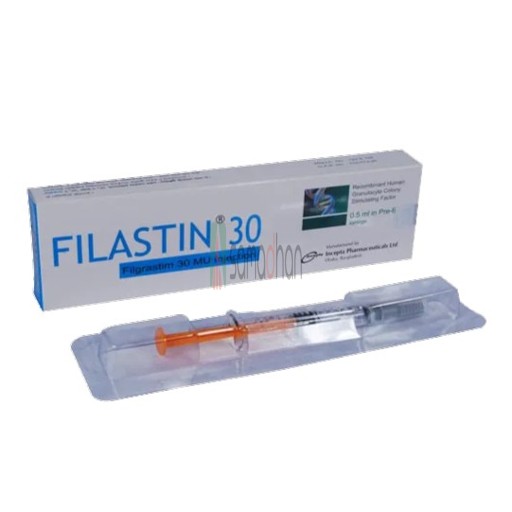
Filastin 300 mcg/0.5 ml
Incepta Pharmaceuticals Ltd. · IV/SC Injection
Filgrastim
/ 0.5 ml pre-filled syringe
Description of Filastin 300 mcg/0.5 ml
Filastin 300 mcg/0.5 ml may be available as a prescription or over-the-counter medicine, depending on local regulations and medical recommendations. It is used for the treatment and management of specific conditions or symptoms. The way this medicine is used may vary depending on the patient's condition and the advice of a healthcare provider. Detailed information about the approved uses, therapeutic applications, and other relevant details of Filastin 300 mcg/0.5 ml is provided below to help users gain a clear understanding of this medicine.
What Is Filastin 300 mcg/0.5 ml Indications and Uses?
Cancer patients receiving myelosuppressive chemotherapy: The decrease of the incidence of infection, as manifested by febrile neutropenia, in patients with non myeloid malignancies receiving myelosuppressive anticancer drugs associated with a significant incidence of severe neutropenia ... Read moreCancer patients receiving myelosuppressive chemotherapy: The decrease of the incidence of infection, as manifested by febrile neutropenia, in patients with non myeloid malignancies receiving myelosuppressive anticancer drugs associated with a significant incidence of severe neutropenia with fever.Cancer patients undergoing Acute Myeloid Leukemia: The reduction of the time to neutrophil recovery and the duration of fever, following induction or consolidation chemotherapy treatment of patients with acute myeloid leukemia (AML).Cancer Patients Receiving Bone Marrow Transplantation (BMT): The reduction of the duration of neutropenia and neutropenia-related clinical sequelae, e.g., febrile neutropenia, in patients with nonmyeloid malignancies undergoing myeloablatlve chemotherapy followed by bone marrow transplantation.Patients with severe chronic neutropenia: The reduction of the incidence and duration of sequelae of neutropenia (e.g., fever, infection or opharyngeal ulcers) in symptomatic patients with congenital neutropenia, cyclic neutropenia or idiopathic neutropenia.Patients acutely exposed to myelosuppressive doses of radiation: The increase of the survival in patients acutely exposed to myelosuppressive doses of radiation (Hematopoietic syndrome of acute radiation syndrome).Patients with HIV infection: The prevention and treatment of persistent neutropenia in patients with advanced HIV infection, in order to reduce the risk of bacterial infections, when other options to manage neutropenia are inappropriate.
Pharmacology (Source, Chemical and Physical Composition) Of Filastin 300 mcg/0.5 ml
Filgrastim is a 175 amino acid human granulocyte colony-stimulating factor (G-CSF) manufactured by recombinant DNA technology. Filgrastim regulates the production of neutrophils within the bone marrow and affects neutrophil progenitor proliferation and differentiation. It also causes the enhanced phagocytic ability, priming of the cellular metabolism associated with respiratory burst, antibody-dependent killing and the increased expression of some cell surface antigens.Filgrastim exhibits nonlinear pharmacokinetics. Clearance is dependent on Filgrastim concentration and neutrophil count. Filgrastim is cleared by kidney. It has a tmax of 2 to 8 hours. The absolute bioavailability of Filgrastim after subcutaneous administration is 60-70%.
Dosage And Administration of Filastin 300 mcg/0.5 ml
Cancer patients receiving myelosuppressive chemotherapy or induction and/or consolidation chemotherapy for AML: The recommended dose of Filgrastim is 0.5 MU (5 mcg)/kg/day, administered as a single daily subcutaneous injection or by intravenous infusion (over 30 minutes). The first dose shouldn't be administered in less than 24 hours following cytotoxic Chemotherapy. Continue until neutrophil count in normal range, usually for 14 days (up to 38 days in AML.)Cancer patients undergoing bone marrow transplantation: The recommended dosage of Filgrastim following bone marrow transplantation (BMT) is 1.0 MU (10 mcg)/kg/day given as an intravenous infusion no longer than 24 hours. Administer the first dose of Filgrastim at least 24 hours after cytotoxic chemotherapy and at least 24 hours after bone marrow transplantation. Dose adjustment should be accordingly to absolute neutrophil count (ANC).Patients undergoing autologous peripheral blood progenitor cell (PBPC) collection and therapy: The recommended dosage of Filgrastim for the mobilization of autologous PBPC is 1.0 MU (10 mcg)/kg/day given by subcutaneous injection for 5-7 days. Administer Filgrastim for at least 4 days before the first leukapheresis procedure and continue until the last leukapheresis. Discontinue Filgrastim if the white blood cell (WBC) count rises to greater than 100,000/mm³.Patients with severe chronic neutropenia: The recommended starting dosage in patients with congenital neutropenia is 0.6 MU (6 mcg)/kg as a twice daily subcutaneous injection and with idiopathic or cyclic neutropenia is 0.5 MU (5 mcg)/kg as a single daily subcutaneous injection. Dose adjustment should be accordingly to ANC and complete blood count (CBC).Patients acutely exposed to myelosuppressive doses of radiation hematopoietic syndrome of acute radiation syndrome: The recommended dose of Filgrastim is 1.0 MU (10 mcg)/kg as a single daily subcutaneous injection for patients exposed to myelosuppressive doses of radiation.Patients with HIV infection: The recommended starting dose of Filgrastim is 0.1 MU (1.0 mcg)/kg/day is given daily by subcutaneous injection with titration up to a maximum of 0.4 MU (4 mcg) /kg/day until a normal neutrophil count is reached and can be maintained (ANC > 2.0 x 10 9 /I), Or, as directed by the registered physicians.
Drug Interactions of Filastin 300 mcg/0.5 ml
Drug Interactions between Filgrastim and other drugs have not been fully evaluated. Drugs which may potentiate the release of neutrophils, such as Lithium should be used with caution.
Side Effects of Filastin 300 mcg/0.5 ml
Most common side effects in patients-
With nonmyeloid malignancies receiving myelosuppressive anti-cancer drugs are pyrexia, pain, rash, cough and dyspnea.
With AML are pain, epistaxis and rash.
With nonmyeloid malignancies undergoing myeloablative chemotherapy followed by BMT is rash.
Undergoing peripheral blood progenitor cell mobilization and collection are bone pain, pyrexia and headache.
With severe chronic neutropenia (SCN) are pain, anemia, epistaxis, diarrhea, hypoesthesia and alopecia.
Use During Pregnancy and Lactation
Pregnancy Category C. There are no adequate and well-controlled studies in pregnant women. It is not known whether this drug is excreted in human milk. Because many drugs are excreted in human milk, caution should be exercised if it is administered to women who are breastfeeding.
Precautions And Warnings for Filastin 300 mcg/0.5 ml
Filgrastim should not be administered within 24 hours before and afier chemotherapy
The possibility of Filgrastim acting as a growth factor for any tumor type cannot be excluded
To avoid -adverse effects of excessive neutrophils complete blood count is recommended twice per week during treatment
Filgrastim is given by subcutaneous or intravenous infusion as required
Dilution of Filgrastim conc less than 5 mcg/ml is not recommended at any time
Filgrastim may be diluted in 5% dextrose as required
Therapeutic Class
Haematopoietic Agents
Storage Conditions of It
Refrigerate at 2-8° C. Protect from light. Do not freeze & avoid shaking.
Data Source: Data source of Indications and Usages, Pharmacology, Dosage & Administration, Drug Interactions, Side Effects, Use during Pregnancy & Lactation, Precautions & Warnings, Use in Special Populations, Therapeutic Class, and Storage Conditions is the concerned medicine company or respective organization.
Alternative Medicines
⚠ Disclaimer
The information provided on All Samadhan is intended for general informational purposes only and is prepared based on our best practices. It is not a substitute for professional medical advice, diagnosis, or treatment. While we strive to keep the information accurate and up to date, we do not guarantee its completeness or accuracy. The absence of specific information or warnings about any medicine or service should not be considered as an assurance or endorsement by All Samadhan. All Samadhan shall not be held responsible for any consequences arising from the use of this information. We strongly recommend consulting a qualified healthcare professional or physician for any medical concerns, questions, or clarifications.All Samadhan is a digital healthcare software platform operated by MS Genius Experts. We provide technology solutions for pharmacies and healthcare providers; we are not a direct seller or dispenser of prescription medicines

N.B.: All Samadhan is a digital healthcare software platform operated by MS Genius Experts. We provide technology solutions for pharmacies and healthcare providers; we are not a direct seller or dispenser of prescription medicines.
Copyright © All Samadhan - Operated by M/S. Genius Experts | All Rights Reserved
DBID
Registration ID: 176322642
Trade License: TRAD/DNCC/040904/2023