
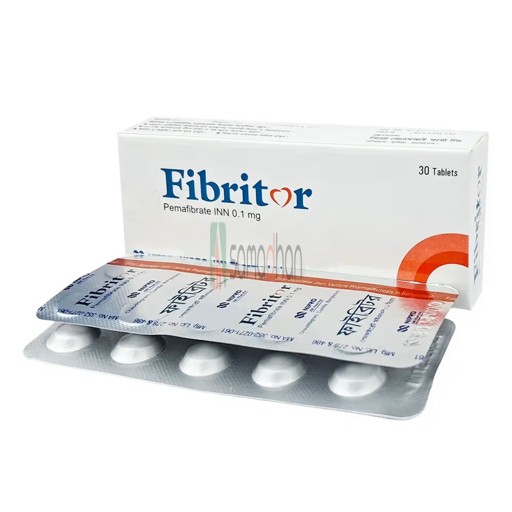
Fibritor 0.1 mg is a Product of the Generic Pemafibrate
Fibritor 0.1 mg belongs to the generic category of Pemafibrate. This medicine should be used according to a doctor's advice. We have provided detailed information about the uses, dosage, effectiveness, side effects, precautions, drug interactions, storage conditions, and other important details of Fibritor 0.1 mg. Our goal is to present essential medicine information in one place for patients, caregivers, and healthcare professionals. To better understand Pemafibrate and ensure the safe use of this medicine, please read the information below carefully and consult a healthcare professional when necessary.
*Up to 10% Discount
(Depends on pharmacy)
Fibritor 0.1 mg
NIPRO JMI Pharma Ltd. · Tablet
Pemafibrate
/ Piece
Description of Fibritor 0.1 mg
Fibritor 0.1 mg may be available as a prescription or over-the-counter medicine, depending on local regulations and medical recommendations. It is used for the treatment and management of specific conditions or symptoms. The way this medicine is used may vary depending on the patient's condition and the advice of a healthcare provider. Detailed information about the approved uses, therapeutic applications, and other relevant details of Fibritor 0.1 mg is provided below to help users gain a clear understanding of this medicine.
What Is Fibritor 0.1 mg Indications and Uses?
Pemafibrate tablet is indicated as adjunctive therapy to diet to reduce TG in patients with dyslipidemia, including familial hyperlipidemia.
Pharmacology (Source, Chemical and Physical Composition) Of Fibritor 0.1 mg
Hypertriglyceridemia along with reduced HDL-C are risk factors of Atherosclerotic Cardiovascular Disease (ASCVD). Factors such as sedentary lifestyle, lipid-rich diet etc. makes it more difficult to control high triglyceride (TG).
Fibrates are considered as the preferred treatment for reducing TG. They act primarily by binding to and activating peroxisome proliferator activated receptor alpha (PPARα), a nuclear receptor. But conventional fibrates have low selectivity and potency for binding to PPARα. As a result, sometimes they fail to achieve desired TG level and often associated with various side effects.Pemafibrate, a new selective PPARα modulator, is strongly effective in treating hypertriglyceridemia and low HDL-C levels. Its unique Y-shaped structure allows it to bind tightly to the PPARα receptor.Pemafibrate structure contains benzoxazole and phenoxyalkyl side-chains along with common fibric acid group, which ensures-
High selectivity for PPARα
Strong interaction with the receptor
Maximum activation of the receptor
Thus, Pemafibrate shows over 2,500-fold greater potency for PPARα compared to conventional fibrates and provides better therapeutic outcome.
Dosage And Administration of Fibritor 0.1 mg
Adult dose: The usual adult dosage is 0.1 mg of pemafibrate orally administered twice daily. The dose may be individualized according to the patient’s age and symtoms. Pemafibrate can be taken with or without food. Use in children: The safety of Pemafibrate in children has not been established. Renal impairment: Pemafibrate should be used with caution in patients with renal impairment defined as estimated glomerular filtration rate (eGFR) less than 30 mg/min/1.73 m2. A lower starting dose or prolong dosing intervals should be considered. The maximum dose is 0.2 mg daily. Hepatic impairment: Pemafibrate should be used with caution in patients with severe hepatic disorder.
Drug Interactions of Fibritor 0.1 mg
Other fibrates: The risk or severity of adverse effects can be increased when Pemafibrate is combined with other fibrates.HMG CoA reductase inhibitors: Concurrent use with statins, which are commonly prescribed for lipid management, may increase the risk of muscle-related side effects such as myopathy or rhabdomyolysis. Oral anticoagulant therapy: Patients taking anticoagulants such as warfarin should also be cautious, as Pemafibrate can potentiate the effects of these medications, increasing the risk of bleeding. Regular monitoring of coagulation parameters is recommended to adjust the anticoagulant dose as needed.
Side Effects of Fibritor 0.1 mg
Gastro-intestinal disorder (e.g. nausea, diarrhoea, abdominal pain), jaundice, skin rashes, gallstones, myotoxicity.
Use During Pregnancy and Lactation
Pregnancy: Pemafibrate is contraindicated in pregnant or possibly pregnant women. The safety of Pemafibrate has notbeen established for use during pregnancy. Breast-feeding: The use of Pemafibrate should be avoided in beast-feeding women. If the administration of Pemafibrate is unavoidable, breast-feeding should be discontinued.
Precautions And Warnings for Fibritor 0.1 mg
An increased risk of rhabdomyolysis has been reported with other fibrates when co-administered with an HMG-CoA reductase inhibitor (statin), especially in case of pre-existing muscular disease. Pemafibrate should be used with caution in patients receiving statins. Muscle toxicity should be suspected in patients presenting diffuse myalgia, myositis, muscle cramps and weakness and/or marked increase in (CK>5 times the upper limit of normal range). In such cases, treatment with Pemafibrate should be stopped. Pemafibrate should be used with caution in patients with hepatic disorder or those with history of hepatic disorder. Abnormal liver function tests may occur. The plasma concentration of Pemafibrate may increase in patients with hepatic disorder (Child-Pugh grade A cirrhosis, etc). Liver function should be monitored periodically during treatment. Since cholelithiasis has been reported, Pemafibrate should be used with caution in patients with a history of cholelithiasis. Since increase in LDL-cholesterol levels may occur, LDL-cholesterol levels should be monitored periodically during treatment.
Therapeutic Class
Anti-anginal & lipid lowering drugs
Storage Conditions of It
Do not store above 30°C. Keep away from light and out of the reach of children.
Data Source: Data source of Indications and Usages, Pharmacology, Dosage & Administration, Drug Interactions, Side Effects, Use during Pregnancy & Lactation, Precautions & Warnings, Use in Special Populations, Therapeutic Class, and Storage Conditions is the concerned medicine company or respective organization.
Alternative Medicines
⚠ Disclaimer
The information provided on All Samadhan is intended for general informational purposes only and is prepared based on our best practices. It is not a substitute for professional medical advice, diagnosis, or treatment. While we strive to keep the information accurate and up to date, we do not guarantee its completeness or accuracy. The absence of specific information or warnings about any medicine or service should not be considered as an assurance or endorsement by All Samadhan. All Samadhan shall not be held responsible for any consequences arising from the use of this information. We strongly recommend consulting a qualified healthcare professional or physician for any medical concerns, questions, or clarifications.All Samadhan is a digital healthcare software platform operated by MS Genius Experts. We provide technology solutions for pharmacies and healthcare providers; we are not a direct seller or dispenser of prescription medicines

N.B.: All Samadhan is a digital healthcare software platform operated by MS Genius Experts. We provide technology solutions for pharmacies and healthcare providers; we are not a direct seller or dispenser of prescription medicines.
Copyright © All Samadhan - Operated by M/S. Genius Experts | All Rights Reserved
DBID
Registration ID: 176322642
Trade License: TRAD/DNCC/040904/2023