
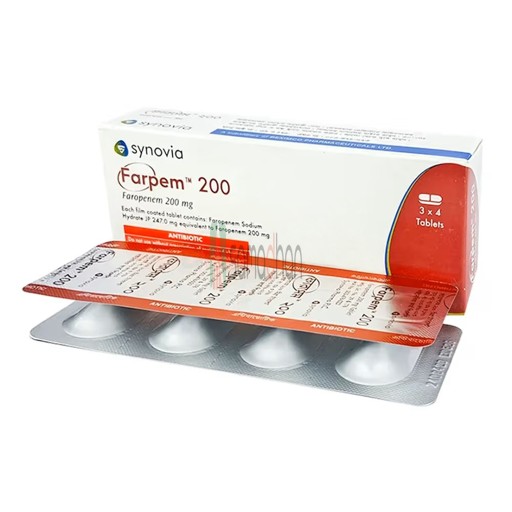
Farpem 200 mg is a Product of the Generic Faropenem
Farpem 200 mg belongs to the generic category of Faropenem. This medicine should be used according to a doctor's advice. We have provided detailed information about the uses, dosage, effectiveness, side effects, precautions, drug interactions, storage conditions, and other important details of Farpem 200 mg. Our goal is to present essential medicine information in one place for patients, caregivers, and healthcare professionals. To better understand Faropenem and ensure the safe use of this medicine, please read the information below carefully and consult a healthcare professional when necessary.
*Up to 10% Discount
(Depends on pharmacy)
Farpem 200 mg
Synovia Pharma PLC. · Tablet
Faropenem
/ Piece
Description of Farpem 200 mg
Farpem 200 mg may be available as a prescription or over-the-counter medicine, depending on local regulations and medical recommendations. It is used for the treatment and management of specific conditions or symptoms. The way this medicine is used may vary depending on the patient's condition and the advice of a healthcare provider. Detailed information about the approved uses, therapeutic applications, and other relevant details of Farpem 200 mg is provided below to help users gain a clear understanding of this medicine.
What Is Farpem 200 mg Indications and Uses?
Faropenem Tablets are indicated in the treatment of the following infections:
Lower respiratory tract infections: acute bronchitis, pneumonia, pulmonary suppuration.
Ear, nose, and throat (ENT) infections: otitis externa, tympanitis, sinusitis. ... Read moreFaropenem Tablets are indicated in the treatment of the following infections:
Lower respiratory tract infections: acute bronchitis, pneumonia, pulmonary suppuration.
Ear, nose, and throat (ENT) infections: otitis externa, tympanitis, sinusitis.
Genito-urinary infections: pyelonephritis, cystitis, prostatitis, seminal gland inflammation.
Upper respiratory tract infections: pharyngitis, tonsillitis.
Skin and skin structure infections: pustular acne, folliculitis, contagious impetigo, erysipelas, lymphangitis, suppurative nail inflammation, subcutaneous abscess, hidradenitis (sweat gland inflammation), infective sebaceous cyst, chronic pyoderma, secondary infection of external wounds or surgical wounds.
Gynecological infections: adnexitis, bartholin gland inflammation.
Pharmacology (Source, Chemical and Physical Composition) Of Farpem 200 mg
Faropenem is a penem class of antimicrobial and has bactericidal activity against a variety of gm-ve, gm+ve and anaerobic bacteria. Faropenem is bactericidal, with a strong affinity for the high molecular penicillin binding proteins (PBPs) of the cell wall, which is essential for the multiplication of bacilli; it, thus, acts by inhibiting the cell wall synthesis. Faropenem shows broad antibacterial activity against both aerobic and anaerobic Gram-positive and Gram-negative bacteria. Faropenem is highly stable against various beta lactamases and binds preferentially to the PBPs, 2 and 1A, of Escherichia coli (E. coli).
Dosage And Administration of Farpem 200 mg
Upper respiratory tract infections: 150 mg t.i.d., can be increased to 200 mg t.i.d.ENT infections: 200 mg t.i.d., can be increased to 300 mg t.i.d.Lower respiratory tract infections: 200 mg t.i.d., can be increased to 300 mg t.i.d.Skin and skin structure infections: 150 mg t.i.d., can be increased to 200 mg t.i.d.Genito-urinary infections: 200 mg t.i.d., can be increased to 300 mg t.i.d.Gynecological infections: 150 mg t.i.d., can be increased to 200 mg t.i.d.
Drug Interactions of Farpem 200 mg
Imipenem and Cilastatin sodium combination: It has been reported that in animal studies (rat), the concentration of faropenem in the blood increases. It is due to the obstruction of metabolic fermentation by cilastatin.Furosemide: It has been reported in animal studies (dog), that the kidney toxicity of faropenem increases.Sodium valproate: It has been reported that due to joint usage with carbapenem drugs (meropenem, panipenem and imipenem-cilastatin sodium) the concentration of valproic acid in the blood reduces, and there is a recurrence of epileptic fits.
Side Effects of Farpem 200 mg
Common side effects of this drug are Headache, Nausea, Vomiting, Stomach pain and Diarrhea.
Use During Pregnancy and Lactation
Safety regarding therapy during pregnancy has not been established. In pregnant women or expectant mothers, the medicine should be given only if the benefit of the treatment is greater than the risks involved. Faropenem is excreted in human milk. Therefore, Faropenem should be given to nursing mothers only if the benefits outweigh the risks.
Precautions And Warnings for Farpem 200 mg
Faropenem should be administered with caution in the following:
Patients with a past history of hypersensitivity to penicillin, cephem or carbapenem drugs.
Patients with a family history of atopy.
Patients with renal impairment. The dosage should be reduced or the interval between doses should be increased.
Geriatric patients.
Patients with poor oral intake or poor general state (since there are cases that show symptoms of vitamin K deficiency, proper monitoring should be done).
Use In Special Populations
Renal Impairment: In patients with renal impairment, it was found that the plasma concentrations of the drug are increased, and the half-life is extended.Geriatric Use: The half-life of Faropenem is prolonged in the elderly and this may be due to a decline in kidney functions, which results in high plasma concentrations. Therefore, in the elderly, start with a dose of 150 mg and monitor the patient for any undesirable effects. If diarrhea and loose bowel movements appear, stop the medicine, monitor correctly, and take appropriate measures. There is a tendency of hemorrhage due to vitamin K deficiency in the elderly.
Storage Conditions of It
Store Faropenem at room temperature between 20°C to 25°C in its original package. Safely throw away any Faropenem that is out of date or no longer needed. Keep Faropenem and all medicines out of the reach of children. Protect from moisture.
Data Source: Data source of Indications and Usages, Pharmacology, Dosage & Administration, Drug Interactions, Side Effects, Use during Pregnancy & Lactation, Precautions & Warnings, Use in Special Populations, Therapeutic Class, and Storage Conditions is the concerned medicine company or respective organization.
Alternative Medicines
⚠ Disclaimer
The information provided on All Samadhan is intended for general informational purposes only and is prepared based on our best practices. It is not a substitute for professional medical advice, diagnosis, or treatment. While we strive to keep the information accurate and up to date, we do not guarantee its completeness or accuracy. The absence of specific information or warnings about any medicine or service should not be considered as an assurance or endorsement by All Samadhan. All Samadhan shall not be held responsible for any consequences arising from the use of this information. We strongly recommend consulting a qualified healthcare professional or physician for any medical concerns, questions, or clarifications.All Samadhan is a digital healthcare software platform operated by MS Genius Experts. We provide technology solutions for pharmacies and healthcare providers; we are not a direct seller or dispenser of prescription medicines

N.B.: All Samadhan is a digital healthcare software platform operated by MS Genius Experts. We provide technology solutions for pharmacies and healthcare providers; we are not a direct seller or dispenser of prescription medicines.
Copyright © All Samadhan - Operated by M/S. Genius Experts | All Rights Reserved
DBID
Registration ID: 176322642
Trade License: TRAD/DNCC/040904/2023