
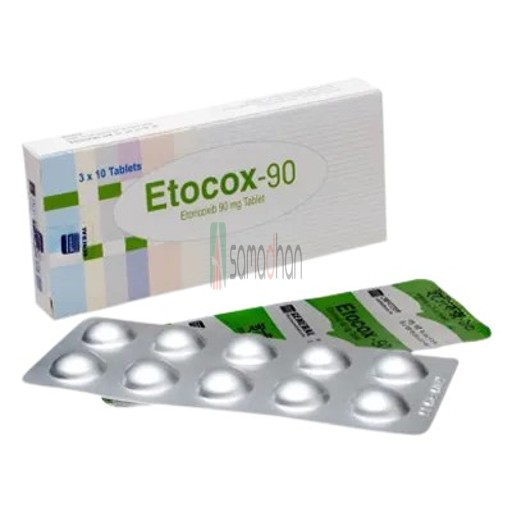
Etocox 90 mg is a Product of the Generic Etoricoxib
Etocox 90 mg belongs to the generic category of Etoricoxib. This medicine should be used according to a doctor's advice. We have provided detailed information about the uses, dosage, effectiveness, side effects, precautions, drug interactions, storage conditions, and other important details of Etocox 90 mg. Our goal is to present essential medicine information in one place for patients, caregivers, and healthcare professionals. To better understand Etoricoxib and ensure the safe use of this medicine, please read the information below carefully and consult a healthcare professional when necessary.
*Up to 10% Discount
(Depends on pharmacy)
Etocox 90 mg
General Pharmaceuticals Ltd. · Tablet
Etoricoxib
/ Piece
Description of Etocox 90 mg
Etocox 90 mg may be available as a prescription or over-the-counter medicine, depending on local regulations and medical recommendations. It is used for the treatment and management of specific conditions or symptoms. The way this medicine is used may vary depending on the patient's condition and the advice of a healthcare provider. Detailed information about the approved uses, therapeutic applications, and other relevant details of Etocox 90 mg is provided below to help users gain a clear understanding of this medicine.
What Is Etocox 90 mg Indications and Uses?
Etoricoxib tablet is indicated for the symptomatic relief of-
Osteoarthritis (OA)
Rheumatoid arthritis (RA)
Ankylosing spondylitis, and
The pain and signs of inflammation associated with acute gouty arthritis.
For the short-term treatment of moderate pain associated with dental surgery.
Pharmacology (Source, Chemical and Physical Composition) Of Etocox 90 mg
Etoricoxib is a potent, orally active cyclooxygenase-2 (COX-2) specific inhibitor within, and significantly above, the clinical dose range. Two isoforms of cyclooxygenase have been identified: cyclooxygenase-1 (COX-1) and cyclooxygenase-2 (COX-2). COX-1 is responsible for prostaglandin-mediated normal physiologic functions such as gastric cytoprotection and platelet aggregation. Inhibition of COX-1 by nonselective NSAIDs has been associated with gastric damage and inhibition of platelet aggregation. COX-2 has been shown to be primarily responsible for the synthesis of prostanoid mediators of pain, inflammation, and fever. Selective inhibition of COX-2 by etoricoxib (within the clinical dose range) decreases these clinical signs and symptoms with decreased potential for Gl toxicity and effects on platelet aggregation. Etoricoxib produced dose-dependent inhibition of COX-2 without inhibition of COX-1 at doses up to 150 mg daily. Etoricoxib did not inhibit gastric prostaglandin synthesis.
Dosage And Administration of Etocox 90 mg
Adult and adolescent over 16 years:
Osteoarthritis: The recommended dose is 30 mg once daily. In some patients with insufficient relief from symptoms, an increased dose of 60 mg once daily may increase efficacy.
Rheumatoid arthritis: The recommended dose is 90 mg once daily.
Ankylosing spondylitis: The recommended dose is 90 mg once daily.
Acute gouty arthritis: The recommended dose is 120 mg once daily. In clinical trials for acute gouty arthritis, Etoricoxib was given for 8 days.
Postoperative dental surgery pain: The recommended dose is 90 mg once daily, limited to a maximum of 3 days.
Some patients may require additional postoperative analgesia. As the cardiovascular risks of Etoricoxib may increase with dose and duration of exposure, the shortest duration possible and the lowest effective daily dose should be used. The patient's need for symptomatic relief and response to therapy should be re-evaluated periodically, especially in patients with osteoarthritis.
Drug Interactions of Etocox 90 mg
With medicine:
Oral anticoagulants: In subjects stabilized on chronic warfarin therapy, the administration of Etoricoxib was associated with an increase in prothrombin time.
Diuretics, ACE inhibitors and Angiotensin II Antagonists: NSAIDs may reduce the effect of diuretics and other antihypertensive drugs.
Acetylsalicylic Acid: Etoricoxib can be used concomitantly with acetylsalicylic acid at doses used for cardiovascular prophylaxis (low-dose acetylsalicylic acid).
Ciclosporin and tacrolimus: Although this interaction has not been studied with Etoricoxib, coadministration of ciclosporin or tacrolimus with any NSAID may increase the nephrotoxic effect of ciclosporin or tacrolimus.
Lithium: NSAIDs decrease lithium renal excretion and therefore increase lithium plasma levels.
With food & others: Take without regards to meals.
Side Effects of Etocox 90 mg
Side-effects may include palpitation, fatigue, influenza-like symptoms, ecchymosis; less commonly dry mouth, taste disturbance, mouth ulcer, appetite and weight change, atrial fibrillation, transient ischaemic attack, chest pain, flushing, cough, dyspnoea, epistaxis, anxiety, mental acuity impaired, paraesthesia, electrolyte disturbance, myalgia and arthralgia; very rarely confusion and hallucinations.
Use During Pregnancy and Lactation
The use of Etoricoxib, as with any drug substance known to inhibit COX-2, is not recommended in women attempting to conceive. It is not known whether Etoricoxib is excreted in human milk. Etoricoxib is excreted in the milk of lactating rats. Women who use Etoricoxib must not breastfeed.
Precautions And Warnings for Etocox 90 mg
Caution is advised with treatment of patients most at risk of developing a gastrointestinal complication with NSAIDs; the elderly, patients using any other NSAID or acetylsalicylic acid concomitantly or patients with a prior history of gastrointestinal disease, such as ulceration and Gl bleeding.
Patients with significant risk factors for cardiovascular events (e.g. hypertension, hyperlipidaemia, diabetes mellitus, smoking) should only be treated with Etoricoxib after careful consideration.
Administration of Etoricoxib may cause a reduction in prostaglandin formation and, secondarily, in renal blood flow, and thereby impair renal function. Monitoring of renal function in such patients should be considered.
Caution should be exercised in patients with a history of cardiac failure, left ventricular dysfunction, or hypertension and in patients with pre-existing edema from any other reason.
Any patients with symptoms and/or signs suggesting liver dysfunction, or in whom an abnormalliver function test has occurred, should be monitored. If signs of hepatic insufficiency occur, or if persistently abnormal liver function tests (three times the upper limit of normal) are detected, Etoricoxib should be discontinued.
Etoricoxib should be discontinued at the first appearance of skin rash, mucosal lesions, or any other sign of hypersensitivity.
Etoricoxib may mask fever and other signs of inflammation. Caution should be exercised when co-administering Etoricoxib with warfarin or other oral anticoagulants.
Therapeutic Class
Non-steroidal Anti-inflammatory Drugs (NSAIDs)
Storage Conditions of It
Store at a temperature of below 30°C, protect from light & moisture. Keep out of reach of children.
Data Source: Data source of Indications and Usages, Pharmacology, Dosage & Administration, Drug Interactions, Side Effects, Use during Pregnancy & Lactation, Precautions & Warnings, Use in Special Populations, Therapeutic Class, and Storage Conditions is the concerned medicine company or respective organization.
Alternative Medicines
⚠ Disclaimer
The information provided on All Samadhan is intended for general informational purposes only and is prepared based on our best practices. It is not a substitute for professional medical advice, diagnosis, or treatment. While we strive to keep the information accurate and up to date, we do not guarantee its completeness or accuracy. The absence of specific information or warnings about any medicine or service should not be considered as an assurance or endorsement by All Samadhan. All Samadhan shall not be held responsible for any consequences arising from the use of this information. We strongly recommend consulting a qualified healthcare professional or physician for any medical concerns, questions, or clarifications.All Samadhan is a digital healthcare software platform operated by MS Genius Experts. We provide technology solutions for pharmacies and healthcare providers; we are not a direct seller or dispenser of prescription medicines

N.B.: All Samadhan is a digital healthcare software platform operated by MS Genius Experts. We provide technology solutions for pharmacies and healthcare providers; we are not a direct seller or dispenser of prescription medicines.
Copyright © All Samadhan - Operated by M/S. Genius Experts | All Rights Reserved
DBID
Registration ID: 176322642
Trade License: TRAD/DNCC/040904/2023