
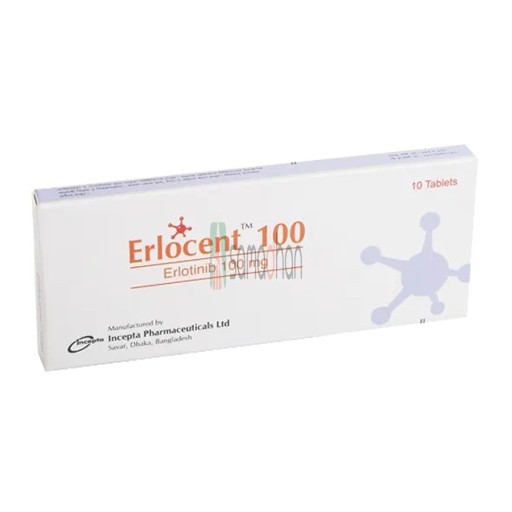
Erlocent 100 mg is a Product of the Generic Erlotinib
Erlocent 100 mg belongs to the generic category of Erlotinib. This medicine should be used according to a doctor's advice. We have provided detailed information about the uses, dosage, effectiveness, side effects, precautions, drug interactions, storage conditions, and other important details of Erlocent 100 mg. Our goal is to present essential medicine information in one place for patients, caregivers, and healthcare professionals. To better understand Erlotinib and ensure the safe use of this medicine, please read the information below carefully and consult a healthcare professional when necessary.
*Up to 10% Discount
(Depends on pharmacy)
Erlocent 100 mg
Incepta Pharmaceuticals Ltd. · Tablet
Erlotinib
/ Piece
Description of Erlocent 100 mg
Erlocent 100 mg may be available as a prescription or over-the-counter medicine, depending on local regulations and medical recommendations. It is used for the treatment and management of specific conditions or symptoms. The way this medicine is used may vary depending on the patient's condition and the advice of a healthcare provider. Detailed information about the approved uses, therapeutic applications, and other relevant details of Erlocent 100 mg is provided below to help users gain a clear understanding of this medicine.
What Is Erlocent 100 mg Indications and Uses?
First-line treatment of patients with metastatic Non-Small Cell Lung cancer (NSCLC) whose tumors have Epidermal Growth Factor Receptor (EGFR) exon 19 deletions or exon 21 substitution mutations as detected.Maintenance treatment of patients with locally advanced or metastatic NSCLC whose ... Read moreFirst-line treatment of patients with metastatic Non-Small Cell Lung cancer (NSCLC) whose tumors have Epidermal Growth Factor Receptor (EGFR) exon 19 deletions or exon 21 substitution mutations as detected.Maintenance treatment of patients with locally advanced or metastatic NSCLC whose disease has not progressed after four cycles of platinum based first-line chemotherapy.Treatment of locally advanced or metastatic NSCLC after failure of at least one prior chemotherapy regimen.First-line treatment of patients with locally advanced, unresectable or metastatic pancreatic cancer, in combination with gemcitabine.
Dosage And Administration of Erlocent 100 mg
NSCLC: The recommended daily dose of Erlotinib for NSCLC is 150 mg taken on an empty stomach, i.e., at least one hour before or two hours after the ingestion of food. Treatment should continue until disease progression or unacceptable toxicity occurs.Pancreatic Cancer: The recommended daily dose of Erlotinib for pancreatic cancer is 100 mg taken once daily in combination with gemcitabine. Take Erlotinib on an empty stomach, i.e., at least one hour before or two hours after the ingestion of food. Treatment should continue until disease progression or unacceptable toxicity occurs.Reduce Erlotinib by 50 mg decrements: If severe reactions occur with concomitant use of strong CYP3A4 inhibitors (such as atazanavir, Clarithromycin, Indinavir, Itraconazole, Ketoconazole, Nefazodone, Nelfinavir, Ritonavir, Saquinavir, Telithromycin, Voriconazole or grapefruit or grapefruit juice] or when using concomitantly with an inhibitor of both CYP3A4 and CYP1A2 (e.g., Ciprofloxacin).Increase Erlotinib by 50 mg increments as tolerated for: Concomitant use with CYP3A4 inducers, such as rifampin, rifabutin, rifapentine, phenytoin, carbamazepine, phenobarbital, or St. John's Wort. Increase doses by 50 mg increments at 2 week intervals to a maximum of 450 mg. Avoid concomitant use, if possible.Concurrent cigarette smoking: Increase by 50 mg increments at 2 week intervals to a maximum of 300 mg. Immediately reduce the dose of Erlotinib to the recommended dose (150 mg or 100 mg daily) upon cessation of smoking.
Drug Interactions of Erlocent 100 mg
Anticoagulants: Interaction with coumarin-derived anticoagulants, including warfarin, leading to increased International Normalized Ratio (INR) and bleeding adverse reactions.CYP3A4 inhibitors: Erlotinib is metabolized predominantly by CYP3A4. Co-treatment with the potent CYP3A4 inhibitor ketoconazole increased Erlotinib AUC by 67%. When Erlotinib was co-administered with Ciprofloxacin, an inhibitor of both CYP3A4 and CYP1A2, the Erlotinib exposure [AUC] and maximum concentration [Cmax] increased by 39% and 17%, respectively.CYP3A4 inducers: Pre-treatment with the CYP3A4 inducer Rifampicin for 7-11 days prior to Erlotinib decreased Erlotinib AUC by 58% to 80%. Dose modifications are recommended.Drugs affecting gastric pH: Co-administration of Erlotinib with omeprazole decreased Erlotinib AUC by 46% and co-administration of Erlotinib with Ranitidine 300 mg decreased Erlotinib AUC by 33%.
Side Effects of Erlocent 100 mg
The most common adverse reactions (20%) with Erlotinib from a pooled analysis of studies were rash, diarrhea, anorexia, fatigue, dyspnea, cough, nausea, and vomiting. The following serious adverse reactions, which may include fatalities.
Interstitial Lung Disease (ILD)
Renal Failure
Hepatotoxicity with or without Hepatic Impairment
Gastrointestinal Perforation
Bullous and Exfoliative Skin Disorders
Myocardial Infarction/Ischemia
Cerebrovascular Accident
Microangiopathic Hemolytic Anemia with Thrombocytopenia
Ocular Disorders
Hemorrhage in Patients Taking Warfarin
Use During Pregnancy and Lactation
Pregnancy category D. Based on its mechanism of action, Erlotinib can cause fetal harm when administered to a pregnant woman. It is not known whether Erlotinib is present in human milk. Because many drugs are present in human milk and because of the potential for serious adverse reactions in nursing infants from Erlotinib, a decision should be made whether to discontinue nursing or discontinue the drug, taking into account the importance of the drug to the mother.
Precautions And Warnings for Erlocent 100 mg
Interstitial Lung Disease (ILD): Occurs in 1.1% of patients. Withhold Erlotinib for acute onset of new or progressive unexplained pulmonary symptoms, such as dyspnea, cough and fever. Discontinue Erlotinib if ILD is diagnosed.
Renal Failure: Monitor renal function and electrolytes, particularly in patients at risk of dehydration. Withhold Erlotinib for severe renal toxicity.
Hepatotoxicity with or without hepatic impairment including hepatic failure and hepatorenal syndrome: Monitor periodic liver testing. Withhold or discontinue Erlotinib for severe or worsening liver tests.
Gastrointestinal perforations-discontinue Erlotinib.
Bullous and exfoliative skin disorders-discontinue Erlotinib.
Myocardial infarction (Ml)/ischemia: The risk of Ml is increased in patients with pancreatic cancer.
Use In Special Populations
Pediatric use: The safety and effectiveness of Erlotinib in pediatric patients have not been established.Geriatric use: No overall differences in safety or efficacy were observed between subjects 65 years and older and those younger than 65.
Therapeutic Class
Targeted Cancer Therapy
Storage Conditions of It
Store at a temperature not exceeding 30°C in a dry place. Protect from light and moisture.
Data Source: Data source of Indications and Usages, Pharmacology, Dosage & Administration, Drug Interactions, Side Effects, Use during Pregnancy & Lactation, Precautions & Warnings, Use in Special Populations, Therapeutic Class, and Storage Conditions is the concerned medicine company or respective organization.
Alternative Medicines
⚠ Disclaimer
The information provided on All Samadhan is intended for general informational purposes only and is prepared based on our best practices. It is not a substitute for professional medical advice, diagnosis, or treatment. While we strive to keep the information accurate and up to date, we do not guarantee its completeness or accuracy. The absence of specific information or warnings about any medicine or service should not be considered as an assurance or endorsement by All Samadhan. All Samadhan shall not be held responsible for any consequences arising from the use of this information. We strongly recommend consulting a qualified healthcare professional or physician for any medical concerns, questions, or clarifications.All Samadhan is a digital healthcare software platform operated by MS Genius Experts. We provide technology solutions for pharmacies and healthcare providers; we are not a direct seller or dispenser of prescription medicines

N.B.: All Samadhan is a digital healthcare software platform operated by MS Genius Experts. We provide technology solutions for pharmacies and healthcare providers; we are not a direct seller or dispenser of prescription medicines.
Copyright © All Samadhan - Operated by M/S. Genius Experts | All Rights Reserved
DBID
Registration ID: 176322642
Trade License: TRAD/DNCC/040904/2023