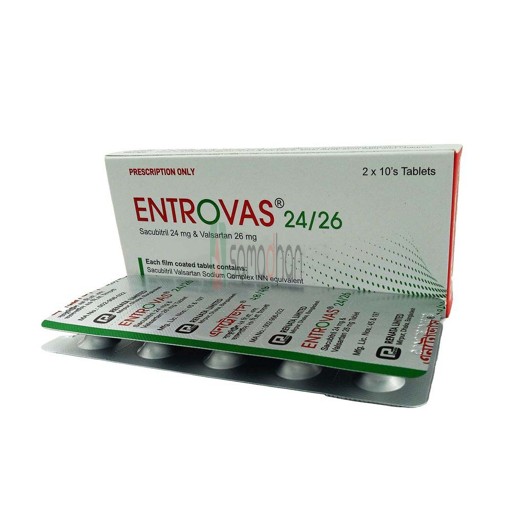
Entrovas 24 mg+26 mg is a Product of the Generic Sacubitril + Valsartan
Entrovas 24 mg+26 mg belongs to the generic category of Sacubitril + Valsartan. This medicine should be used according to a doctor's advice. We have provided detailed information about the uses, dosage, effectiveness, side effects, precautions, drug interactions, storage conditions, and other important details of Entrovas 24 mg+26 mg. Our goal is to present essential medicine information in one place for patients, caregivers, and healthcare professionals. To better understand Sacubitril + Valsartan and ensure the safe use of this medicine, please read the information below carefully and consult a healthcare professional when necessary.
*Up to 10% Discount
(Depends on pharmacy)
Entrovas 24 mg+26 mg
Renata PLC · Tablet
Sacubitril + Valsartan
/ Piece
Description of Entrovas 24 mg+26 mg
Entrovas 24 mg+26 mg may be available as a prescription or over-the-counter medicine, depending on local regulations and medical recommendations. It is used for the treatment and management of specific conditions or symptoms. The way this medicine is used may vary depending on the patient's condition and the advice of a healthcare provider. Detailed information about the approved uses, therapeutic applications, and other relevant details of Entrovas 24 mg+26 mg is provided below to help users gain a clear understanding of this medicine.
What Is Entrovas 24 mg+26 mg Indications and Uses?
This combination tablet is indicated:
To reduce the risk of cardiovascular death and hospitalization for heart failure in patients with chronic heart failure (NYHA Class ll-IV) and reduced ejection fraction.
For the treatment of symptomatic heart failure with systemic left ventricular systolic dysfunction in pediatric patients aged one year and older.
This is usually administered in conjunction with other heart failure therapies, in place of an angiotensin-converting enzyme inhibitor (ACEi) or other ARB.
Pharmacology (Source, Chemical and Physical Composition) Of Entrovas 24 mg+26 mg
This tablet contains a neprilysin inhibitor, sacubitril, and an angiotensin receptor blocker, valsartan. This tablet inhibits neprilysin (neutral endopeptidase; NEP) via LBQ657, the active metabolite of the prodrug sacubitril, and blocks the angiotensin II type-1 (AT1 ) receptor via valsartan. The cardiovascular and renal effects of this tablet in heart failure patients are attributed to the increased levels of peptides that are degraded by neprilysin, such as natriuretic peptides, by LBQ657, and the simultaneous inhibition of the effects of angiotensin II by valsartan. Valsartan inhibits the effects of angiotensin II by selectively blocking the AT1 receptor, and also inhibits angiotensin II-dependent aldosterone release.
Dosage And Administration of Entrovas 24 mg+26 mg
Adult Heart Failure: The recommended starting dose is 49/51 mg orally twice daily. Double the dose after 2 to 4 weeks to the target maintenance dose of 97/103 mg twice daily, as tolerated by the patient.Reduce the starting dose to 24/26 mg twice daily for:
Patients not currently taking an angiotensin-converting enzyme inhibitor (ACEi) or an angiotensin II receptor blocker (ARB) or previously taking a low dose of these agents.
Patients with severe renal impairment.
Patients with moderate hepatic impairment.
Pediatric Heart Failure: Refer to Table 1 for the recommended dose for pediatric patients aged one year and older. Take the recommended dose orally twice daily. Adjust pediatric patient doses every 2 weeks, as tolerated by the patient.Recommended Dose Titration-Pediatric Patients Less than 40 kg:
Starting: 1.6 mg/kg
Second: 2.3 mg/kg
Final: 3.1 mg/kg
Pediatric Patients At least 40 kg, less than 50 kg:
Starting: 24/26 mg
Second: 49/51 mg
Final: 49/51 mg
Pediatric Patients At least 50 kg:
Starting: 49/51 mg
Second: 72/78 mg
Final: 97/103 mg
Drug Interactions of Entrovas 24 mg+26 mg
Dual Blockade of the Renin-Angiotensin-Aldosterone System: Should not be used with an ACEi, aliskiren in patients with diabetes, and use with an ARB should be avoided.Potassium-sparing Diuretics: Serum potassium level may be increased.NSAIDs: Risk of renal impairment may be increased.Lithium: Increased risk of lithium toxicity.
Side Effects of Entrovas 24 mg+26 mg
The most common side effects are Angioedema, Hypotension, Impaired Renal Function, Hyperkalemia, Cough, Dizziness.
Use During Pregnancy and Lactation
Pediatric Use: Safety and effectiveness have not been established in pediatric patients less than 1 year of age.Geriatric Use: No relevant pharmacokinetic differences have been observed in elderly (>65 years) or very elderly (>75 years) patients compared to the overall population. Hepatic Impairment: No dose adjustment is required when administering this tablet to patients with mild hepatic impairment (Child-Pugh A classification). This tablet is not recommended in patients with severe hepatic impairment, as no studies have been conducted in these patients.Renal Impairment: No dose adjustment is required in patients with mild (eGFR 60 to 90 ml/min/1.73 m2) to moderate (eGFR 30 to 60 ml/min/1.73 m2) renal impairment. The recommended starting dose in patients with severe renal impairment (eGFR <30 ml/min/1.73 m2) is 24/26 mg twice daily.
Precautions And Warnings for Entrovas 24 mg+26 mg
This tablet may cause angioedema and must not be used in patients with a known history of angioedema related to previous ACEi or ARB therapy and in patients with hereditary angioedema.This tablet lowers blood pressure and may cause symptomatic hypotension. Closely monitor serum creatinine, and down-titrate or interrupt this tablet in patients who develop a clinically significant decrease in renal function. In patients with renal artery stenosis, monitor renal function.Monitor serum potassium periodically and treat appropriately, especially in patients with risk factors for hyperkalemia such as severe renal impairment, diabetes, hypoaldosteronism, or a high potassium diet. Dosage reduction or interruption of this tablet may be required.
Use In Special Populations
Pediatric Use: Safety and effectiveness in pediatric patients have not been established.Geriatric Use: No relevant pharmacokinetic differences have been observed in elderly (≥65 years) or very elderly (≥75 years) patients compared to the overall populationRenal Impairment:
Severe: A starting dose of 24/26 mg twice-daily is recommended for patients with severe renal impairment (eGFR <30 mL/min/1.73 m²). Double the dose of Sacubitril & Valsartan every 2 to 4 weeks to the target maintenance dose of 97/103 mg twice daily, as tolerated by the patient.
Mild or moderate: No starting dose adjustment is needed for mild or moderate renal impairment.
Hepatic Impairment:
Moderate: A starting dose of 24/26 mg twice-daily is recommended for patients with moderate hepatic impairment (Child-Pugh B classification). Double the dose of Sacubitril & Valsartan every 2 to 4 weeks to the target maintenance dose of 97/103 mg twice daily, as tolerated by the patient.
Mild: No starting dose adjustment is needed for mild hepatic impairment.
Severe: Use in patients with severe hepatic impairment is not recommended.
Storage Conditions of It
Keep in a dry place and store below 30°C. Protect from moisture and keep out of the reach of children.
Data Source: Data source of Indications and Usages, Pharmacology, Dosage & Administration, Drug Interactions, Side Effects, Use during Pregnancy & Lactation, Precautions & Warnings, Use in Special Populations, Therapeutic Class, and Storage Conditions is the concerned medicine company or respective organization.
Alternative Medicines
⚠ Disclaimer
The information provided on All Samadhan is intended for general informational purposes only and is prepared based on our best practices. It is not a substitute for professional medical advice, diagnosis, or treatment. While we strive to keep the information accurate and up to date, we do not guarantee its completeness or accuracy. The absence of specific information or warnings about any medicine or service should not be considered as an assurance or endorsement by All Samadhan. All Samadhan shall not be held responsible for any consequences arising from the use of this information. We strongly recommend consulting a qualified healthcare professional or physician for any medical concerns, questions, or clarifications.All Samadhan is a digital healthcare software platform operated by MS Genius Experts. We provide technology solutions for pharmacies and healthcare providers; we are not a direct seller or dispenser of prescription medicines

N.B.: All Samadhan is a digital healthcare software platform operated by MS Genius Experts. We provide technology solutions for pharmacies and healthcare providers; we are not a direct seller or dispenser of prescription medicines.
Copyright © All Samadhan - Operated by M/S. Genius Experts | All Rights Reserved
DBID
Registration ID: 176322642
Trade License: TRAD/DNCC/040904/2023