
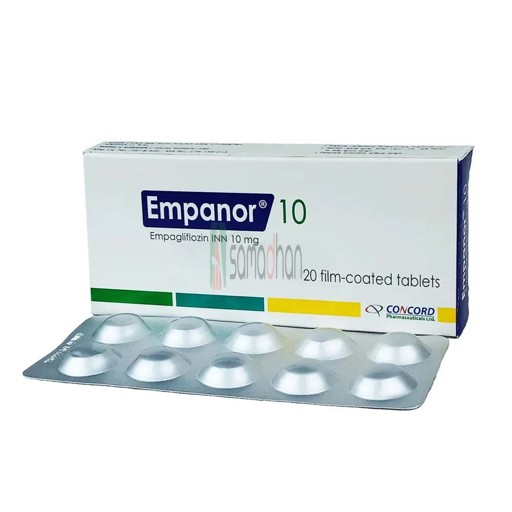
Empanor 10 mg is a Product of the Generic Empagliflozin
Empanor 10 mg belongs to the generic category of Empagliflozin. This medicine should be used according to a doctor's advice. We have provided detailed information about the uses, dosage, effectiveness, side effects, precautions, drug interactions, storage conditions, and other important details of Empanor 10 mg. Our goal is to present essential medicine information in one place for patients, caregivers, and healthcare professionals. To better understand Empagliflozin and ensure the safe use of this medicine, please read the information below carefully and consult a healthcare professional when necessary.
*Up to 10% Discount
(Depends on pharmacy)
Empanor 10 mg
Concord Pharmaceuticals Ltd. · Tablet
Empagliflozin
/ Piece
Description of Empanor 10 mg
Empanor 10 mg may be available as a prescription or over-the-counter medicine, depending on local regulations and medical recommendations. It is used for the treatment and management of specific conditions or symptoms. The way this medicine is used may vary depending on the patient's condition and the advice of a healthcare provider. Detailed information about the approved uses, therapeutic applications, and other relevant details of Empanor 10 mg is provided below to help users gain a clear understanding of this medicine.
What Is Empanor 10 mg Indications and Uses?
Empagliflozin is indicated in:
As an adjunct to diet and exercise to improve glycemic control in adults with type 2 diabetes mellitus.
To reduce the risk of cardiovascular death in adult patients with type 2 diabetes mellitus and established cardiovascular disease.
Pharmacology (Source, Chemical and Physical Composition) Of Empanor 10 mg
Empagliflozin is a sodium glucose co-transporter-2 (SGLT-2) inhibitor. SGLT2 co-transporters are responsible for reabsorption of glucose from the glomerular filtrate in the kidney. The glucuretic effect resulting from SGLT2 inhibition reduces renal absorption and lowers the renal threshold for glucose, resulting in increased glucose excretion. Additionally, it contributes to reduced hyperglycaemia, assists weight loss, and reduces blood pressure.
Dosage And Administration of Empanor 10 mg
The recommended dose of Empagliflozin is 10 mg once daily, taken in the morning, with or without food. In patients tolerating Empagliflozin, the dose may be increased to 25 mg once daily. In patients with volume depletion, correcting this condition prior to initiation of Empagliflozin is recommended.
Drug Interactions of Empanor 10 mg
Diuretics: Co-administration of Empagliflozin with diuretics resulted in increased urine volume. Insulin or Insulin Secretagogues: Co-administration of Empagliflozin with insulin or insulin secretagogues increases the risk for hypoglycemia. Positive Urine Glucose Test: Monitoring glycemic control with urine glucose tests is not recommended in patients taking SGLT2 inhibitors as SGLT2 inhibitors increase urinary glucose excretion and will lead to positive urine glucose tests. Use alternative methods to monitor glycemic control. Interference with 1,5-anhydroglucitol (1,5-AG) Assay: Monitoring glycemic control with 1,5-AG assay is not recommended as measurements of 1,5-AG are unreliable in assessing glycemic control in patients taking SGLT2 inhibitors. Use alternative methods to monitor glycemic control.
Side Effects of Empanor 10 mg
The most common adverse reactions associated with Empagliflozin are urinary tract infections and female genital mycotic infections. Others common side effects includes dehydration, hypotension, weakness, dizziness and increased thirstiness.
Use During Pregnancy and Lactation
There are no adequate and well-controlled studies of Empagliflozin in pregnant women. Empagliflozin should be used during pregnancy only if the potential benefit justifies the potential risk to the fetus. It is not known if Empagliflozin is excreted in human milk. It is not recommended when breastfeeding.
Precautions And Warnings for Empanor 10 mg
Assessment of renal function is recommended prior to initiation of Empagliflozin and periodically thereafter. Empagliflozin should not initiated in patients with an eGFR less than 45 ml/min/1.73 m2. No dose adjustment is needed in patients with an eGFR greater than or equal to 45 ml/min/1.73 m2.
Therapeutic Class
Sodium-glucose Cotransporter-2 (SGLT2) Inhibitors
Storage Conditions of It
Keep in a cool & dry place (below 30° C), protected from light & moisture. Keep out of the reach of children.
Data Source: Data source of Indications and Usages, Pharmacology, Dosage & Administration, Drug Interactions, Side Effects, Use during Pregnancy & Lactation, Precautions & Warnings, Use in Special Populations, Therapeutic Class, and Storage Conditions is the concerned medicine company or respective organization.
Alternative Medicines
⚠ Disclaimer
The information provided on All Samadhan is intended for general informational purposes only and is prepared based on our best practices. It is not a substitute for professional medical advice, diagnosis, or treatment. While we strive to keep the information accurate and up to date, we do not guarantee its completeness or accuracy. The absence of specific information or warnings about any medicine or service should not be considered as an assurance or endorsement by All Samadhan. All Samadhan shall not be held responsible for any consequences arising from the use of this information. We strongly recommend consulting a qualified healthcare professional or physician for any medical concerns, questions, or clarifications.All Samadhan is a digital healthcare software platform operated by MS Genius Experts. We provide technology solutions for pharmacies and healthcare providers; we are not a direct seller or dispenser of prescription medicines

N.B.: All Samadhan is a digital healthcare software platform operated by MS Genius Experts. We provide technology solutions for pharmacies and healthcare providers; we are not a direct seller or dispenser of prescription medicines.
Copyright © All Samadhan - Operated by M/S. Genius Experts | All Rights Reserved
DBID
Registration ID: 176322642
Trade License: TRAD/DNCC/040904/2023