
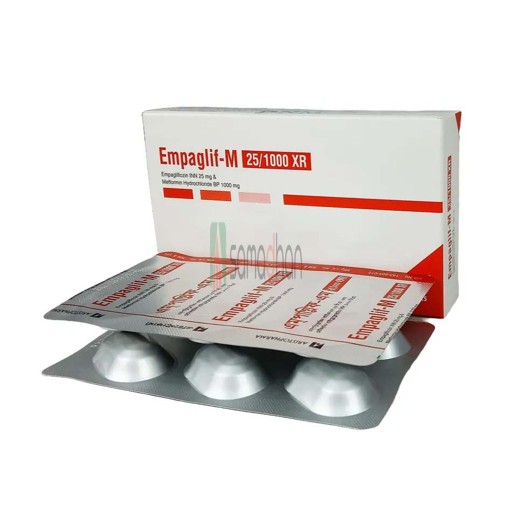
Empaglif-M XR 25 mg+1000 mg is a Product of the Generic Empagliflozin + Metformin Hydrochloride
Empaglif-M XR 25 mg+1000 mg belongs to the generic category of Empagliflozin + Metformin Hydrochloride. This medicine should be used according to a doctor's advice. We have provided detailed information about the uses, dosage, effectiveness, side effects, precautions, drug interactions, storage conditions, and other important details of Empaglif-M XR 25 mg+1000 mg. Our goal is to present essential medicine information in one place for patients, caregivers, and healthcare professionals. To better understand Empagliflozin + Metformin Hydrochloride and ensure the safe use of this medicine, please read the information below carefully and consult a healthcare professional when necessary.
*Up to 10% Discount
(Depends on pharmacy)
Empaglif-M XR 25 mg+1000 mg
Aristopharma Ltd. · Tablet (Extended Release)
Empagliflozin + Metformin Hydrochloride
/ Piece
Description of Empaglif-M XR 25 mg+1000 mg
Empaglif-M XR 25 mg+1000 mg may be available as a prescription or over-the-counter medicine, depending on local regulations and medical recommendations. It is used for the treatment and management of specific conditions or symptoms. The way this medicine is used may vary depending on the patient's condition and the advice of a healthcare provider. Detailed information about the approved uses, therapeutic applications, and other relevant details of Empaglif-M XR 25 mg+1000 mg is provided below to help users gain a clear understanding of this medicine.
What Is Empaglif-M XR 25 mg+1000 mg Indications and Uses?
This combination tablet is indicated for the treatment of adults with type 2 diabetes mellitus as an adjunct to diet and exercise:
In patients insufficiently controlled on their maximally tolerated dose of Metformin alone
In combination with other medicinal products for the treatment of diabetes, in patients insufficiently controlled with Metformin and these medicinal products
In patients already being treated with the combination of Empagliflozin and Metformin as separate tablets.
Pharmacology (Source, Chemical and Physical Composition) Of Empaglif-M XR 25 mg+1000 mg
Empagliflozin is an inhibitor of Sodium-Glucose Co-Transporter 2 (SGLT2). SGLT2 is the predominant transporter, responsible for reabsorption of glucose from the kidney back into the circulation. By inhibiting SGLT2, Empagliflozin reduces renal reabsorption of filtered glucose and lowers the renal threshold for glucose and thereby increases urinary glucose excretion.Metformin Hydrochloride is a biguanide type oral antihyperglycemic drug, used in the management of type 2 diabetes. It lowers both basal and postprandial plasma glucose. It does not produce hypoglycemia. Metformin Hydrochloride decreases hepatic glucose production, decreases intestinal absorption of glucose and improves insulin sensitivity by an increase in peripheral glucose uptake and utilization.
Dosage And Administration of Empaglif-M XR 25 mg+1000 mg
The dosage should be individualized based on effectiveness and tolerability. Take this combination twice daily with meals. Dose escalation should be gradual to reduce the gastrointestinal side effects due to Metformin Hydrochloride. Maximum recommended daily dose of Metformin Hydrochloride is 2000 mg and Empagliflozin is 25 mg.Recommended individualized starting dose:
In patients on Metformin Hydrochloride, switch to this combination containing Empagliflozin 5 mg with a similar total daily dose of Metformin Hydrochloride.
In patients on Empagliflozin, switch to this combination containing Metformin Hydrochloride 500 mg with a similar total daily dose of Empagliflozin.
In patients already treated with Empagliflozin and Metformin Hydrochloride separately switch to this combination containing the same total daily doses of each component.
In patients with volume depletion not previously treated with Empagliflozin, correct this condition before initiating this combination.
Extended-release formulations: Individualize starting dose based on the patient’s current drug regimen. Take film coated tablet twice daily with meal and extended-release formulations should be taken once daily with meal, with gradual dose escalation to reduce the Gl adverse effects due to Metformin. Adjust dosing based on effectiveness and tolerability while not exceeding the maximum recommended daily dose of Metformin Hydrochloride 2000 mg and Empagliflozin 25 mg.Renal impaired patient: Assess renal function before initiating this combination. In patients with an eGFR below 45 mL/min/1.73 m2 is contraindicated.Pediatric patients under 18 years of age: Safety and effectiveness in pediatric patients under 18 years of age have not been established.
Drug Interactions of Empaglif-M XR 25 mg+1000 mg
Diuretics: Co-administration of Empagliflozin with diuretics resulted in increased urine volume and frequency of voids, which might enhance the potential for volume depletion.Insulin or Insulin Secretagogues: Co-administration of Empagliflozin with insulin or insulin secretagogues increases the risk for hypoglycemia.Positive Urine Glucose Test: Monitoring glycemic control with urine glucose tests is not recommended in patients taking SGLT2 inhibitors. Use alternative methods to monitor glycemic control.Drugs that Reduce Metformin Clearance: Drugs that reduce Metformin clearance (such as ranolazine, vandetanib, dolutegravir, and cimetidine) may increase the accumulation of Metformin.Carbonic Anhydrase Inhibitors: Carbonic anhydrase inhibitors may increase risk of lactic acidosis.Drugs Affecting Glycemic Control: Thiazides and other diuretics, corticosteroids, phenothiazines, thyroid products, estrogens, oral contraceptives, phenytoin, nicotinic acid, sympathomimetics, calcium channel blocking drugs, and isoniazid produce hoperglycemia. When such drugs are administered to a patient receiving Empagliflozin and Metformin combination, the patient should be closely observed to maintain adequate glycemic control. When such drugs are withdrawn from a patient receiving Empagliflozin and Metformin combination, the patient should be observed closely for hypoglycemia.Alcohol: Alcohol can potentiate the effect of Metformin on lactate metabolism. Warn patients against excessive alcohol intake.
Side Effects of Empaglif-M XR 25 mg+1000 mg
Most common adverse reactions associated with Empagliflozin (5% or greater incidence) were urinary tract infection and female genital mycotic infections. Most common adverse reactions associated with Metformin (>5%) are diarrhea, nausea/vomiting, flatulence, abdominal discomfort, indigestion, asthenia, and headache. The following important adverse reactions are given below:
Very common: Hypoglycemia (when used with sulphonylurea or insulin), Gastrointestinal symptoms
Common: Vaginal moniliasis, vulvovaginitis, balanitis and other genital infection. Urinary tract infection (including pyelonephritis and urosepsis), thirst, taste disturbance, pruritus (generalised), rash, Increased urination, serum lipids increased
Uncommon: Volume depletion, urticaria, dysuria, blood creatinine increased/Glomerular filtration rate decreased, Haematocrit increased
Rare: Diabetic ketoacidosis.
Use During Pregnancy and Lactation
Advise females of the potential risk to a fetus especially during the second and third trimesters. This is not recommended when breastfeeding.
Precautions And Warnings for Empaglif-M XR 25 mg+1000 mg
Lactic Acidosis: Postmarketing cases of Metformin Hydrochloride-associated lactic acidosis. If lactic acidosis is suspected, general supportive measures should be instituted promptly in a hospital setting, along with immediate discontinuation of this combination. Hypotension: Before initiating this combination assess and correct volume status in patients with renal impairment, the elderly, in patients with low systolic blood pressure, and in patients on diuretics. Monitor for signs and symptoms of hypotension after initiating therapy and increase monitoring in clinical situations where volume contraction is expected. Ketoacidosis: Before initiating this combination assess patients who present with signs and symptoms of metabolic acidosis for ketoacidosis, regardless of blood glucose level. If suspected, discontinue this combination, evaluate and treat promptly. Acute kidney injury & impairment in renal function: Consider temporarily discontinuing this combination in settings of reduced oral intake or fluid losses. If acute kidney injury occurs, discontinue this combination promptly and institute treatment. Urosepsis, Pyelonephritis, Fournier’s gangrene & Genital mycotic infections: Treatment with SGLT2 inhibitors increases the risk for urinary tract infections. Evaluate patients for signs and symptoms of urinary tract infections and treat promptly, if indicated. Hypoglycemia: Consider lowering the dose of insulin secretagogue or insulin to reduce the risk of hypoglycemia when initiating this combination. Vitamin B12 Deficiency: Metformin Hydrochloride may lower vitamin B12 levels. Monitor hematologic parameters annually. Increased LDL-C: Monitor and treat as appropriate. Macrovascular Outcomes: There have been no clinical studies establishing conclusive evidence of macrovascular risk reduction with this combination.
Therapeutic Class
Combination Oral hypoglycemic preparations
Storage Conditions of It
Keep below 30°C temperature, protected from light & moisture. Keep out of the reach of children.
Data Source: Data source of Indications and Usages, Pharmacology, Dosage & Administration, Drug Interactions, Side Effects, Use during Pregnancy & Lactation, Precautions & Warnings, Use in Special Populations, Therapeutic Class, and Storage Conditions is the concerned medicine company or respective organization.
Alternative Medicines
⚠ Disclaimer
The information provided on All Samadhan is intended for general informational purposes only and is prepared based on our best practices. It is not a substitute for professional medical advice, diagnosis, or treatment. While we strive to keep the information accurate and up to date, we do not guarantee its completeness or accuracy. The absence of specific information or warnings about any medicine or service should not be considered as an assurance or endorsement by All Samadhan. All Samadhan shall not be held responsible for any consequences arising from the use of this information. We strongly recommend consulting a qualified healthcare professional or physician for any medical concerns, questions, or clarifications.All Samadhan is a digital healthcare software platform operated by MS Genius Experts. We provide technology solutions for pharmacies and healthcare providers; we are not a direct seller or dispenser of prescription medicines

N.B.: All Samadhan is a digital healthcare software platform operated by MS Genius Experts. We provide technology solutions for pharmacies and healthcare providers; we are not a direct seller or dispenser of prescription medicines.
Copyright © All Samadhan - Operated by M/S. Genius Experts | All Rights Reserved
DBID
Registration ID: 176322642
Trade License: TRAD/DNCC/040904/2023