
Emestop 40 mg is a Product of the Generic Aprepitant
Emestop 40 mg belongs to the generic category of Aprepitant. This medicine should be used according to a doctor's advice. We have provided detailed information about the uses, dosage, effectiveness, side effects, precautions, drug interactions, storage conditions, and other important details of Emestop 40 mg. Our goal is to present essential medicine information in one place for patients, caregivers, and healthcare professionals. To better understand Aprepitant and ensure the safe use of this medicine, please read the information below carefully and consult a healthcare professional when necessary.
*Up to 10% Discount
(Depends on pharmacy)
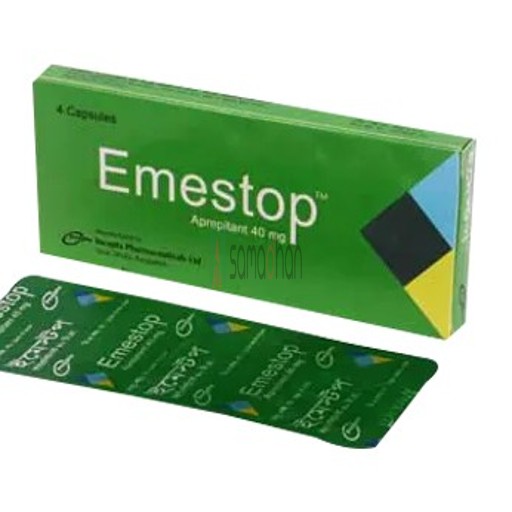
Emestop 40 mg
Incepta Pharmaceuticals Ltd. · Capsule
Aprepitant
/ Piece
Description of Emestop 40 mg
Emestop 40 mg may be available as a prescription or over-the-counter medicine, depending on local regulations and medical recommendations. It is used for the treatment and management of specific conditions or symptoms. The way this medicine is used may vary depending on the patient's condition and the advice of a healthcare provider. Detailed information about the approved uses, therapeutic applications, and other relevant details of Emestop 40 mg is provided below to help users gain a clear understanding of this medicine.
What Is Emestop 40 mg Indications and Uses?
Aprepitant is indicated for-
Prevention of postoperative nausea and vomiting (PONV)
Prevention of Chemotherapy induced nausea and vomiting (CINV)
Pharmacology (Source, Chemical and Physical Composition) Of Emestop 40 mg
Aprepitant is a selective high affinity antagonist of human substance P neurokinin 1 (NK1) receptors. When substance P attaches to these receptors, it causes nausea and vomiting. Aprepitant stops substance P from binding to the NK1 receptors. By blocking the receptors, Aprepitant can prevent nausea and vomiting, which often happens after chemotherapy or as a complication of surgery.
Dosage And Administration of Emestop 40 mg
Post Operative Nausea and Vomiting: The recommended oral dosage of Aprepitant is 40 mg within 3 hours prior to induction of anesthesia. Chemotherapy-Induced Nausea and Vomiting: The following regimen should be used for the prevention of nausea and vomiting associated with highly emetogenic cancer chemotherapy-
Day 1: Aprepitant 125 mg orally, Dexamethasone 12 mg orally, 5-HT3 antagonist (Ondansetron): 24 mg 30 minutes before the start of chemotherapy.
Day 2: Aprepitant 80 mg orally, Dexamethasone 8 mg orally
Day 3: Aprepitant 80 mg orally, Dexamethasone 8 mg orally
Day 4: Dexamethasone 8 mg orally
Aprepitant is administered orally 1 hour prior to chemotherapy treatment on Day 1 and in the morning on Days 2 and 3. Dexamethasone is administered 30 minutes prior to chemotherapy treatment on Day 1 and in the morning on Days 2 through 4. The dose of dexamethasone accounts for drug interactions.The following regimen should be used for the prevention of nausea and vomiting associated with moderately emetogenic cancer chemotherapy:
Day 1: Aprepitant 125 mg orally, Dexamethasone 12 mg orally, 5-HT3 antagonist (Ondansetron): one 8 mg tablet 30 minutes before chemotherapy followed by an 8 mg dose 8 hours later.
Day 2: Aprepitant 80 mg orally, 5-HT3 antagonist (Ondansetron): 8 mg tablet twice a day
Day 3: Aprepitant 80 mg orally, 5-HT3 antagonist (Ondansetron): 8 mg tablet twice a day.
Aprepitant is administered orally 1 hour prior to chemotherapy treatment on Day 1 and in the morning on Days 2 and 3. Dexamethasone is administered 30 minutes prior to chemotherapy treatment on Day 1. The dose of dexamethasone accounts for drug interactions.Aprepitant may be taken with or without food. No dosage adjustment is necessary for the elderly patients.
Drug Interactions of Emestop 40 mg
Aprepitant is a substrate, a weak-to-moderate (dose dependent) inhibitor, and an inducer of CYP3A4. Aprepitant is also an inducer of CYP2C9. Precautions should be taken while coadministering Aprepitant with drugs that use CYP3A4 or CYP2C9, for example- Warfarin, Tolbutamide, Phenytoin, Ketoconazole, Itraconazole, Nefazodone, Troleandomycin, Clarithromycin, Ritonavir, Nelfinavir, Diltiazem, Rifampin, Carbamazepine etc. Upon coadministration with Aprepitant, the efficacy of hormonal contraceptives during and for 28 days following the last dose of Aprepitant may be reduced. Alternative or back-up methods of contraception should be used during treatment with Aprepitant and for 1 month following the last dose of Aprepitant.
Side Effects of Emestop 40 mg
Constipation, Hypotension, Pruritus, Pyrexia
Use During Pregnancy and Lactation
Pregnancy Category B. This drug should be used during pregnancy only if clearly needed. It is not known whether this drug is excreted in human milk. A decision should be made whether to discontinue nursing or to discontinue the drug based on patient’s importance.
Use In Special Populations
Patients with Renal Impairment: No dosage adjustment is necessary for patients with renal impairment or for patients with end-stage renal disease (ESRD) undergoing hemodialysis.Patients with Hepatic Impairment: No dosage adjustment is necessary for patients with mild to moderate hepatic impairment. There are no clinical data in patients with severe hepatic impairment.
Therapeutic Class
Anti-emetic drugs
Storage Conditions of It
Keep below 30°C temperature, away from light & moisture. Keep out of the reach of children.
Data Source: Data source of Indications and Usages, Pharmacology, Dosage & Administration, Drug Interactions, Side Effects, Use during Pregnancy & Lactation, Precautions & Warnings, Use in Special Populations, Therapeutic Class, and Storage Conditions is the concerned medicine company or respective organization.
Alternative Medicines
⚠ Disclaimer
The information provided on All Samadhan is intended for general informational purposes only and is prepared based on our best practices. It is not a substitute for professional medical advice, diagnosis, or treatment. While we strive to keep the information accurate and up to date, we do not guarantee its completeness or accuracy. The absence of specific information or warnings about any medicine or service should not be considered as an assurance or endorsement by All Samadhan. All Samadhan shall not be held responsible for any consequences arising from the use of this information. We strongly recommend consulting a qualified healthcare professional or physician for any medical concerns, questions, or clarifications.All Samadhan is a digital healthcare software platform operated by MS Genius Experts. We provide technology solutions for pharmacies and healthcare providers; we are not a direct seller or dispenser of prescription medicines

N.B.: All Samadhan is a digital healthcare software platform operated by MS Genius Experts. We provide technology solutions for pharmacies and healthcare providers; we are not a direct seller or dispenser of prescription medicines.
Copyright © All Samadhan - Operated by M/S. Genius Experts | All Rights Reserved
DBID
Registration ID: 176322642
Trade License: TRAD/DNCC/040904/2023