
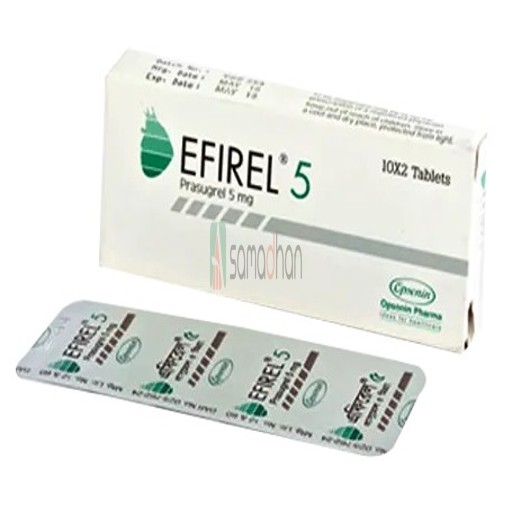
Efirel 5 mg is a Product of the Generic Prasugrel Hydrochloride
Efirel 5 mg belongs to the generic category of Prasugrel Hydrochloride. This medicine should be used according to a doctor's advice. We have provided detailed information about the uses, dosage, effectiveness, side effects, precautions, drug interactions, storage conditions, and other important details of Efirel 5 mg. Our goal is to present essential medicine information in one place for patients, caregivers, and healthcare professionals. To better understand Prasugrel Hydrochloride and ensure the safe use of this medicine, please read the information below carefully and consult a healthcare professional when necessary.
*Up to 10% Discount
(Depends on pharmacy)
Efirel 5 mg
Opsonin Pharma Ltd. · Tablet
Prasugrel Hydrochloride
/ Piece
Description of Efirel 5 mg
Efirel 5 mg may be available as a prescription or over-the-counter medicine, depending on local regulations and medical recommendations. It is used for the treatment and management of specific conditions or symptoms. The way this medicine is used may vary depending on the patient's condition and the advice of a healthcare provider. Detailed information about the approved uses, therapeutic applications, and other relevant details of Efirel 5 mg is provided below to help users gain a clear understanding of this medicine.
What Is Efirel 5 mg Indications and Uses?
Prasugrel is indicated to reduce the rate of thrombotic cardiovascular (CV) events (including stent thrombosis) in patients with acute coronary syndrome (ACS) who are to be managed with percutaneous coronary intervention (PCI) as follows:
Patients with unstable angina (UA) or non-ST-elevation myocardial infarction (NSTEMI).
Patients with ST-elevation myocardial infarction (STEMI) when managed with primary or delayed PCI.
Pharmacology (Source, Chemical and Physical Composition) Of Efirel 5 mg
Prasugrel is an thienopyridine and a prodrug which inhibits ADP receptors by irreversibly acting on the P2Y12 receptor on platelets. The active metabolite of prasugrel prevents binding of adenosine diphosphate (ADP) to its platelet receptor, impairing the ADP-mediated activation of the glycoprotein GPIIb/IIIa complex. Prasugrel is proposed to have a similar mechanism of action to clopidogrel.
Dosage And Administration of Efirel 5 mg
Adults: Prasugrel should be initiated with a single 60mg loading dose and then continued at 10 mg once a day. Patients taking Prasugrel should also take ASA daily (75 mg to 325 mg). In patients with acute coronary syndrome (ACS) who are managed with PCI, premature discontinuation of any antiplatelet agent, including Prasugrel, could result in an increased risk of thrombosis, myocardial infarction or death due to the patient’s underlying disease. A treatment of up to 12 months is recommended, unless the discontinuation of Prasugrel is clinically indicated.Patients ≥75 years old: The use of Prasugrel in patients ≥75 years of age is generally not recommended. If, after a careful individual benefit/risk evaluation by the prescribing physician, treatment is deemed necessary in the patients age group ≥75 years, then following a 60mg loading dose a reduced maintenance dose of 5 mg should be prescribed. Patients ≥75 years of age have greater sensitivity to bleeding and higher exposure to the active metabolite of prasugrel.Patients weighing <60 kg: Prasugrel should be given as a single 60mg loading dose and then continued at a 5mg once-daily dose. The 10mg maintenance dose is not recommended. This is due to an increase inexposure to the active metabolite of prasugrel, and an increased risk of bleeding in patients with body weight <60 kg when given a 10mg once-daily dose, compared with patients <60 kg.Renal impairment: No dose adjustment is necessary for patients with renal impairment, including patients with end-stage renal disease.Hepatic impairment: No dose adjustment is necessary in subjects with mild to moderate hepatic impairment (Child-Pugh class A and B). There is limited therapeutic experience in patients with mild and moderate hepatic dysfunction.Children and adolescents: Prasugrel is not recommended for use in children below age 18 due to a lack of data on safety and efficacy.
Drug Interactions of Efirel 5 mg
Warfarin: Coadministration of Prasugrel and warfarin increases the risk of bleeding. Non-Steroidal Anti-Inflammatory Drugs: Coadministration of Prasugrel and NSAIDs (used chronically) may increase the risk of bleeding. Other Concomitant Medications: Prasugrel can be administered with drugs that are inducers or inhibitors of cytochrome P450 enzymes. Prasugrel can be administered with aspirin (75mg to 325mg per day), heparin, GPIIb/IIIa inhibitors, statins, digoxin, and drugs that elevate gastric pH, including proton pump inhibitors and H2.
Side Effects of Efirel 5 mg
Common: Anaemia, Haematoma, Epistaxis, Gastrointestinal haemorrhage, Rash, Ecchymosis, Haematuria, Vessel puncture site haematoma, Puncture site haemorrhage, Contusion. Uncommon: Hypersensitivity including angioedema, Eye haemorrhage, Haemoptysis, Retroperitoneal haemorrhage, Rectal haemorrhage, Haematochezia, Gingival bleeding, Post-procedural haemorrhage. Rare: Thrombocytopaenia, Subcutaneous haematoma.
Use During Pregnancy and Lactation
There are no adequate and well-controlled studies of Prasugrel use in pregnant women. Reproductive and developmental toxicology studies in rats and rabbits at doses of up to 30 times the recommended therapeutic exposures in humans revealed no evidence of fetal harm; however, animal studies are not always predictive of a human response.It is not known whether Prasugrel is excreted in human milk. Because many drugs are excreted in human milk, Prasugrel should be used during nursing only if the potential benefit to the mother justifies the potential risk to the nursing infant.
Precautions And Warnings for Efirel 5 mg
Bleeding risk: In the phase 3 clinical trial, key exclusion criteria included an increased risk of bleeding; anaemia; thrombocytopaenia; a history of pathological intracranial findings. Patients with acute coronary syndromes undergoing PCI treated with Prasugrel and ASA showed an increased risk of major and minor bleeding according to the TIMI classification system. Therefore, the use of Prasugrel in patients at increased risk of bleeding should only be considered when the benefits in terms of prevention of ischaemic events are deemed to outweigh the risk of serious bleedings. This concern applies especially to patients:
Age ≥75 years.
With a propensity to bleed (e.g., due to recent trauma, recent surgery, recent or recurrent gastrointestinal bleeding, or active peptic ulcer disease).
With body weight <60 kg. In these patients the 10mg maintenance dose is not recommended. A 5mg maintenance dose should be used.
With concomitant administration of medicinal products that may increase the risk of bleeding, including oral anticoagulants, clopidogrel, non-steroidal anti-inflammatory drugs (NSAIDs), and fibrinolytics.
Surgery: Patients should be advised to inform physicians and dentists that they are taking prasugrel before any surgery is scheduled, and before any new medicinal product is taken. If a patient is to undergo elective surgery, and an antiplatelet effect is not desired, Prasugrel should be discontinued at least 7 days prior to surgery. Increased frequency (3-fold) and severity of bleeding may occur in patients undergoing CABG surgery within 7 days of discontinuation of prasugrel . The benefits and risks of prasugrel should be carefully considered in patients in whom the coronary anatomy has not been defined, and urgent CABG is a possibility.
Therapeutic Class
Anti-platelet drugs
Storage Conditions of It
Keep in dry place and away from light and heat. Keep out of the reach of children.
Data Source: Data source of Indications and Usages, Pharmacology, Dosage & Administration, Drug Interactions, Side Effects, Use during Pregnancy & Lactation, Precautions & Warnings, Use in Special Populations, Therapeutic Class, and Storage Conditions is the concerned medicine company or respective organization.
Alternative Medicines
⚠ Disclaimer
The information provided on All Samadhan is intended for general informational purposes only and is prepared based on our best practices. It is not a substitute for professional medical advice, diagnosis, or treatment. While we strive to keep the information accurate and up to date, we do not guarantee its completeness or accuracy. The absence of specific information or warnings about any medicine or service should not be considered as an assurance or endorsement by All Samadhan. All Samadhan shall not be held responsible for any consequences arising from the use of this information. We strongly recommend consulting a qualified healthcare professional or physician for any medical concerns, questions, or clarifications.All Samadhan is a digital healthcare software platform operated by MS Genius Experts. We provide technology solutions for pharmacies and healthcare providers; we are not a direct seller or dispenser of prescription medicines

N.B.: All Samadhan is a digital healthcare software platform operated by MS Genius Experts. We provide technology solutions for pharmacies and healthcare providers; we are not a direct seller or dispenser of prescription medicines.
Copyright © All Samadhan - Operated by M/S. Genius Experts | All Rights Reserved
DBID
Registration ID: 176322642
Trade License: TRAD/DNCC/040904/2023