
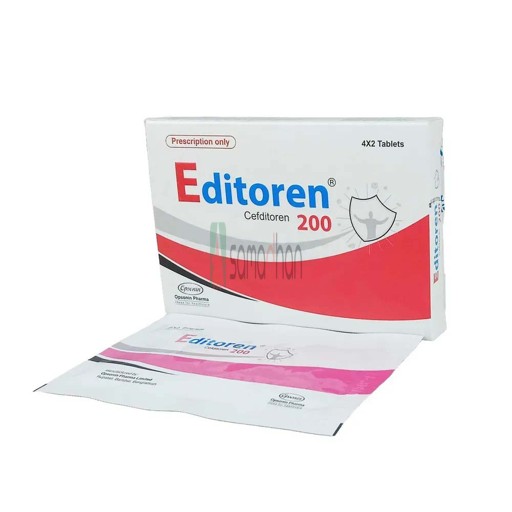
Editoren 200 mg is a Product of the Generic Cefditoren
Editoren 200 mg belongs to the generic category of Cefditoren. This medicine should be used according to a doctor's advice. We have provided detailed information about the uses, dosage, effectiveness, side effects, precautions, drug interactions, storage conditions, and other important details of Editoren 200 mg. Our goal is to present essential medicine information in one place for patients, caregivers, and healthcare professionals. To better understand Cefditoren and ensure the safe use of this medicine, please read the information below carefully and consult a healthcare professional when necessary.
*Up to 10% Discount
(Depends on pharmacy)
Editoren 200 mg
Opsonin Pharma Ltd. · Tablet
Cefditoren
/ Piece
Description of Editoren 200 mg
Editoren 200 mg may be available as a prescription or over-the-counter medicine, depending on local regulations and medical recommendations. It is used for the treatment and management of specific conditions or symptoms. The way this medicine is used may vary depending on the patient's condition and the advice of a healthcare provider. Detailed information about the approved uses, therapeutic applications, and other relevant details of Editoren 200 mg is provided below to help users gain a clear understanding of this medicine.
What Is Editoren 200 mg Indications and Uses?
Cefditoren is indicated for the treatment of mild to moderate infections in adults and adolescents (12 years of age or older) which are caused by susceptible strains of the designated microorganisms in the conditions listed below:
Acute Bacterial Exacerbation of Chronic Bronchitis
Community Acquired Pneumonia
Pharyngitis
Tonsillitis
Uncomplicated Skin and Skin-Structure Infections
Pharmacology (Source, Chemical and Physical Composition) Of Editoren 200 mg
Cefditoren is a preparation of Cefditoren Pivoxil which is a broad spectrum third generation cephalosporin antibiotic. Cefditoren is a prodrug which is hydrolyzed by esterases during absorption, and the drug is distributed in the circulating blood as active Cefditoren. Cefditoren has antibacterial activity against gram-positive and gram-negative pathogens. The bactericidal activity of Cefditoren results from the inhibition of cell wall synthesis via affinity for penicillin- binding proteins (PBPs). Cefditoren is stable in the presence of a variety of ß-lactamases, including penicillinases and some cephalosporinases.
Dosage And Administration of Editoren 200 mg
Cefditoren should be taken after meals.Community-Acquired Pneumonia: 400 mg twice daily for 14 days.Acute Exacerbation of Chronic Bronchitis: 400 mg twice daily for 10 days.Pharyngotonsillitis and Acute Sinusitis: 200 mg twice daily for 10 days.Uncomplicated Skin and Soft Structure Infections: 200 mg twice daily for 10 days.
Drug Interactions of Editoren 200 mg
Antacids and Famotidine (intravenous administration) reduced the oral absorption of Cefditoren. As with other ß-lactam antibiotics, co-administration of probenecid with Cefditoren Pivoxil resulted in an increase in the plasma exposure of Cefditoren. Multiple doses of Cefditoren had no effect on the pharmacokinetics of ethinyl estradiol, the estrogenic component in most oral contraceptives.
Side Effects of Editoren 200 mg
The most common side effects of Cefditoren are diarrhea, nausea, headache, abdominal pain, vaginal moniliasis, dyspepsia, vomiting, abnormal dreams, allergic reaction, anorexia, constipation, dizziness, dry mouth and fever.
Use During Pregnancy and Lactation
Pregnancy category B. There are no adequate and well-controlled studies in pregnant women. Cefditoren should be used during pregnancy only if clearly needed. Animal studies show that Cefditoren excreted in breast milk. Caution should be exercised when Cefditoren is administered to nursing women.
Precautions And Warnings for Editoren 200 mg
Cefditoren is not recommended when prolonged antibiotic treatment is necessary, since other pivalate-containing compounds have caused clinical manifestations of carnitine deficiency when used over a period of months. Prescribing Cefditoren in the absence of a proven or strongly suspected bacterial infection or a prophylactic indication is unlikely to provide benefit to the patient and increases the risk of the development of drug-resistant bacteria.
Use In Special Populations
Children: Use of Cefditoren is not recommended for pediatric patients less than 12 years of age. The safety and efficacy of Cefditoren tablets in this population, including any effects of altered carnitine concentration, have not been established.Geriatric: No dose adjustments are necessary in geriatric patients with normal (for their age) renal function. Patients with renal insufficiency: No dose adjustment is necessary for patients with mild renal impairment (ClCr: 50-80 mL/min/1.73 m2). It is recommended that not more than 200 mg BID be administered to patients with moderate renal impairment (ClCr: 30-49 mL/min/1.73 m2) and 200 mg QD be administered to patients with severe renal impairment (ClCr: <30 mL/min/1.73 m2 ). The appropriate dose in patients with end-stage renal disease has not been determined.Patients with hepatic disease: No dose adjustments are necessary for patients with mild or moderate hepatic impairment.
Therapeutic Class
Third generation Cephalosporins
Storage Conditions of It
Keep below 25°C temperature, away from light & moisture. Keep out of the reach of children.
Data Source: Data source of Indications and Usages, Pharmacology, Dosage & Administration, Drug Interactions, Side Effects, Use during Pregnancy & Lactation, Precautions & Warnings, Use in Special Populations, Therapeutic Class, and Storage Conditions is the concerned medicine company or respective organization.
Alternative Medicines
⚠ Disclaimer
The information provided on All Samadhan is intended for general informational purposes only and is prepared based on our best practices. It is not a substitute for professional medical advice, diagnosis, or treatment. While we strive to keep the information accurate and up to date, we do not guarantee its completeness or accuracy. The absence of specific information or warnings about any medicine or service should not be considered as an assurance or endorsement by All Samadhan. All Samadhan shall not be held responsible for any consequences arising from the use of this information. We strongly recommend consulting a qualified healthcare professional or physician for any medical concerns, questions, or clarifications.All Samadhan is a digital healthcare software platform operated by MS Genius Experts. We provide technology solutions for pharmacies and healthcare providers; we are not a direct seller or dispenser of prescription medicines

N.B.: All Samadhan is a digital healthcare software platform operated by MS Genius Experts. We provide technology solutions for pharmacies and healthcare providers; we are not a direct seller or dispenser of prescription medicines.
Copyright © All Samadhan - Operated by M/S. Genius Experts | All Rights Reserved
DBID
Registration ID: 176322642
Trade License: TRAD/DNCC/040904/2023