
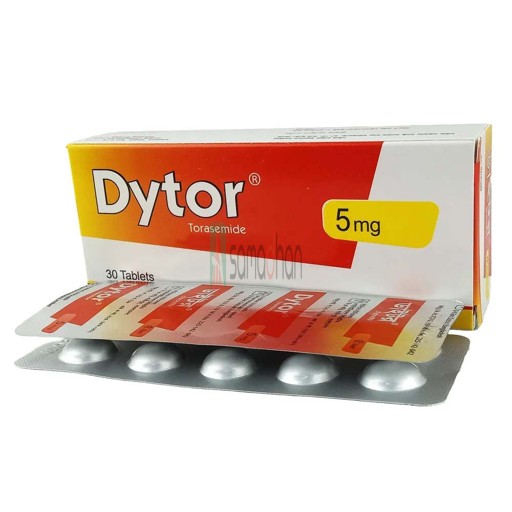
Dytor 5 mg is a Product of the Generic Torasemide
Dytor 5 mg belongs to the generic category of Torasemide. This medicine should be used according to a doctor's advice. We have provided detailed information about the uses, dosage, effectiveness, side effects, precautions, drug interactions, storage conditions, and other important details of Dytor 5 mg. Our goal is to present essential medicine information in one place for patients, caregivers, and healthcare professionals. To better understand Torasemide and ensure the safe use of this medicine, please read the information below carefully and consult a healthcare professional when necessary.
*Up to 10% Discount
(Depends on pharmacy)
Dytor 5 mg
UniMed UniHealth Pharmaceuticals Ltd. · Tablet
Torasemide
/ Piece
Description of Dytor 5 mg
Dytor 5 mg may be available as a prescription or over-the-counter medicine, depending on local regulations and medical recommendations. It is used for the treatment and management of specific conditions or symptoms. The way this medicine is used may vary depending on the patient's condition and the advice of a healthcare provider. Detailed information about the approved uses, therapeutic applications, and other relevant details of Dytor 5 mg is provided below to help users gain a clear understanding of this medicine.
What Is Dytor 5 mg Indications and Uses?
Torasemide is indicated for the management of edema of cardiac, renal and hepatic origin.The management of hypertension, as a sole therapeutic agent or in combination with other classes of antihypertensive agents.
Pharmacology (Source, Chemical and Physical Composition) Of Dytor 5 mg
Torasemide inhibits the Na+/K+/2CI- carrier system (via interference of the chloride binding site) in the lumen of the thick ascending portion of the loop of Henle, resulting in a decrease in reabsorption of sodium and chloride. This results in an increase in the rate of delivery of tubular fluid and electrolytes to the distal sites of hydrogen and potassium ion secretion, while plasma volume contraction increases aldosterone production. The increased delivery and high aldosterone levels promote sodium reabsorption at the distal tubules, and By increasing the delivery of sodium to the distal renal tubule, torasemide indirectly increases potassium excretion via the sodium-potassium exchange mechanism. Torasemide's effects in other segments of the nephron have not been demonstrated. Thus torasemide increases the urinary excretion of sodium, chloride, and water, but it does not significantly alter glomerular filtration rate, renal plasma flow, or acid-base balance. Torasemide's effects as a antihypertensive are due to its diuretic actions. By reducing extracellular and plasma fluid volume, blood pressure is reduced temporarily, and cardiac output also decreases.
Dosage And Administration of Dytor 5 mg
Congestive heart failure: The usual initial oral dose is 10 mg or 20 mg once daily. If the diuretic response is inadequate, the dose should be titrated upward by approximately doubling until the desired diuretic response is obtained. Single doses higher than 200 mg have not been adequately studied.Chronic renal failure: The usual initial oral dose is 20 mg once daily. lf the diuretic response is inadequate, the dose should be titrated upward by approximately doubling until the desired diuretic response is obtained. Single doses higher than 200mg have not been adequately studied.Hepatic cirrhosis: The usual initial oral dose is 5 mg or 10 mg once daily, administered together with an aldosterone antagonist or a potassium sparing diuretic. If the diuretic response is inadequate, the dose should be titrated upward by approximately doubling until the desired diuretic response is obtained. Single doses higher than 40 mg have not been adequately studied. Chronic use of any diuretic in hepatic disease has not been studied in adequate and well-controlled trials.Hypertension: The usual initial oral dose is 2.5-5 mg once daily. If the 5 mg dose does not provide adequate reduction of blood pressure within 4 to 6 weeks, the dose may be increased to 10 mg once daily. If the response to 10 mg is insufficient, an additional antihypertensive should be added to the treatment regimen.
Drug Interactions of Dytor 5 mg
Increased risk of severe hypokalaemia with amphotercin B, corticosteroids, carbenoxolone, hypokalaemia-causing medications. Increased risk of lithium toxicity. Increased potential for ototoxicity and nephrotoxicity with nephrotoxic or ototoxic medications e.g. aminoglycosides. High dose salicylates may increase the risk of salicylate toxicity. Increased risk of toxicity with digoxin. Reduced diuretic effect with NSAIDs. Increased risk of hypotension with antihypertensives.
Side Effects of Dytor 5 mg
Usually torasemide is well tolerated. However, a few side effects like dry mouth, dizziness, tiredness, skin rash, diarrhea, constipation, nausea, vomiting, orthostatic hypotention and muscle cramp may occur. All side effects usually are mild and transient.
Use During Pregnancy and Lactation
Pregnancy: Adequate and well controlled studies of torasemide have not been carried out in pregnant woman. Because animal reproduction studies are not always predictive of human response, torasemide can be used during pregnancy only if clearly needed.Nursing Mother: lt is not known whether torasemide is excreted in human milk. Because many drugs are excreted in human milk, caution should be exercised when torasemide is administered to a nursing mother.
Precautions And Warnings for Dytor 5 mg
Precautions should be taken while torasemide is administered in the conditions like diabetes, gout, hypotension and liver failure.
Use In Special Populations
Use in children: Safety and efficacy of torasemide in children have not been established.
Therapeutic Class
Loop diuretics
Storage Conditions of It
Store Torasemide at room temperature less than 30° C and keep in cool and dry place, away from moisture and sunlight. Keep the medicine out of the reach of children.
Data Source: Data source of Indications and Usages, Pharmacology, Dosage & Administration, Drug Interactions, Side Effects, Use during Pregnancy & Lactation, Precautions & Warnings, Use in Special Populations, Therapeutic Class, and Storage Conditions is the concerned medicine company or respective organization.
Alternative Medicines
⚠ Disclaimer
The information provided on All Samadhan is intended for general informational purposes only and is prepared based on our best practices. It is not a substitute for professional medical advice, diagnosis, or treatment. While we strive to keep the information accurate and up to date, we do not guarantee its completeness or accuracy. The absence of specific information or warnings about any medicine or service should not be considered as an assurance or endorsement by All Samadhan. All Samadhan shall not be held responsible for any consequences arising from the use of this information. We strongly recommend consulting a qualified healthcare professional or physician for any medical concerns, questions, or clarifications.All Samadhan is a digital healthcare software platform operated by MS Genius Experts. We provide technology solutions for pharmacies and healthcare providers; we are not a direct seller or dispenser of prescription medicines

N:B-All Samadhan is a digital healthcare software platform operated by MS Genius Experts. We provide technology solutions for pharmacies and healthcare providers; we are not a direct seller or dispenser of prescription medicines"
Copyright © All Samadhan - Operated by M/S. Genius Experts | All Rights Reserved
DBID
Registration ID: 176322642
Trade License: TRAD/DNCC/040904/2023