
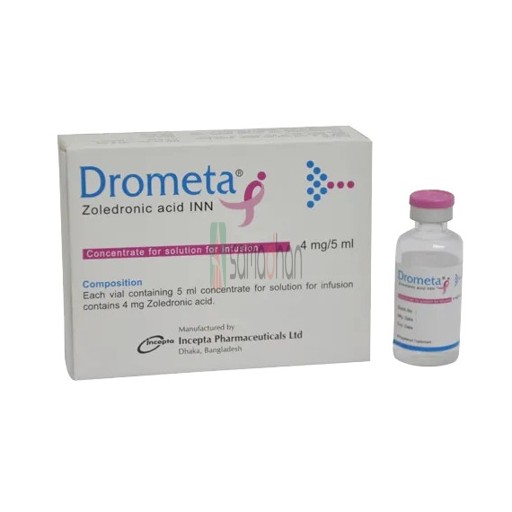
Drometa 4 mg/5 ml is a Product of the Generic Zoledronic Acid [For hypercalcemia]
Drometa 4 mg/5 ml belongs to the generic category of Zoledronic Acid [For hypercalcemia]. This medicine should be used according to a doctor's advice. We have provided detailed information about the uses, dosage, effectiveness, side effects, precautions, drug interactions, storage conditions, and other important details of Drometa 4 mg/5 ml. Our goal is to present essential medicine information in one place for patients, caregivers, and healthcare professionals. To better understand Zoledronic Acid [For hypercalcemia] and ensure the safe use of this medicine, please read the information below carefully and consult a healthcare professional when necessary.
*Up to 10% Discount
(Depends on pharmacy)
Drometa 4 mg/5 ml
Incepta Pharmaceuticals Ltd. · IV Infusion
Zoledronic Acid [For hypercalcemia]
/ 4 mg vial
Description of Drometa 4 mg/5 ml
Drometa 4 mg/5 ml may be available as a prescription or over-the-counter medicine, depending on local regulations and medical recommendations. It is used for the treatment and management of specific conditions or symptoms. The way this medicine is used may vary depending on the patient's condition and the advice of a healthcare provider. Detailed information about the approved uses, therapeutic applications, and other relevant details of Drometa 4 mg/5 ml is provided below to help users gain a clear understanding of this medicine.
What Is Drometa 4 mg/5 ml Indications and Uses?
Zoledronic Acid is indicated in:
Hypercalcaemia of malignancy,
Bone metastases associated with solid tumours, Osteolytic lesions associated with multiple myeloma,
Corticosteroid-induced osteoporosis, Increase bone mass in men with osteoporosis, Osteoporosis in postmenopausal women
Paget's disease of bone
Prophylaxis of postmenopausal osteoporosis
Pharmacology (Source, Chemical and Physical Composition) Of Drometa 4 mg/5 ml
Zoledronic acid belongs to the class of nitrogen-containing bisphosphonates and acts primarily on bone. It is an inhibitor of osteoclast-mediated bone resorption. The action of bisphosphonates on bone is based on their high affinity for mineralized bone. Intravenously administered Zoledronic acid is rapidly distributed to bone. The main molecular target of Zoledronic acid in the osteoclast is the enzyme farnesyl pyrophosphate synthase, but this does not exclude other mechanisms. Clinical studies in tumour-induced hypercalcemia demonstrated that the effect of Zoledronic acid is characterized by decreases in serum calcium and urinary calcium excretion. In addition to its inhibitory activity against bone resorption, Zoledronic acid also possesses anti-tumour activity, anti-angiogenic activity, anti-pain activity, cytostatic and pro-apoptotic activity on tumour cells and synergistic cytostatic effect with other anti-cancer drugs. There was no accumulation of the active substance in plasma after multiple doses given every 28 days. Zoledronic acid is not metabolized and is excreted unchanged via the kidney.
Dosage And Administration of Drometa 4 mg/5 ml
Hypercalcemia of malignancy: The maximum recommended dose of Zoledronic Acid in hypercalcemia of malignancy (serum calcium 12 mg/dl or 3.0 mmol/l) is 4 mg. The 4 mg dose must be given as a single-dose intravenous infusion. Dose adjustment of Zoledronic Acid is not necessary in treating patients for hypercalcemia of malignancy presenting with mild-to-moderate renal impairment. Re-treatment with Zoledronic Acid may be considered if serum calcium does not return to normal after initial treatment. It is recommended that a minimum of 7 days elapse before re-treatment, to allow for full response to the initial dose. Multiple myeloma and bone metastases of solid tumors: The recommended dose of Zoledronic Acid in patients with multiple myeloma and metastatic bone lesions from solid tumors is 4 mg infused every 3-4 weeks. Patients should also be administered an oral calcium supplement of 500 mg and 400 IU of Vitamin-D daily.
Drug Interactions of Drometa 4 mg/5 ml
In clinical studies, Zoledronic acid has been administered concomitantly with commonly used anticancer agents, diuretics, antibiotics and analgesics without interactions. Caution is advised when Zoledronic acid are administered with aminoglycosides, since these agents may have an additive effect to lower serum calcium level for prolonged periods. In multiple myeloma patients, the risk of renal dysfunction may be increased when Zoledronic acid is used in combination with thalidomide. Concomitant use of loop diuretics with Zoledronic acid increases the risk of hypocalcemia. Caution is indicated when Zoledronic acid is used with other potentially nephrotoxic drugs.
Side Effects of Drometa 4 mg/5 ml
The post-dose side-effects are headache, nausea, anorexia, fatigue, osteonecrosis of jaw, anemia, bone pain, constipation, fever, vomiting, flu-like syndrome, hypocalcemia, myalgia, arthralgia and hypophosphataemia.
Use During Pregnancy and Lactation
Zoledronic acid is contraindicated during pregnancy and in breast-feeding women. It is also not recommended for use in children and adolescents below 18 years of age.
Precautions And Warnings for Drometa 4 mg/5 ml
Patients must be appropriately hydrated prior to administration of Zoledronic Acid. This is especially important in the elderly and for patients receiving diuretic therapy. Adequate hydration can be achieved by the patient drinking two glasses of fluid (such as water) before and after the infusion. Serum levels of calcium, phosphate, magnesium and potassium, as well as serum creatinine should be carefully monitored after initiating Zoledronic Acid therapy. If hypocalcemia, hypophosphatemia or hypomagnesemia occurs, short-term supplemental therapy may be necessary. Moreover, careful renal function monitoring should be considered.
Use In Special Populations
Patients with renal impairment: The use of Zoledronic Acid is not recommended in patients with severe renal impairment (Creatinine clearance <30 ml/min). No dose adjustment is necessary in patients with creatinine clearance >60 ml/min. Based on creatinine clearance the following dose should be used in patient with impaired renal function:
CrCl > 60 ml/min: 4 mg (5 ml)
CrCl 50-60 ml/min: 3.5 mg (4.4 ml)
CrCl 40-49 ml/min: 3.3 mg (4.1 ml)
CrCl 30-39 ml/min: 3 mg (3.8 ml)
Therapeutic Class
Bisphosphonate preparations
Storage Conditions of It
Store below 30° C prior to opening. Protect from moisture and light. Zoledronic Acid must be kept out of the reach and sight of children.
Data Source: Data source of Indications and Usages, Pharmacology, Dosage & Administration, Drug Interactions, Side Effects, Use during Pregnancy & Lactation, Precautions & Warnings, Use in Special Populations, Therapeutic Class, and Storage Conditions is the concerned medicine company or respective organization.
Alternative Medicines
⚠ Disclaimer
The information provided on All Samadhan is intended for general informational purposes only and is prepared based on our best practices. It is not a substitute for professional medical advice, diagnosis, or treatment. While we strive to keep the information accurate and up to date, we do not guarantee its completeness or accuracy. The absence of specific information or warnings about any medicine or service should not be considered as an assurance or endorsement by All Samadhan. All Samadhan shall not be held responsible for any consequences arising from the use of this information. We strongly recommend consulting a qualified healthcare professional or physician for any medical concerns, questions, or clarifications.All Samadhan is a digital healthcare software platform operated by MS Genius Experts. We provide technology solutions for pharmacies and healthcare providers; we are not a direct seller or dispenser of prescription medicines

N.B.: All Samadhan is a digital healthcare software platform operated by MS Genius Experts. We provide technology solutions for pharmacies and healthcare providers; we are not a direct seller or dispenser of prescription medicines.
Copyright © All Samadhan - Operated by M/S. Genius Experts | All Rights Reserved
DBID
Registration ID: 176322642
Trade License: TRAD/DNCC/040904/2023