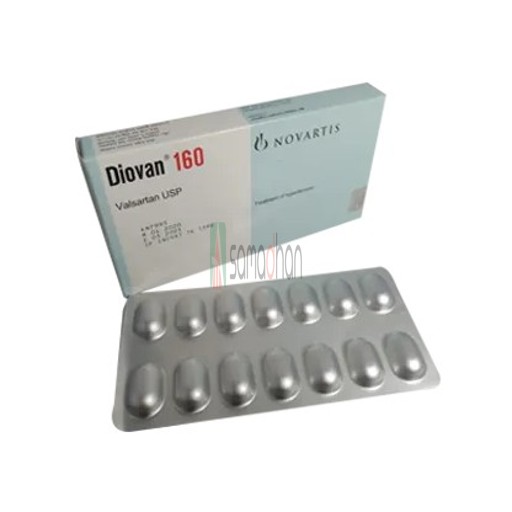
Diovan 160 mg is a Product of the Generic Valsartan
Diovan 160 mg belongs to the generic category of Valsartan. This medicine should be used according to a doctor's advice. We have provided detailed information about the uses, dosage, effectiveness, side effects, precautions, drug interactions, storage conditions, and other important details of Diovan 160 mg. Our goal is to present essential medicine information in one place for patients, caregivers, and healthcare professionals. To better understand Valsartan and ensure the safe use of this medicine, please read the information below carefully and consult a healthcare professional when necessary.
*Up to 10% Discount
(Depends on pharmacy)
Diovan 160 mg
Nevian Lifescience PLC · Tablet
Valsartan
/ Piece
Description of Diovan 160 mg
Diovan 160 mg may be available as a prescription or over-the-counter medicine, depending on local regulations and medical recommendations. It is used for the treatment and management of specific conditions or symptoms. The way this medicine is used may vary depending on the patient's condition and the advice of a healthcare provider. Detailed information about the approved uses, therapeutic applications, and other relevant details of Diovan 160 mg is provided below to help users gain a clear understanding of this medicine.
What Is Diovan 160 mg Indications and Uses?
Valsartan is indicated:
For hypertension
To reduce hospitalizations in patients with congestive heart failure
To reduce death in patients who developed congestive heart failure after myocardial infarction.
Pharmacology (Source, Chemical and Physical Composition) Of Diovan 160 mg
Valsartan is an oral medication that belongs to a class of drugs called angiotensin receptor blockers (ARBs). It is orally active and specific angiotensin II antagonist acting on the AT1 subtype. Angiotensin's attachment to the receptors cause the blood vessels to narrow (vasoconstrict) which leads to an increase in blood pressure (hypertension). Valsartan blocks the angiotensin II receptor. By blocking the action of angiotensin, Valsartan dilates blood vessels and reduces blood pressure without affecting pulse rate. Valsartan has much greater affinity (about 20,000-fold) for the AT1 receptor than for the AT2 receptor. It does not bind or block other hormone receptors or ion channels known to be important in cardiovascular regulation.
Dosage And Administration of Diovan 160 mg
Hypertension: The usual dose of Valsartan is 80 to 160 mg once daily. The maximum dose is 320 mg daily. Maximum blood pressure reduction occurs within 4 weeks. Heart failure: The usual dose is 40 mg twice daily and may be increased to 80-160 mg twice daily. Post-Myocardial Infarction: The initial dose after myocardial infarction is 20 mg twice daily. The dose should be increased with a target of 160 mg daily if tolerated without side effects.
Drug Interactions of Diovan 160 mg
No drug interactions of clinical significance have been found. Compounds which have been studied in clinical trials include Cimetidine, Warfarin, Furosemide, Digoxin, Atenolol, Indomethacin, Hydrochlorothiazide, Amlodipine and GlibenclamideAs Valsartan is not metabolized to a significant extent, clinically relevant drug-drug interactions in the form of metabolic induction or inhibition of the cytochrome P450 system are not expected with Valsartan. Although valsartan is highly bound to plasma proteins, in vitrostudies have not shown any interaction at this level with a range of molecules which are also highly protein bound, such as Diclofenac, Furosemide, and Warfarin. Concomitant use of potassium sparing diuretics (e.g., Spironolactone, Triamterene, Amiloride) potassium supplements, or salt substitutes containing potassium may lead to increase in serum potassium. If co medication is considered necessary, caution is advisable
Side Effects of Diovan 160 mg
Valsartan is generally well tolerated and side effects are rare. The most common side effects include headache, dizziness, fatigue, abdominal pain, cough, diarrhea and nausea. Patient may also experience hyperkalemia, impotency, reduced renal function, allergic reactions, dyspnea, constipation, back pain, muscle cramps, rash, anxiety, insomnia and vertigo. Hypotension may also occur if patient have been taking diuretics along with Valsartan.
Use During Pregnancy and Lactation
Pregnancy: Valsartan should not be used in pregnancy, as in 2nd and 3rd trimester it can cause injury and even death to fetus. When pregnancy is detected, Valsartan should be stopped as soon as possible.Nursing mothers: It is not known whether Valsartan is excreted in human milk. Because of the potential for adverse effects on the nursing infant, a decision should be made whether to discontinue nursing or discontinue the drug, taking into account the importance of the drug to the mother.
Precautions And Warnings for Diovan 160 mg
Impaired Hepatic Function: As the majority of Valsartan is eliminated in the bile, care should be exercised in patients with mild to moderate hepatic impairment including biliary obstructive disorder.Impaired Renal Function: Dosage reduction or discontinuation may be required with patients having pre-existing renal impairment.Heart Failure and Myocardial Infarction: Caution should be exercised when initiating therapy in patients with heart failure and post-myocardial infarction patients.
Use In Special Populations
Pediatric use: Safety and effectiveness in paediatric patients have not been established.Geriatric use: No overall difference in the efficacy or safety of Valsartan was observed in this patient population, but greater sensitivity of some elderly persons cannot be ruled out.Hepatic Impairment:
Mild to moderate: Max: 80 mg once daily.
Severe: Contraindicated.
Therapeutic Class
Angiotensin-ll receptor blocker
Storage Conditions of It
Store between 15-30° C. Protect from moisture and heat.
Data Source: Data source of Indications and Usages, Pharmacology, Dosage & Administration, Drug Interactions, Side Effects, Use during Pregnancy & Lactation, Precautions & Warnings, Use in Special Populations, Therapeutic Class, and Storage Conditions is the concerned medicine company or respective organization.
Alternative Medicines
⚠ Disclaimer
The information provided on All Samadhan is intended for general informational purposes only and is prepared based on our best practices. It is not a substitute for professional medical advice, diagnosis, or treatment. While we strive to keep the information accurate and up to date, we do not guarantee its completeness or accuracy. The absence of specific information or warnings about any medicine or service should not be considered as an assurance or endorsement by All Samadhan. All Samadhan shall not be held responsible for any consequences arising from the use of this information. We strongly recommend consulting a qualified healthcare professional or physician for any medical concerns, questions, or clarifications.All Samadhan is a digital healthcare software platform operated by MS Genius Experts. We provide technology solutions for pharmacies and healthcare providers; we are not a direct seller or dispenser of prescription medicines

N.B.: All Samadhan is a digital healthcare software platform operated by MS Genius Experts. We provide technology solutions for pharmacies and healthcare providers; we are not a direct seller or dispenser of prescription medicines.
Copyright © All Samadhan - Operated by M/S. Genius Experts | All Rights Reserved
DBID
Registration ID: 176322642
Trade License: TRAD/DNCC/040904/2023