
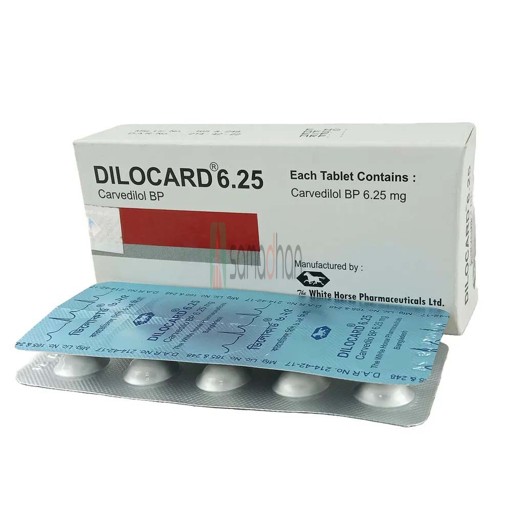
Dilocard 6.25 mg is a Product of the Generic Carvedilol
Dilocard 6.25 mg belongs to the generic category of Carvedilol. This medicine should be used according to a doctor's advice. We have provided detailed information about the uses, dosage, effectiveness, side effects, precautions, drug interactions, storage conditions, and other important details of Dilocard 6.25 mg. Our goal is to present essential medicine information in one place for patients, caregivers, and healthcare professionals. To better understand Carvedilol and ensure the safe use of this medicine, please read the information below carefully and consult a healthcare professional when necessary.
*Up to 10% Discount
(Depends on pharmacy)
Dilocard 6.25 mg
The White Horse Pharmaceuticals Ltd. · Tablet
Carvedilol
/ Piece
Description of Dilocard 6.25 mg
Dilocard 6.25 mg may be available as a prescription or over-the-counter medicine, depending on local regulations and medical recommendations. It is used for the treatment and management of specific conditions or symptoms. The way this medicine is used may vary depending on the patient's condition and the advice of a healthcare provider. Detailed information about the approved uses, therapeutic applications, and other relevant details of Dilocard 6.25 mg is provided below to help users gain a clear understanding of this medicine.
What Is Dilocard 6.25 mg Indications and Uses?
Carvedilol is indicated for the treatment of mild, moderate or severe heart failure of ischemic or cardiomyopathic origin, in conjunction with digitalis, diuretics and ACE inhibitor, to reduce the progression of disease as evidenced by cardiovascular death, cardiovascular hospitalization, or the need ... Read moreCarvedilol is indicated for the treatment of mild, moderate or severe heart failure of ischemic or cardiomyopathic origin, in conjunction with digitalis, diuretics and ACE inhibitor, to reduce the progression of disease as evidenced by cardiovascular death, cardiovascular hospitalization, or the need to adjust other heart failure medications. Carvedilol may be used in patients unable to tolerate an ACE inhibitor. Carvedilol may be used in patients who are not receiving digitalis, hydralazine or nitrate therapy.
Pharmacology (Source, Chemical and Physical Composition) Of Dilocard 6.25 mg
Carvedilol is a cardiovascular drug whose main pharmacological action is non-selective antagonism of β-adrenergic receptors but which also possesses appreciable a-adrenergic antagonistic activity. It also has antiproliferative properties and is a scavenger of reactive free oxidant radicals. It is used in the treatment of hypertension, angina pectoris and congestive heart failure.
Dosage And Administration of Dilocard 6.25 mg
In hypertension: initially, 12.5 mg once daily, increased after 2 days to the usual dose of 25 mg once daily; if necessary the dose may be further increased at intervals of at least 2 weeks to maximum 50 mg daily in single or divided doses. In elderly patients, the initial dose of 12.5 mg daily may provide satisfactory control.In angina pectoris: the recommended dose for initiation of therapy is 12.5 mg twice daily for the first 2 days. Thereafter, the recommended dosage is 25 mg twice daily. For elderly patients, the maximum daily dose is 50 mg daily in divided doses.In heart failure: initially, 3.125 mg twice daily (with food) may be given, the dose may be increased at intervals of at least 2 weeks to 6.25 mg twice daily, then to 12.5 mg twice daily, then to 25 mg twice daily. The dose may be increased to the highest dose tolerated, maximum 25 mg twice daily in patients less than 85 kg body-weight and 50 mg twice daily in patients over 85 kg.
Drug Interactions of Dilocard 6.25 mg
Digoxin: In normal healthy volunteers a single dose of carvedilol taken together with a single dose of digoxin resulted in significantly increased levels of digoxin 24 hours later. Patients with congestive heart failure stabilized on digoxin have been given carvedilol concomitantly without any adverse effects. Increased monitoring of digoxin is recommended when initiating, adjusting, or discontinuing the dose of carvedilol.Rifampin: Pretreatment with rifampin resulted in a 60% decrease in Cmax and AUC.Warfarin: Carvedilol did not alter the in vitro plasma protein binding of warfarin.Clonidine: β-receptor antagonists potentiate the pressor reaction which may follow the sudden withdrawal of treatment with clonidine although, in theory, the a-blocking action of carvedilol should modify the pressure rise.
Side Effects of Dilocard 6.25 mg
Postural hypotension, dizziness, headache, fatigue, gastro-intestinal disturbances, bradycardia; occasionally diminished peripheral circulation, peripheral oedema and painful extremities, dry mouth, dry eyes, eye irritation or disturbed vision, impotence, disturbances of micturition, influenza-like symptoms, rarely angina, AV block, exacerbation of intermittent claudication or Raynaud's phenomenon, allergic skin reactions, exacerbation of psoriasis, nasal stuffiness, wheezing, depressed mood, sleep disturbances, paresthesia, heart failure, changes in liver enzymes, thrombocytopenia, leukopenia are also reported.
Use During Pregnancy and Lactation
Carvedilol should not be used during breast-feeding, since no studies have been performed in lactating women and animal studies have shown that carvedilol is excreted in breast milk. Safety and efficacy in children have not been established with carvedilol. Carvedilol should not be used during pregnancy as no studies have been performed in this group. Animal studies have shown that carvedilol crosses the placental barrier. No information is available on the safety and efficacy of Carvedilol use in neonates.
Precautions And Warnings for Dilocard 6.25 mg
Take caution in hepatic impairment and in heart failure monitor clinical status for 2-3 hours after initiation and after increasing each dose. Before increasing dose ensure that the renal function and heart failure are not deteriorating
Therapeutic Class
Alpha adrenoceptor blocking drugs, Beta-adrenoceptor blocking drugs, Beta-blockers
Storage Conditions of It
Keep below 30°C temperature, away from light & moisture. Keep out of the reach of children.
Data Source: Data source of Indications and Usages, Pharmacology, Dosage & Administration, Drug Interactions, Side Effects, Use during Pregnancy & Lactation, Precautions & Warnings, Use in Special Populations, Therapeutic Class, and Storage Conditions is the concerned medicine company or respective organization.
Alternative Medicines
⚠ Disclaimer
The information provided on All Samadhan is intended for general informational purposes only and is prepared based on our best practices. It is not a substitute for professional medical advice, diagnosis, or treatment. While we strive to keep the information accurate and up to date, we do not guarantee its completeness or accuracy. The absence of specific information or warnings about any medicine or service should not be considered as an assurance or endorsement by All Samadhan. All Samadhan shall not be held responsible for any consequences arising from the use of this information. We strongly recommend consulting a qualified healthcare professional or physician for any medical concerns, questions, or clarifications.All Samadhan is a digital healthcare software platform operated by MS Genius Experts. We provide technology solutions for pharmacies and healthcare providers; we are not a direct seller or dispenser of prescription medicines

N.B.: All Samadhan is a digital healthcare software platform operated by MS Genius Experts. We provide technology solutions for pharmacies and healthcare providers; we are not a direct seller or dispenser of prescription medicines.
Copyright © All Samadhan - Operated by M/S. Genius Experts | All Rights Reserved
DBID
Registration ID: 176322642
Trade License: TRAD/DNCC/040904/2023