
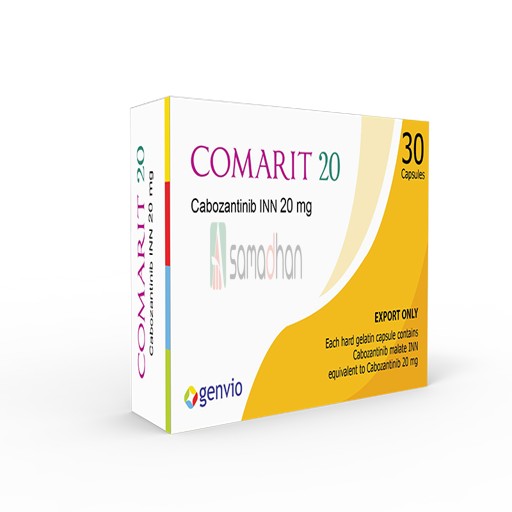
Comarit 20 mg is a Product of the Generic Cabozantinib
Comarit 20 mg belongs to the generic category of Cabozantinib. This medicine should be used according to a doctor's advice. We have provided detailed information about the uses, dosage, effectiveness, side effects, precautions, drug interactions, storage conditions, and other important details of Comarit 20 mg. Our goal is to present essential medicine information in one place for patients, caregivers, and healthcare professionals. To better understand Cabozantinib and ensure the safe use of this medicine, please read the information below carefully and consult a healthcare professional when necessary.
*Up to 10% Discount
(Depends on pharmacy)
Comarit 20 mg
Genvio Pharma Ltd. · Capsule
Cabozantinib
/ Piece
Description of Comarit 20 mg
Comarit 20 mg may be available as a prescription or over-the-counter medicine, depending on local regulations and medical recommendations. It is used for the treatment and management of specific conditions or symptoms. The way this medicine is used may vary depending on the patient's condition and the advice of a healthcare provider. Detailed information about the approved uses, therapeutic applications, and other relevant details of Comarit 20 mg is provided below to help users gain a clear understanding of this medicine.
What Is Comarit 20 mg Indications and Uses?
Renal Cell Carcinoma: Cabozantinib is indicated for the treatment of patients with advanced renal cell carcinoma (RCC).Hepatocellular Carcinoma: Cabozantinib is indicated for the treatment of patients with hepatocellular carcinoma (HCC) who have been previously treated with Sorafenib.
Pharmacology (Source, Chemical and Physical Composition) Of Comarit 20 mg
In vitro biochemical and/or cellular assays have shown that Cabozantinib inhibits the tyrosine kinase activity of MET, VEGFR-1, -2 and -3, AXL, RET, ROS1, TYRO3, MER, KIT, TRKB, FLT-3, and TIE-2. These receptor tyrosine kinases are involved in both normal cellular function and pathologic processes such as oncogenesis, metastasis, tumor angiogenesis, drug resistance, and maintenance of the tumor microenvironment.Absorption: Median time to peak cabozantinib concentrations (Tmax) ranged from 3 to 4 hours post-dose. A 19% increase in the Cmax of Cabozantinib compared to a Cabozantinib capsule formulation was observed following a single 140 mg dose. A less than 10% difference in the AUC was observed between Cabozantinib and a Cabozantinib capsule formulation.Distribution: The oral volume of distribution (Vz/F) of Cabozantinib is approximately 319 L. Cabozantinib is highly protein-bound in human plasma (≥99.7%).Elimination: The predicted terminal half-life is approximately 99 hours and the clearance (CL/F) at steady state is estimated to be 2.2 L/hr.Metabolism: Cabozantinib is a substrate of CYP3A4 in vitro.Excretion: Approximately 81% of the total administered radioactivity was recovered within a 48-day collection period following a single dose of radiolabeled 14 C- Cabozantinib in healthy subjects. Approximately 54% was recovered in feces and 27% in urine. Unchanged Cabozantinib accounted for 43% of the total radioactivity in feces and was not detectable in urine following a 72-hour collection.
Dosage And Administration of Comarit 20 mg
Recommended Dosage for Renal Cell Carcinoma: The recommended dosage of Cabozantinib is 60 mg once daily without food until the patient no longer experiences clinical benefit or experiences unacceptable toxicity.Recommended Dosage for Hepatocellular Carcinoma: The recommended dosage of Cabozantinib is 60 mg once daily without food until disease progression or unacceptable toxicity. Or, as directed by the registered physicians.
Stop treatment with Cabozantinib at least 28 days prior to scheduled surgery, including dental surgery.
Do not substitute Cabozantinib tablets with Cabozantinib capsules.
Do not administer Cabozantinib with food. Administer at least 1 hour before or at least 2 hours after eating.
Swallow Cabozantinib tablets whole. Do not crush Cabozantinib tablets.
Do not take a missed dose within 12 hours of the next dose.
Modify the dose for certain patients with hepatic impairment and for patients taking drugs known to strongly induce or inhibit CYP450.
Pediatric Use: The safety and effectiveness of Cabozantinib in pediatric patients have not been established.
Drug Interactions of Comarit 20 mg
Strong CYP3A4 Inhibitors: Coadministration of a Cabozantinib capsule formulation with a strong CYP3A4 inhibitor increased the exposure of Cabozantinib, which may increase the risk of exposure-related adverse reactions. Avoid coadministration of Cabozantinib with strong CYP3A4 inhibitors. Reduce the dosage of Cabozantinib if coadministration with strong CYP3A4 inhibitors cannot be avoided. Avoid grapefruit or grapefruit juice which may also increase exposure of Cabozantinib.Strong CYP3A Inducers: Coadministration of a Cabozantinib capsule formulation with a strong CYP3A4 inducer decreased the exposure of Cabozantinib, which may reduce efficacy. Avoid coadministration of Cabozantinib with strong CYP3A4 inducers. Increase the dosage of Cabozantinib if coadministration with strong CYP3A4 inducers cannot be avoided. Avoid St. John's Wort which may also decrease exposure of Cabozantinib.
Side Effects of Comarit 20 mg
Hemorrhage
Perforations and Fistulas
Thrombotic Events
Hypertension and Hypertensive Crisis
Diarrhea
Palmar-plantar Erythrodysesthesia
Proteinuria
Osteonecrosis of the Jaw
Wound Complications
Reversible Posterior Leukoencephalopathy Syndrome
Use During Pregnancy and Lactation
Pregnancy: Cabozantinib can cause fetal harm when administered to a pregnant woman. There are no available data in pregnant women to inform the drug-associated risk. Lactation: There is no information regarding the presence of Cabozantinib or its metabolites in human milk, or their effects on the breastfed child or milk production. Because of the potential for serious adverse reactions in breastfed children, women should be advised not to breastfeed during treatment with Cabozantinib and for 4 months after the final dose.Contraception: Cabozantinib can cause fetal harm when administered to a pregnant woman.Females: Females of reproductive potential should be advised to use effective contraception during treatment with Cabozantinib and for 4 months after the final dose.Infertility: Females and Males: Based on findings in animals, Cabozantinib may impair fertility in females and males of reproductive potential.
Precautions And Warnings for Comarit 20 mg
Hemorrhage: Severe and fatal hemorrhages occurred with Cabozantinib. Discontinue Cabozantinib for Grade 3 or 4 hemorrhage. Do not administer Cabozantinib to patients who have a recent history of hemorrhage, including hemoptysis, hematemesis, or melena.Perforations and Fistulas: Fistulas, including fatal cases, occurred in 1% of Cabozantinib-treated patients. Gastrointestinal (GI) perforations, including fatal cases, occurred in 1% of Cabozantinib-treated patients. Monitor patients for signs and symptoms of fistulas and perforations, including abscess and sepsis. Discontinue Cabozantinib in patients who experience a fistula that cannot be appropriately managed or a GI perforation.Thrombotic Events: Cabozantinib increased the risk of thrombotic events. Venous thromboembolism occurred in 7% (including 4% pulmonary embolism) and arterial thromboembolism occurred in 2% of Cabozantinib-treated patients. Fatal thrombotic events occurred in Cabozantinib-treated patients. Discontinue Cabozantinib in patients who develop an acute myocardial infarction or serious arterial or venous thromboembolic events that require medical intervention.Hypertension and Hypertensive Crisis: Cabozantinib can cause hypertension, including hypertensive crisis. Do not initiate Cabozantinib in patients with uncontrolled hypertension. Monitor blood pressure regularly during Cabozantinib treatment. Withhold Cabozantinib for hypertension that is not adequately controlled with medical management; when controlled, resume Cabozantinib at a reduced dose. Discontinue Cabozantinib for severe hypertension that cannot be controlled with anti-hypertensive therapy or for hypertensive crisis.Diarrhea: Diarrhea occurred in 63% of patients treated with Cabozantinib. Withhold Cabozantinib until improvement to Grade 1 and resume Cabozantinib at a reduced dose for intolerable Grade 2 diarrhea, Grade 3 diarrhea that cannot be managed with standard antidiarrheal treatments, or Grade 4 diarrhea.Palmar-Plantar Erythrodysesthesia: Palmar-plantar erythrodysesthesia (PPE) occurred in 44% of patients treated with Cabozantinib. Withhold Cabozantinib until improvement to Grade 1 and resume Cabozantinib at a reduced dose for intolerable Grade 2 PPE or Grade 3 PPE.Proteinuria: Proteinuria was observed in 7% of patients receiving Cabozantinib. Monitor urine protein regularly during Cabozantinib treatment. Discontinue Cabozantinib in patients who develop nephrotic syndrome.Osteonecrosis of the Jaw: Osteonecrosis of the jaw (ONJ) occurred in <1% of patients treated with Cabozantinib. ONJ can manifest as jaw pain, osteomyelitis, osteitis, bone erosion, tooth or periodontal infection, toothache, gingival ulceration or erosion, persistent jaw pain or slow healing of the mouth or jaw after dental surgery. Perform an oral examination prior to initiation of Cabozantinib and periodically during Cabozantinib. Advise patients regarding good oral hygiene practices. Withhold Cabozantinib for at least 28 days prior to scheduled dental surgery or invasive dental procedures, if possible. Withhold Cabozantinib for development of ONJ until complete resolution.Wound Complications: Wound complications have been reported with Cabozantinib. Stop Cabozantinib at least 28 days prior to scheduled surgery. Resume Cabozantinib after surgery based on clinical judgment of adequate wound healing. Withhold Cabozantinib in patients with dehiscence or wound healing complications requiring medical intervention. Reversible Posterior Leukoencephalopathy Syndrome: Reversible Posterior Leukoencephalopathy Syndrome (RPLS), a syndrome of subcortical vasogenic edema diagnosed by characteristic finding on MRI, can occur with Cabozantinib. Perform an evaluation for RPLS in any patient presenting with seizures, headache, visual disturbances, confusion or altered mental function. Discontinue Cabozantinib in patients who develop RPLS.Embryo-Fetal Toxicity: Based on data from animal studies and its mechanism of action, Cabozantinib can cause fetal harm when administered to a pregnant woman. Advise pregnant women of the potential risk to a fetus. Advise females of reproductive potential to use effective contraception during treatment with Cabozantinib and for 4 months after the last dose.
Therapeutic Class
Tyrosine Kinase Inhibitor
Storage Conditions of It
Store below 30°C in a cool and dry place, away from sunlight. Keep out of reach of children.
Data Source: Data source of Indications and Usages, Pharmacology, Dosage & Administration, Drug Interactions, Side Effects, Use during Pregnancy & Lactation, Precautions & Warnings, Use in Special Populations, Therapeutic Class, and Storage Conditions is the concerned medicine company or respective organization.
Alternative Medicines
⚠ Disclaimer
The information provided on All Samadhan is intended for general informational purposes only and is prepared based on our best practices. It is not a substitute for professional medical advice, diagnosis, or treatment. While we strive to keep the information accurate and up to date, we do not guarantee its completeness or accuracy. The absence of specific information or warnings about any medicine or service should not be considered as an assurance or endorsement by All Samadhan. All Samadhan shall not be held responsible for any consequences arising from the use of this information. We strongly recommend consulting a qualified healthcare professional or physician for any medical concerns, questions, or clarifications.All Samadhan is a digital healthcare software platform operated by MS Genius Experts. We provide technology solutions for pharmacies and healthcare providers; we are not a direct seller or dispenser of prescription medicines

N.B.: All Samadhan is a digital healthcare software platform operated by MS Genius Experts. We provide technology solutions for pharmacies and healthcare providers; we are not a direct seller or dispenser of prescription medicines.
Copyright © All Samadhan - Operated by M/S. Genius Experts | All Rights Reserved
DBID
Registration ID: 176322642
Trade License: TRAD/DNCC/040904/2023