
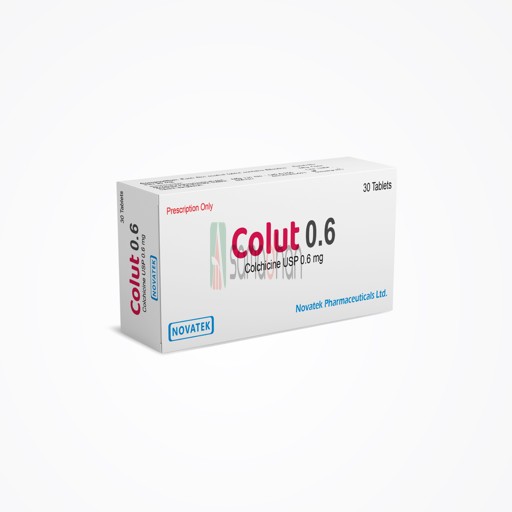
Colut 0.6 mg is a Product of the Generic Colchicine
Colut 0.6 mg belongs to the generic category of Colchicine. This medicine should be used according to a doctor's advice. We have provided detailed information about the uses, dosage, effectiveness, side effects, precautions, drug interactions, storage conditions, and other important details of Colut 0.6 mg. Our goal is to present essential medicine information in one place for patients, caregivers, and healthcare professionals. To better understand Colchicine and ensure the safe use of this medicine, please read the information below carefully and consult a healthcare professional when necessary.
*Up to 10% Discount
(Depends on pharmacy)
Colut 0.6 mg
Novatek Pharmaceuticals Ltd. · Tablet
Colchicine
/ Piece
Description of Colut 0.6 mg
Colut 0.6 mg may be available as a prescription or over-the-counter medicine, depending on local regulations and medical recommendations. It is used for the treatment and management of specific conditions or symptoms. The way this medicine is used may vary depending on the patient's condition and the advice of a healthcare provider. Detailed information about the approved uses, therapeutic applications, and other relevant details of Colut 0.6 mg is provided below to help users gain a clear understanding of this medicine.
What Is Colut 0.6 mg Indications and Uses?
Colchicine are indicated for treatment of acute gout flares. And also indicated in Familial Mediterranean fever (FMF) in adults and children 4 years or older.
Pharmacology (Source, Chemical and Physical Composition) Of Colut 0.6 mg
An acute attack of gout apparently occurs as a result of an inflammatory reaction to crystals of monosodium urate that are deposited in the joint tissue from hyperuric body fluids; the reaction is aggravated as more urate crystals accumulate. Leukocytes migrate to the sites where urate crystals have been deposited and try to engulf the crystals by phagocytosis. As a result lactic acid and proinflammatory enzymes are released which cause inflammation with severe pain, redness, and swelling of the affected joint. Lactic acid favors a local decrease in pH that enhances uric acid deposition. Colchicine inhibits the phagocytosis of uric acid by leukocytes & also diminishes the lactic acid production directly. Thus interrupts the cycle of urate crystal deposition and inflammatory response that sustains the acute attack of gout. Colchicine is absorbed when given orally, reaching a mean Cmax of 2.5 ng/mL (range 1.1 to 4.4 ng/mL) in 1 to 2 hours after a single dose administered under fasting conditions. The mean apparent volume of distribution is approximately 5 to 8 L/kg. Colchicine binding to serum protein is low (39 ± 5%), primarily to albumin regardless of concentration. CYP3A4 is involved in the metabolism of Colchicine to 2-O-demethylcolchicine and 3-O-demethylcolchicine. Plasma levels of these metabolites are minimal (less than 5% of parent drug). Following multiple oral doses (0.6 mg twice daily), the mean elimination half-life is 26.6 to 31.2 hours.
Dosage And Administration of Colut 0.6 mg
Acute gouty arthritis:
First dose- 1 to 1.2 mg (two 0.5 mg or two 0.6 mg tablets) at a time every 2 hours until pain and inflammation aborted.
The total amount of colchicine needed to control pain and inflammation during an attack usually ranges from 4 to 8 mg.
Articular pain and swelling typically reduced within 12 hours and are usually gone in 24 to 48 hours, An interval of three days between colchicine courses is advised in order to minimize the possibility of cumulative toxicity.
For prophylaxis during intercritical periods:
To reduce the frequency of their severity, colchicine may be administered continuously.
In patients who have less than one attack per year, the usual dose is 0.5 or 0.6 mg per day, three or four days a week.
For cases involving more than one attack per year, the usual dose is 0.5 or 0.6 mg daily.
Severe cases may require two or three 0.5 mg or 0.6 mg tablets daily.
For prophylaxis against attacks of gout in patients undergoing surgery:
In patients with gout, an attack may be precipitated by even a minor surgical procedure. One 0.5 mg tablet or one 0.6 mg tablet three times daily should be administered for three days before and three days after surgery.
Drug Interactions of Colut 0.6 mg
Co-administration of P-gp and/or CYP3A4 inhibitors (e.g., clarithromycin or cyclosporine) have been demonstrated to alter the concentration of Colchicine
Side Effects of Colut 0.6 mg
Blood dyscrasias: Myelosuppression, leukopenia, granulocytopenia, thrombocytopenia, and aplastic anemia have been reported. Diarrhea and pharyngolaryngeal pain may occur.
Use During Pregnancy and Lactation
Pregnancy Category C. There are no adequate and well-controlled studies with Colchicine in pregnant women. Colchicine is excreted into human milk. Caution should be exercised when administered to a nursing woman.
Use In Special Populations
Pediatric Use: Gout is rare in pediatric patients. Safety and effectiveness of Colchicine in pediatric patients have not been established.
Therapeutic Class
Drugs used in Gout
Storage Conditions of It
Store below 30°C temperature. Protect from light and moisture. Keep the medicine out of reach of children.
Data Source: Data source of Indications and Usages, Pharmacology, Dosage & Administration, Drug Interactions, Side Effects, Use during Pregnancy & Lactation, Precautions & Warnings, Use in Special Populations, Therapeutic Class, and Storage Conditions is the concerned medicine company or respective organization.
Alternative Medicines
⚠ Disclaimer
The information provided on All Samadhan is intended for general informational purposes only and is prepared based on our best practices. It is not a substitute for professional medical advice, diagnosis, or treatment. While we strive to keep the information accurate and up to date, we do not guarantee its completeness or accuracy. The absence of specific information or warnings about any medicine or service should not be considered as an assurance or endorsement by All Samadhan. All Samadhan shall not be held responsible for any consequences arising from the use of this information. We strongly recommend consulting a qualified healthcare professional or physician for any medical concerns, questions, or clarifications.All Samadhan is a digital healthcare software platform operated by MS Genius Experts. We provide technology solutions for pharmacies and healthcare providers; we are not a direct seller or dispenser of prescription medicines

N.B.: All Samadhan is a digital healthcare software platform operated by MS Genius Experts. We provide technology solutions for pharmacies and healthcare providers; we are not a direct seller or dispenser of prescription medicines.
Copyright © All Samadhan - Operated by M/S. Genius Experts | All Rights Reserved
DBID
Registration ID: 176322642
Trade License: TRAD/DNCC/040904/2023