
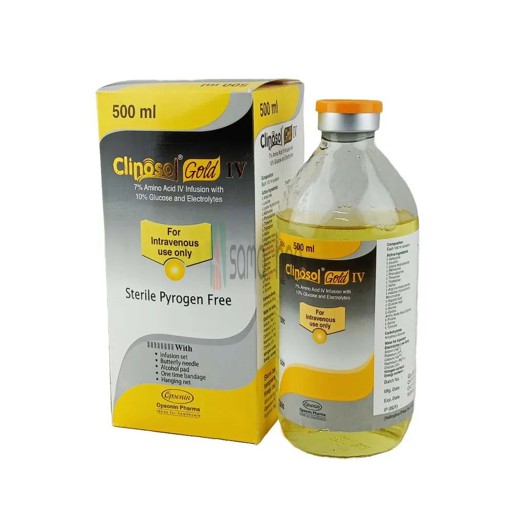
Clinosol Gold 7%+10% is a Product of the Generic Amino acids, Glucose & Electrolytes
Clinosol Gold 7%+10% belongs to the generic category of Amino acids, Glucose & Electrolytes. This medicine should be used according to a doctor's advice. We have provided detailed information about the uses, dosage, effectiveness, side effects, precautions, drug interactions, storage conditions, and other important details of Clinosol Gold 7%+10%. Our goal is to present essential medicine information in one place for patients, caregivers, and healthcare professionals. To better understand Amino acids, Glucose & Electrolytes and ensure the safe use of this medicine, please read the information below carefully and consult a healthcare professional when necessary.
*Up to 10% Discount
(Depends on pharmacy)
Clinosol Gold 7%+10%
Opsonin Pharma Ltd. · IV Infusion
Amino acids, Glucose & Electrolytes
/ 500 ml bottle
Description of Clinosol Gold 7%+10%
Clinosol Gold 7%+10% may be available as a prescription or over-the-counter medicine, depending on local regulations and medical recommendations. It is used for the treatment and management of specific conditions or symptoms. The way this medicine is used may vary depending on the patient's condition and the advice of a healthcare provider. Detailed information about the approved uses, therapeutic applications, and other relevant details of Clinosol Gold 7%+10% is provided below to help users gain a clear understanding of this medicine.
What Is Clinosol Gold 7%+10% Indications and Uses?
This is indicated as a source of amino acids, glucose and electrolytes in adult and pediatric patients needing IV nutrition. This is particularly suitable for patients with basal amino acid requirements.
Pharmacology (Source, Chemical and Physical Composition) Of Clinosol Gold 7%+10%
A crystalline amino acid solution provides crystalline amino acids to promote protein synthesis and wound healing, and to reduce the rate of endogenous protein catabolism. Amino Acids given by central venous infusion in combination with concentrated dextrose, electrolytes, vitamins, trace metals, and ancillary fat supplements, constitutes total parenteral nutrition (TPN). Amino Acids can also be administered by peripheral vein with dextrose and maintenance electrolytes.
Dosage And Administration of Clinosol Gold 7%+10%
Adults: The nitrogen requirement for maintenance of body protein mass depends on the patient's condition (nutritional state and degree of metabolic stress). The requirements are 0.10-0.15g nitrogen/kg/day (no or minor metabolic stress and normal nutritional state), 0.15-0.20g nitrogen/kg/day (moderate metabolic stress with or without malnutrition) and up to 0.20-0.25g nitrogen/kg/day (severe catabolism as in burns, sepsis and trauma). The dosage range is 0.10-0.25 g nitrogen/kg/day corresponds to 11-27 ml/kg/day. In obese patients, the dose should be based on the estimated ideal weight. Depending upon the patient’s requirements, 1000-2000 ml may be infused intravenously per 24 hours. This should be infused slowly; at a rate not exceeding 500 ml in 3 hours corresponding to approximately at rates 1.4-2.8 ml (30-60 drops) per minute.Infants and children: In infants & children, a maximal rate of infusion of 30 ml/kg body weight/day is recommended, with a step-wise increase in the rate of administration during the first week of treatment.
Drug Interactions of Clinosol Gold 7%+10%
At the recommended dosage this solution has no pharmacological effect and is expected not to interact with other medicaments.
Side Effects of Clinosol Gold 7%+10%
This preparation is usually well tolerated. Nausea occurs rarely. Vomiting, flushing and sweating have been observed during infusion of the solution at rates exceeding the recommended maximal rate. Transient increases in liver test during intravenous nutrition have been reported. The reasons are at present unclear. The underlying disease and the components and their amount in the intravenous feeding regimens have been suggested. Hypersensitivity reactions have been reported. As with all hypertonic infusion solution, thrombophlebitis may occur when peripheral veins are used. The incidence may be reduced by the simultaneous infusion of 10% fat emulsion.
Use During Pregnancy and Lactation
Successful and safe administration of amino acid solution during pregnancy in human has been reported. Animal reproduction studies have not been carried out with 7% amino acid IV infusion with 10% glucose & electrolytes.
Precautions And Warnings for Clinosol Gold 7%+10%
Hyperphenylalaninemia has been noted in severely ill, premature infants. In these patients, monitoring of the phenylalanine level is recommended and the infusion rate to be adjusted as needed. This preparation should be used with caution in patients with diabetes mellitus, severe heart failure or with renal function in combination with fluid restriction or oliguria/anuria of other origin. In patient with hyperglycemia, administration of exogenous insulin might be necessary. Do not use if the solution is turbid or contains particles. Discard any unused portion.
Therapeutic Class
Parenteral nutritional preparations
Storage Conditions of It
Protect from light and store between 15°C to 25°C temperature. Avoid freezing. Keep away from the reach of children.
Data Source: Data source of Indications and Usages, Pharmacology, Dosage & Administration, Drug Interactions, Side Effects, Use during Pregnancy & Lactation, Precautions & Warnings, Use in Special Populations, Therapeutic Class, and Storage Conditions is the concerned medicine company or respective organization.
Alternative Medicines
⚠ Disclaimer
The information provided on All Samadhan is intended for general informational purposes only and is prepared based on our best practices. It is not a substitute for professional medical advice, diagnosis, or treatment. While we strive to keep the information accurate and up to date, we do not guarantee its completeness or accuracy. The absence of specific information or warnings about any medicine or service should not be considered as an assurance or endorsement by All Samadhan. All Samadhan shall not be held responsible for any consequences arising from the use of this information. We strongly recommend consulting a qualified healthcare professional or physician for any medical concerns, questions, or clarifications.All Samadhan is a digital healthcare software platform operated by MS Genius Experts. We provide technology solutions for pharmacies and healthcare providers; we are not a direct seller or dispenser of prescription medicines

N.B.: All Samadhan is a digital healthcare software platform operated by MS Genius Experts. We provide technology solutions for pharmacies and healthcare providers; we are not a direct seller or dispenser of prescription medicines.
Copyright © All Samadhan - Operated by M/S. Genius Experts | All Rights Reserved
DBID
Registration ID: 176322642
Trade License: TRAD/DNCC/040904/2023