
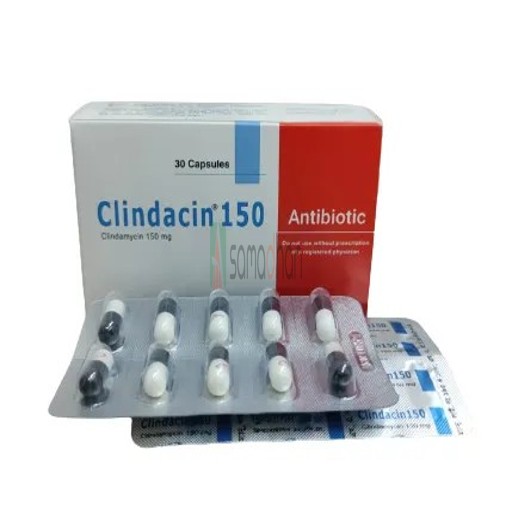
Clindacin 150 mg is a Product of the Generic Clindamycin
Clindacin 150 mg belongs to the generic category of Clindamycin. This medicine should be used according to a doctor's advice. We have provided detailed information about the uses, dosage, effectiveness, side effects, precautions, drug interactions, storage conditions, and other important details of Clindacin 150 mg. Our goal is to present essential medicine information in one place for patients, caregivers, and healthcare professionals. To better understand Clindamycin and ensure the safe use of this medicine, please read the information below carefully and consult a healthcare professional when necessary.
*Up to 10% Discount
(Depends on pharmacy)
Clindacin 150 mg
Incepta Pharmaceuticals Ltd. · Capsule
Clindamycin
/ Piece
Description of Clindacin 150 mg
Clindacin 150 mg may be available as a prescription or over-the-counter medicine, depending on local regulations and medical recommendations. It is used for the treatment and management of specific conditions or symptoms. The way this medicine is used may vary depending on the patient's condition and the advice of a healthcare provider. Detailed information about the approved uses, therapeutic applications, and other relevant details of Clindacin 150 mg is provided below to help users gain a clear understanding of this medicine.
What Is Clindacin 150 mg Indications and Uses?
Clindamycin has been shown to be effective in the treatment of the following infections when caused by susceptible anaerobic bacteria or susceptible strains of gram positive bacteria such as Streptococci, Staphylococci and Pneumococci; Upper respiratory infections, Lower respiratory infections, Skin ... Read moreClindamycin has been shown to be effective in the treatment of the following infections when caused by susceptible anaerobic bacteria or susceptible strains of gram positive bacteria such as Streptococci, Staphylococci and Pneumococci; Upper respiratory infections, Lower respiratory infections, Skin and soft tissue infections, Bone and joint infections, Pelvic infections, Intra-abdominal infections, Septicemia and endocarditis, Dental infections. As an alternative therapy when used in combination with quinine or amodiaquine for the treatment of multi-drug resistant Plasmodium falciporum infection.
Dosage And Administration of Clindacin 150 mg
Dosage of Clindamycin Capsule:
Serious Infections: 150 mg-300 mg every six hours.
More severe infections: 300 mg-450 mg every six hours.
To avoid the possibility of oesophageal irritation, Clindacin capsules should be taken with a full glass of water.Several researches has found that Clindamycin 300 mg capsule provides plasma concentration over MIC90 for more than 12 hours. This finding supports the twice-daily dosing of Clindacin 300 mg capsule, particularly in SSTIs & RTIs. However, in case of bone & joint infections, diabetic foot infections dose of Clindamycin should be 300 mg capsule 3-4 times daily.Dosage of Clindamycin Powder for oral solution:
Serious infections: 8-12 mg/kg/day divided into 3 or 4 equal doses.
Severe infections: 13-16 mg/kg/day divided into 3 or 4 equal doses.
More severe infections: 17-25 mg/kg/day divided into 3 or 4 equal doses.
In pediatric patients weighing 10 kg or less, 1/2 teaspoon (37.5 mg) three times a day should be considered the minimum recommended dose.Dosage of Clindamycin IV/IM Injection:Adults-
Serious infections due to aerobic gram-positive cocci and the more susceptible anaerobes: 600-1200 mg/day in 2- 4 equal doses.
More severe infections: 1200-2700 mg/day in 2-4 equal doses.
For more serious infections: these doses may have to be increased. In life-threatening situations due to either aerobes or anaerobes, these doses may be increased.
Doses of as much as 4800 mg daily have been given intravenously to adults. Single intramuscular injections of greater than 600 mg are not recommended.
Neonates (less than 1 month): 15 to 20 mg/kg/day in 3 to 4 equal doses. The lower effective dosage may be adequate for small prematures.Pediatric patients (1 month of age to 16 years):
20 to 40 mg/kg/day in 3 or 4 equal doses. The higher doses would be used for more severe infections.
Parenteral therapy may be changed to Capsules (clindamycin hydrochloride) when the condition warrants and at the discretion of the physician.
In cases of (3-hemolytic streptococcal infections, treatment should be continued for at least 10 days.
Drug Interactions of Clindacin 150 mg
Clindamycin enhances the action of other neuromuscular blocking agents. Therefore, it should be used with caution in patients receiving such agents. Antagonism has been demonstrated between clindamycin and erythromycin in vitro. Because of possible clinical significance, these two drugs should not be administered concurrently.
Side Effects of Clindacin 150 mg
The adverse effects have been reported with the use of clindamycin are- abdominal pain, oesophagitis and oesophagial ulcer, nausea, vomiting and diarrhoea, pruritus, skin rashes, urticaria.
Use During Pregnancy and Lactation
Pregnancy Category B. Clindamycin crosses the placenta in humans. After multiple doses, amniotic fluid concentrations were approximately 30% of maternal concentrations. Clindamycin should be used in pregnancy only if clearly needed. Clindamycin has been reported to appear in breast milk. Therefore, it is not recommended for nursing mothers if not clearly needed.
Precautions And Warnings for Clindacin 150 mg
Clindamycin should be prescribed with caution in individuals with a history of gastrointestinal disease, particularly colitis.
Use In Special Populations
Use in newborns and infants: When Clindamycin is administered to newborns and infants (birth to 16 years), appropriate monitoring of organ system functions is desirable.Geriatric use: Dose adjustment of Clindamycin is not necessary.
Therapeutic Class
Macrolides
Storage Conditions of It
Keep below 30°C temperature, away from light & moisture. Keep out of the reach of children.
Data Source: Data source of Indications and Usages, Pharmacology, Dosage & Administration, Drug Interactions, Side Effects, Use during Pregnancy & Lactation, Precautions & Warnings, Use in Special Populations, Therapeutic Class, and Storage Conditions is the concerned medicine company or respective organization.
Alternative Medicines
⚠ Disclaimer
The information provided on All Samadhan is intended for general informational purposes only and is prepared based on our best practices. It is not a substitute for professional medical advice, diagnosis, or treatment. While we strive to keep the information accurate and up to date, we do not guarantee its completeness or accuracy. The absence of specific information or warnings about any medicine or service should not be considered as an assurance or endorsement by All Samadhan. All Samadhan shall not be held responsible for any consequences arising from the use of this information. We strongly recommend consulting a qualified healthcare professional or physician for any medical concerns, questions, or clarifications.All Samadhan is a digital healthcare software platform operated by MS Genius Experts. We provide technology solutions for pharmacies and healthcare providers; we are not a direct seller or dispenser of prescription medicines

N.B.: All Samadhan is a digital healthcare software platform operated by MS Genius Experts. We provide technology solutions for pharmacies and healthcare providers; we are not a direct seller or dispenser of prescription medicines.
Copyright © All Samadhan - Operated by M/S. Genius Experts | All Rights Reserved
DBID
Registration ID: 176322642
Trade License: TRAD/DNCC/040904/2023