
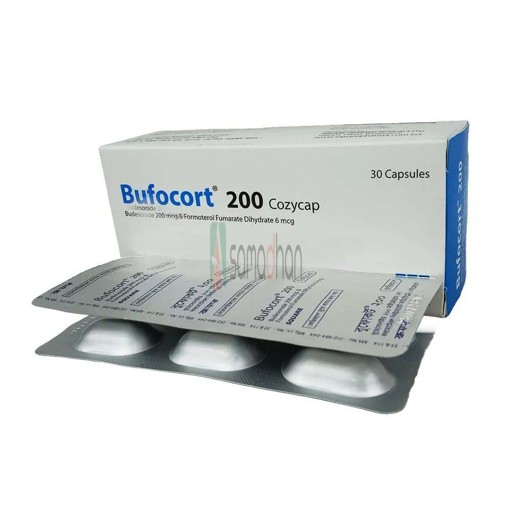
Bufocort 200 mcg+6 mcg is a Product of the Generic Budesonide + Formoterol Fumarate
Bufocort 200 mcg+6 mcg belongs to the generic category of Budesonide + Formoterol Fumarate. This medicine should be used according to a doctor's advice. We have provided detailed information about the uses, dosage, effectiveness, side effects, precautions, drug interactions, storage conditions, and other important details of Bufocort 200 mcg+6 mcg. Our goal is to present essential medicine information in one place for patients, caregivers, and healthcare professionals. To better understand Budesonide + Formoterol Fumarate and ensure the safe use of this medicine, please read the information below carefully and consult a healthcare professional when necessary.
*Up to 10% Discount
(Depends on pharmacy)
Bufocort 200 mcg+6 mcg
Square Pharmaceuticals PLC · Dry Powder Inhalation Capsule (DPI)
Budesonide + Formoterol Fumarate
/ Piece
Description of Bufocort 200 mcg+6 mcg
Bufocort 200 mcg+6 mcg may be available as a prescription or over-the-counter medicine, depending on local regulations and medical recommendations. It is used for the treatment and management of specific conditions or symptoms. The way this medicine is used may vary depending on the patient's condition and the advice of a healthcare provider. Detailed information about the approved uses, therapeutic applications, and other relevant details of Bufocort 200 mcg+6 mcg is provided below to help users gain a clear understanding of this medicine.
What Is Bufocort 200 mcg+6 mcg Indications and Uses?
Treatment of Asthma: This combination inhaler is indicated for the treatment of asthma in patients 12 years of age and older. This is not indicated for the relief of acute bronchospasm. Maintenance treatment of Chronic Obstructive Pulmonary Disease (COPD): ... Read moreTreatment of Asthma: This combination inhaler is indicated for the treatment of asthma in patients 12 years of age and older. This is not indicated for the relief of acute bronchospasm. Maintenance treatment of Chronic Obstructive Pulmonary Disease (COPD): This combination inhalation capsule is indicated for the twice-daily maintenance treatment of airflow obstruction in patients with chronic obstructive pulmonary disease (COPD) including chronic bronchitis and emphysema. This inhalation capsule is the only approved dosage for the treatment of airflow obstruction in COPD.
Pharmacology (Source, Chemical and Physical Composition) Of Bufocort 200 mcg+6 mcg
Budesonide: It is an anti-inflammatory corticosteroid that exhibits potent glucocorticoid activity and weak mineralocorticoid activity. Inflammation is an important component in the pathogenesis of asthma. Corticosteroids have a wide range of inhibitory activities against multiple cell types (e.g., mast cells, eosinophils, neutrophils, macrophages and lymphocytes) and mediators (e.g., histamine, eicosanoids, leukotrienes, and cytokines) involved in allergic and non-allergic mediated inflammation. These anti-inflammatory actions of corticosteroids may contribute to their efficacy in asthma.Formoterol Fumarate Dihydrate: It is a long-acting, selective β2 - adrenergic agonist with a rapid onset of action. Inhaled Formoterol Fumarate Dihydrate BP acts locally in the lungs as a bronchodilator. The pharmacological effects of β2-adrenoceptor agonist drugs are attributable to the stimulation of intracellular adenyl cyclase, the enzyme that catalyses the conversion of adenosine triphosphate (ATP) to cyclic AMP. Increased cyclic AMP levels cause relaxation of bronchial smooth muscle and inhibit the release of mediators of immediate hypersensitivity from the cells, especially from mast cells.
Dosage And Administration of Bufocort 200 mcg+6 mcg
Inhaler (For Asthma)-
Adults and adolescents (12 years and older): The recommended maintenance dose is 1 puff twice daily or 2 puffs once daily. For some patients a maintenance dose of 2 puffs twice daily may be appropriate (for 160/4.5 mcg/inhalation only). Patients should take 1 additional puff as needed in response to symptoms. If symptoms persist after a few minutes, the additional puff should be taken. Not more than 6 puffs should be taken on any single occasion.
Children: The usual maintenance dose is 1 -2 puffs once or twice daily. Patients should take 1 additional puff as needed in response to symptoms. If symptoms persist after a few minutes, the additional puff should be taken. Not more than 4 puffs should be taken on any single occasion.
Inhalation Capsule (For Asthma): There are two alternative dosage regimens for the treatment of asthma with Budesonide and Formoterol combination. Budesonide and Formoterol 100 & 200 Inhalation Capsule maintenance and reliever therapy.Adults and adolescents (12 years and older):
Maintenance dose: Budesonide and Formoterol 100 & 200 Inhalation Capsule twice daily
Reliever dose: 1 additional Inhalation Capsule as needed in response to symptoms. If symptoms persist after a few minutes, an additional Inhalation Capsule should be taken. Not more than 6 Inhalation Capsule should be taken on any single occasion. A total daily dose of more than 8 Inhalation Capsule is not normally needed, however, a total daily dose of up to 12 Inhalation Capsule can be used temporarily.
Children (4 years and older):
Maintenance dose: Budesonide and Formoterol 100 Inhalation Capsule once daily.
Reliever dose: 1 additional Inhalation Capsule as needed in response to symptoms. If symptoms persist after a few minutes, an additional Inhalation Capsule should be taken. Not more than 4 Inhalation Capsule should be taken on any single occasion. A total daily dose of more than 4 Inhalation Capsule is not normally needed, however, a total daily dose of up to 8 Inhalation Capsule could be used temporarily.
Inhalation Capsule (For COPD): Adults (40 years and older)
200 Inhalation Capsule: 2 Inhalation Capsule twice daily. Maximum daily maintenance dose: 4 Inhalation Capsule
400 Inhalation Capsule: 1 Inhalation Capsule twice daily. Maximum daily maintenance dose: 2 Inhalation Capsule.
Drug Interactions of Bufocort 200 mcg+6 mcg
Co-administration with strong cytochrome P450 3A4 inhibitors (e.g., ritonavir) should be avoided as they may cause increased systemic corticosteroid effects. Co-administration with Monoamine oxidase inhibitors and tricyclic antidepressants should be with extreme caution as they may potentiate effect of formoterol on vascular system. Beta-blockers should be use with caution as they may block bronchodilatory effects of beta-agonists and produce severe bronchospasm. Co-administration of Formocort with diuretics should be with caution, as they may cause electrocardiographic changes and/or hypokalemia associated with nonpotassium- sparing diuretics may worsen with concomitant beta-agonists.
Side Effects of Bufocort 200 mcg+6 mcg
As the combination inhaler contains Formoterol Fumarate and Budesonide, the type and severity of adverse reactions associated with each of the compounds may be expected. There is no incidence of additional adverse events following concurrent administration of the two compounds. Adverse events, which have been associated with Formoterol Fumarate Dihydrate and Budesonide, are given below:Formoterol Fumarate: Tremor, palpitations and headache are common adverse events. Cardiac arrhythmias, muscle cramps and hypersensitivity reactions, including rash, oedema and angiooedema are uncommon and rare.Budesonide: Hoarseness, candida infection in the oropharynx and throat irritation may occur in some patients. Cutaneous hypersensitivity reactions, respiratory tract infections, immunosuppression, growth effect in children, glaucoma & cataract have been reported.
Use During Pregnancy and Lactation
For this combination or the concomitant treatment with Formoterol and Budesonide, no clinical data on exposed pregnancies are available. Data from an embryo-foetal development study in the rat, showed no evidence of any additional effect from the combination.There are no adequate data from use of Formoterol in pregnant women. In animal studies Formoterol has caused adverse effects in reproduction studies at very high systemic exposure levels. Budesonide is excreted in breast milk. However, at therapeutic doses no effects on the suckling child are anticipated. It is not known whether Formoterol passes into human breast milk. In rats, small amounts of Formoterol have been detected in maternal milk. Administration of this combination to women who are breast-feeding should only be considered if the expected benefit to the mother is greater than any possible risk to the child.
Precautions And Warnings for Bufocort 200 mcg+6 mcg
Caution should be taken in patients with diabetes mellitus, thyrotoxicosis, untreated hypokalaemia, severe hypertension and severe cardiovascular disorders, such as ischaemic heart disease, tachycardia or severe heart failure, glaucoma and cataract, hypercorticism. Paradoxical bronchospasm may occur, with an immediate increase in wheezing and shortness of breath after dosing. If the patient experiences paradoxical bronchospasm the medication should be discontinued immediately.
Use In Special Populations
It is recommended that the height of children receiving prolonged treatment with inhaled corticosteroids is regularly monitored. If growth is slowed, therapy should be re evaluated with the aim of reducing the dose of inhaled corticosteroid. The benefits of the corticosteroid therapy and the possible risks of growth suppression must be carefully weighed. In addition consideration should be given to referring the patient to a paediatric respiratory specialist.
Storage Conditions of It
Inhalation capsules must not be swallowed. Only to be used with inhalation device. Keep away from light and wet place. Store at or below 25°C temperature. Keep out of reach of children. Remove Inhalation capsule from the blister pack only immediately before use it in the inhalation device as Inhalation capsule exposed to moisture may not be pierced easily.
Data Source: Data source of Indications and Usages, Pharmacology, Dosage & Administration, Drug Interactions, Side Effects, Use during Pregnancy & Lactation, Precautions & Warnings, Use in Special Populations, Therapeutic Class, and Storage Conditions is the concerned medicine company or respective organization.
Alternative Medicines
⚠ Disclaimer
The information provided on All Samadhan is intended for general informational purposes only and is prepared based on our best practices. It is not a substitute for professional medical advice, diagnosis, or treatment. While we strive to keep the information accurate and up to date, we do not guarantee its completeness or accuracy. The absence of specific information or warnings about any medicine or service should not be considered as an assurance or endorsement by All Samadhan. All Samadhan shall not be held responsible for any consequences arising from the use of this information. We strongly recommend consulting a qualified healthcare professional or physician for any medical concerns, questions, or clarifications.All Samadhan is a digital healthcare software platform operated by MS Genius Experts. We provide technology solutions for pharmacies and healthcare providers; we are not a direct seller or dispenser of prescription medicines

N.B.: All Samadhan is a digital healthcare software platform operated by MS Genius Experts. We provide technology solutions for pharmacies and healthcare providers; we are not a direct seller or dispenser of prescription medicines.
Copyright © All Samadhan - Operated by M/S. Genius Experts | All Rights Reserved
DBID
Registration ID: 176322642
Trade License: TRAD/DNCC/040904/2023