
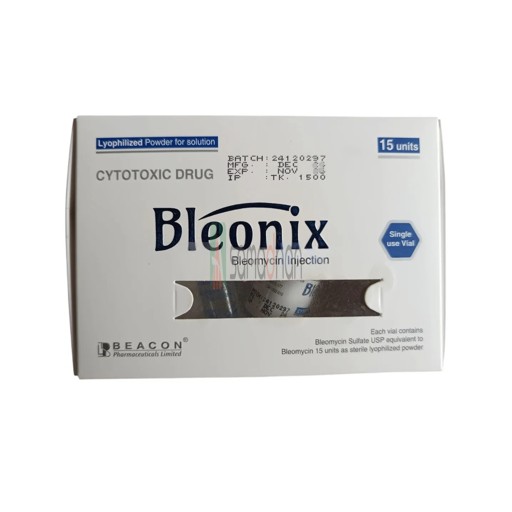
Bleonix 15,000 IU/vial is a Product of the Generic Bleomycin Sulfate
Bleonix 15,000 IU/vial belongs to the generic category of Bleomycin Sulfate. This medicine should be used according to a doctor's advice. We have provided detailed information about the uses, dosage, effectiveness, side effects, precautions, drug interactions, storage conditions, and other important details of Bleonix 15,000 IU/vial. Our goal is to present essential medicine information in one place for patients, caregivers, and healthcare professionals. To better understand Bleomycin Sulfate and ensure the safe use of this medicine, please read the information below carefully and consult a healthcare professional when necessary.
*Up to 10% Discount
(Depends on pharmacy)
Bleonix 15,000 IU/vial
Beacon Pharmaceuticals PLC · Injection
Bleomycin Sulfate
/ 15000 IU vial
Description of Bleonix 15,000 IU/vial
Bleonix 15,000 IU/vial may be available as a prescription or over-the-counter medicine, depending on local regulations and medical recommendations. It is used for the treatment and management of specific conditions or symptoms. The way this medicine is used may vary depending on the patient's condition and the advice of a healthcare provider. Detailed information about the approved uses, therapeutic applications, and other relevant details of Bleonix 15,000 IU/vial is provided below to help users gain a clear understanding of this medicine.
What Is Bleonix 15,000 IU/vial Indications and Uses?
Bleomycin Sulfate is indicated for palliation and treatment adjuvant to surgery and radiation therapy of the following neoplasms:
Squamous cell carcinoma of the skin, head and neck and oesophagus (primary indication)
Squamous cell carcinoma of the larynx, penis and uterine cervix
Squamous cell carcinoma of the bronchus (response infrequent)
Choriocarcinoma and embryonal cell carcinoma of the testis
Advanced Hodgkin's disease and other lymphomas
Mycosis fungoides
Pharmacology (Source, Chemical and Physical Composition) Of Bleonix 15,000 IU/vial
Although the precise mechanism of action of bleomycin is not fully known, it is thought thatn the primary action is to produce single and double-strand breaks in DNA, leading to inhibition of cell division and growth, and inhibition of DNA synthesis in the cells. Bleomycin is probably most effective against cells in the M and G2 (premitotic) phase of the cell cycle. Bleomycin has not been shown to have an immunosuppressive effect in vitro and shows no significant inhibition of immune response in patients treated with the drug. Bleomycin-inactivating enzyme has been detected in both normal and malignant cells and is particularly prominent in liver. The enzyme is not found in lung or skin, two normal tissues sensitive to bleomycin action.
Dosage And Administration of Bleonix 15,000 IU/vial
Total doses of over 300,000 IU should be given with great caution. 10,000 to 20,000 IU/m2 of body surface area given weekly or twice weekly. Alternatively, give 15,000 IU daily for 7 days followed by three weeks off-treatment and repeat twice so that a total dose of approximately 300,000 IU is administered.Improvement of lymphomas and testicular tumours is prompt i.e. within two weeks while response by squamous cell cancers may take as long as three weeks.A therapeutic response should be observed as the total dose approaches 150,000 IU, if this is not seen, consideration should be given to other therapy.Bleomycin may be given by the intramuscular, intravenous, subcutaneous or intra-arterial routes. Because of the possibility of an anaphylactoid reaction, lymphoma patients should receive test doses of between 1-5 units, for the first two treatments. If no acute allergic reaction occurs within 4-6 hours, the balance of the dose may be given. Thereafter the regular dosage schedule may be followed, if no reaction occurs.
Drug Interactions of Bleonix 15,000 IU/vial
Increased incidence and severity of lung toxicity with previous or concurrent radiotherapy to the chest. Combination with vinca alkaloids may result to a syndrome corresponding to morbus Raynaud, ischaemia which can lead to necrosis of peripheral parts of the body (fingers, toes, nose tip). May reduce the absorption of phenytoin. Increased risk of agranulocytosis with clozapine.
Side Effects of Bleonix 15,000 IU/vial
Common side effects of Bleomycin Sulfate include injection site reactions (pain, redness, warmth, itching, or swelling), fever, chills, vomiting, loss of appetite, weight loss, darkening or discoloration of the skin, changes in fingernails or toenails, itching, or pain near your tumor.
Use During Pregnancy and Lactation
Pregnancy Category D. It is not known whether the drug is excreted in human milk. Because many drugs are excreted in human milk and because of the potential for serious adverse reactions in nursing infants, it is recommended that nursing be discontinued by women receiving Bleomycin Sulfate therapy.
Precautions And Warnings for Bleonix 15,000 IU/vial
It is recommended that Bleomycin be administered under the supervision of a qualified physician experienced in the use of cancer chemotherapeutic agents. Appropriate management of therapy and complications is possible only when adequate diagnostic and treatment facilities are readily available. Patients receiving bleomycin must be observed carefully and frequently during and after therapy. After injection, bleomycin is readily absorbed and distributed in the body, particularly in the skin, lungs and any susceptible tumour tissue, leading to possible skin and pulmonary toxicity, as well as antitumour activity. If pulmonary changes are noted, treatment should be discontinued until it can be determined whether the cause is drug-related.
Therapeutic Class
Cytotoxic Chemotherapy
Storage Conditions of It
Store between 2-8°C. Protect from light and should not be used after the expiration date is reached.
Data Source: Data source of Indications and Usages, Pharmacology, Dosage & Administration, Drug Interactions, Side Effects, Use during Pregnancy & Lactation, Precautions & Warnings, Use in Special Populations, Therapeutic Class, and Storage Conditions is the concerned medicine company or respective organization.
Alternative Medicines
⚠ Disclaimer
The information provided on All Samadhan is intended for general informational purposes only and is prepared based on our best practices. It is not a substitute for professional medical advice, diagnosis, or treatment. While we strive to keep the information accurate and up to date, we do not guarantee its completeness or accuracy. The absence of specific information or warnings about any medicine or service should not be considered as an assurance or endorsement by All Samadhan. All Samadhan shall not be held responsible for any consequences arising from the use of this information. We strongly recommend consulting a qualified healthcare professional or physician for any medical concerns, questions, or clarifications.All Samadhan is a digital healthcare software platform operated by MS Genius Experts. We provide technology solutions for pharmacies and healthcare providers; we are not a direct seller or dispenser of prescription medicines

N.B.: All Samadhan is a digital healthcare software platform operated by MS Genius Experts. We provide technology solutions for pharmacies and healthcare providers; we are not a direct seller or dispenser of prescription medicines.
Copyright © All Samadhan - Operated by M/S. Genius Experts | All Rights Reserved
DBID
Registration ID: 176322642
Trade License: TRAD/DNCC/040904/2023