
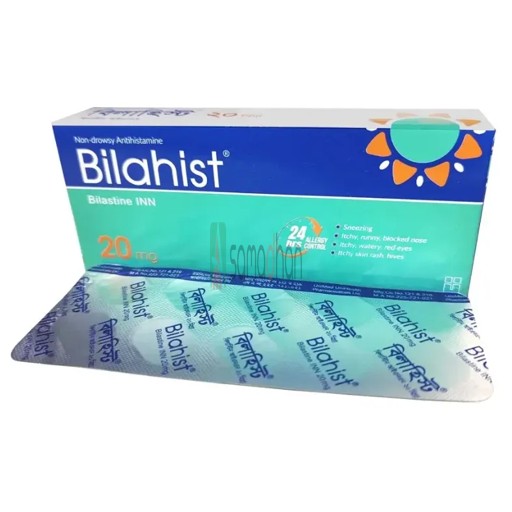
Bilahist 20 mg is a Product of the Generic Bilastine
Bilahist 20 mg belongs to the generic category of Bilastine. This medicine should be used according to a doctor's advice. We have provided detailed information about the uses, dosage, effectiveness, side effects, precautions, drug interactions, storage conditions, and other important details of Bilahist 20 mg. Our goal is to present essential medicine information in one place for patients, caregivers, and healthcare professionals. To better understand Bilastine and ensure the safe use of this medicine, please read the information below carefully and consult a healthcare professional when necessary.
*Up to 10% Discount
(Depends on pharmacy)
Bilahist 20 mg
UniMed UniHealth Pharmaceuticals Ltd. · Tablet
Bilastine
/ Piece
Description of Bilahist 20 mg
Bilahist 20 mg may be available as a prescription or over-the-counter medicine, depending on local regulations and medical recommendations. It is used for the treatment and management of specific conditions or symptoms. The way this medicine is used may vary depending on the patient's condition and the advice of a healthcare provider. Detailed information about the approved uses, therapeutic applications, and other relevant details of Bilahist 20 mg is provided below to help users gain a clear understanding of this medicine.
What Is Bilahist 20 mg Indications and Uses?
Bilastine is indicated for the symptomatic treatment of-
Allergic rhino conjunctivitis (seasonal and perennial) and
Urticaria
Bilastine is also used to relieve the symptoms of hay fever (sneezing, itchy, runny, blocked-nose and red and watery eyes).
Pharmacology (Source, Chemical and Physical Composition) Of Bilahist 20 mg
Bilastine is a potent, effective, non-sedating, long-acting histamine antagonist with selective & high affinity to H1 receptor (3 times higher than Cetirizine and 5 times higher than Fexofenadine). Even at a high concentration, Bilastine does not show affinity for the 30 other receptors including muscarinic, serotonergic, dopaminergic and noradrenergic receptors, for the other histamine receptor subtypes (H2, H3 and H4). It shows excellent safety profile and very favorable pharmacokinetic characteristics. Bilastine doesn’t undergo any metabolism to be active. Bilastine is excreted by feces (non -systemic) & urine (systemic) approximately 66.35% & 28.31% respectively.
Dosage And Administration of Bilahist 20 mg
Adults & adolescents (12 years of age and over): 20 mg tablet once daily for symptomatic relief of allergic rhinitis, urticaria and allergic rhinoconjunctivitis. The maximum recommended daily dose is 20 mg Bilastine (1 tablet) and should not be exceeded. If a dose is missed, the next scheduled dose should be taken. An extra dose should not be taken. 20 mg Bilastine tablet (1 tablet) once daily should be swallowed with water on an empty stomach to achieve optimal exposure to Bilastine.Children between 6 to 11 years: 10 mg mouth dissolving tablet for the symptomatic relief of allergic rhinitis, allergic rhinoconjunctivitis and urticaria. The Mouth dissolving tablet is for oral use only. It should be placed in the mouth. It will disperse rapidly in saliva and can be easily swallowed. Alternatively, the mouth dissolving tablet can be dispersed in a tea spoon of water before being swallowed by the children. The maximum recommended daily dose for children in between 6 to 11 years is 10 mg Bilastine mouth dissolving tablet (1 tablet) and should not be exceeded. If a dose is missed, the next scheduled dose should be taken. An extra dose should not be taken.Children between 2 to 11 years: 4 ml once daily.
Drug Interactions of Bilahist 20 mg
Concomitant use of Bilastine with ketoconazole, erythromycin, cyclosporine or diltiazem increases the concentration of Bilastine. But these changes do not appear to affect the safety profile of any of the drugs. Intake of alcohol and 20 mg Bilastine shows same psychomotor performance similar to that of alcohol and placebo. Concomitant intake of Bilastine 20 mg and lorazepam 3 mg for 8 days did not potentiate the depressant CNS effects of lorazepam.
Side Effects of Bilahist 20 mg
The most commonly reported side effects in clinical trial are headache, dizziness, somnolence and fatigue. These adverse events occurred with a comparable frequency in patients receiving placebo.
Use During Pregnancy and Lactation
There are no or limited amount of data from the use of Bilastine in pregnant women. Animal studies do not indicate direct or indirect harmful effects with respect to reproductive toxicity, parturition or postnatal development. As a precautionary measure, it is preferable to avoid the use of Bilastine during pregnancy. The excretion of Bilastine in milk has not been studied in humans. A decision must be made taking into account the benefit of breast-feeding for the child and the benefit of Bilastine therapy for the mother.
Precautions And Warnings for Bilahist 20 mg
Treatment with Bilastine 20 mg does not affect the driving performance. However, patients should be informed that very rarely some people experience drowsiness, which may affect their ability to drive or use machines. In clinical trials elderly patients (≥65 years) showed no difference in effcacy or safety with respect to younger patients. The maximum plasma concentration of Bilastine after administration of 20 mg in patients with severe renal impairment is below the safety threshold of most common adverse e?ects and cardiac or CNS safety. No dosage adjustment is necessary in patients with renal impairment. Bilastine is not metabolized in human. Since renal elimination is the major excretion, biliary excretion is expected to be only marginally involved in the elimination of Bilastine. Changes in liver function are not expected to have a clinically relevant influence.
Use In Special Populations
Efficacy and safety of Bilastine in children under 2 years of age have not been established and there is little clinical experience in children aged 2 to 5 years, therefore Bilastine should not be used in these age groups.
Therapeutic Class
Non-sedating antihistamines
Storage Conditions of It
Keep below 30°C temperature, protected from light and moisture. Keep out of reach of children.
Data Source: Data source of Indications and Usages, Pharmacology, Dosage & Administration, Drug Interactions, Side Effects, Use during Pregnancy & Lactation, Precautions & Warnings, Use in Special Populations, Therapeutic Class, and Storage Conditions is the concerned medicine company or respective organization.
Alternative Medicines
⚠ Disclaimer
The information provided on All Samadhan is intended for general informational purposes only and is prepared based on our best practices. It is not a substitute for professional medical advice, diagnosis, or treatment. While we strive to keep the information accurate and up to date, we do not guarantee its completeness or accuracy. The absence of specific information or warnings about any medicine or service should not be considered as an assurance or endorsement by All Samadhan. All Samadhan shall not be held responsible for any consequences arising from the use of this information. We strongly recommend consulting a qualified healthcare professional or physician for any medical concerns, questions, or clarifications.All Samadhan is a digital healthcare software platform operated by MS Genius Experts. We provide technology solutions for pharmacies and healthcare providers; we are not a direct seller or dispenser of prescription medicines

N.B.: All Samadhan is a digital healthcare software platform operated by MS Genius Experts. We provide technology solutions for pharmacies and healthcare providers; we are not a direct seller or dispenser of prescription medicines.
Copyright © All Samadhan - Operated by M/S. Genius Experts | All Rights Reserved
DBID
Registration ID: 176322642
Trade License: TRAD/DNCC/040904/2023