
Betagest 50 mg/10 ml is a Product of the Generic Labetalol Hydrochloride
Betagest 50 mg/10 ml belongs to the generic category of Labetalol Hydrochloride. This medicine should be used according to a doctor's advice. We have provided detailed information about the uses, dosage, effectiveness, side effects, precautions, drug interactions, storage conditions, and other important details of Betagest 50 mg/10 ml. Our goal is to present essential medicine information in one place for patients, caregivers, and healthcare professionals. To better understand Labetalol Hydrochloride and ensure the safe use of this medicine, please read the information below carefully and consult a healthcare professional when necessary.
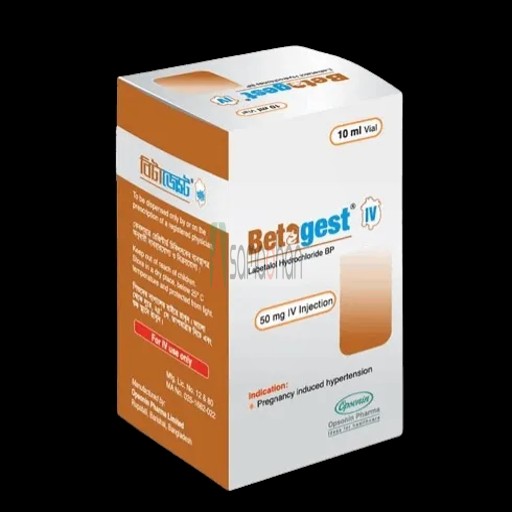
*Up to 10% Discount
(Depends on pharmacy)
Betagest 50 mg/10 ml
Opsonin Pharma Ltd. · IV Injection or Infusion
Labetalol Hydrochloride
/ 10 ml vial
Description of Betagest 50 mg/10 ml
Betagest 50 mg/10 ml may be available as a prescription or over-the-counter medicine, depending on local regulations and medical recommendations. It is used for the treatment and management of specific conditions or symptoms. The way this medicine is used may vary depending on the patient's condition and the advice of a healthcare provider. Detailed information about the approved uses, therapeutic applications, and other relevant details of Betagest 50 mg/10 ml is provided below to help users gain a clear understanding of this medicine.
What Is Betagest 50 mg/10 ml Indications and Uses?
Labetalol Injection is indicated in Hypertension (including hypertension in pregnancy, hypertension after stroke, hypertension with angina, and hypertension following acute myocardial infarction); hypertensive crisis; Anaesthesia when a hypotensive technique is indicated.
Pharmacology (Source, Chemical and Physical Composition) Of Betagest 50 mg/10 ml
Labetalol is an adrenergic receptor-blocking agent that has both selective alpha 1-adrenergic and nonselective beta-adrenergic receptor-blocking actions. Both the alpha and beta-blocking actions of Labetalol contribute to a decrease in blood pressure in hypertensive patients.Labetalol Hydrochloride is completely absorbed from the gastrointestinal tract with peak plasma levels occurring 1 to 2 hours after oral administration. The plasma half-life of Labetalol following oral administration is about 6 to 8 hours. Approximately 55% to 60% of a dose appears in the urine as conjugates or unchanged Labetalol within the first 24 hours of dosing. Doses of Labetalol Hydrochloride that controlled hypertension did not affect renal function in mildly to severely hypertensive patients with normal renal function.
Dosage And Administration of Betagest 50 mg/10 ml
Oral:
Adult: The recommended initial dosage is 100 mg twice daily whether used alone or added to a diuretic regimen. The usual maintenance dosage of Labetalol Hydrochloride is between 200 and 400 mg twice daily.
Patients with severe hypertension: May require from 1,200 to 2,400 mg per day, with or without thiazide diuretics. Titration increments should not exceed 200 mg twice daily.
Elderly Patients: The majority of elderly patients will require between 100 and 200 mg twice daily.
Injection/Infusion:
Intravenous Injection: If it is essential to reduce the blood pressure quickly a dose of 50 mg should be given by intravenous injection (over a period of at least one minute) and, if necessary, repeated at five minute intervals until a satisfactory response occurs. The total dose should not exceed 200 mg.
Intravenous Infusion: For intravenous infusion the injcetion should be diluted with a suitable intravenous infusion fluid to a concentation of 1 mg/1 ml. Compatible fluids include solution of 5% Dextrose, 0.9% Sodium Chloride and mixture of Sodium Chloride and Dextrose Injection.
Hypertension in pregnancy: Initially 20 mg/hour, then doubled every 30 minutes until a satisfactory response is obtained or a dosage of 160 mg/hour is reached.
Hypertension following acute myocardial infarction: Initially 15 mg/hour and gradually increased to a maximum of 120 mg/hour depending on the control of blood pressure.
Hypertension after stroke: 10-20 mg by intravenous injection over 1 to 2 minutes may repeat or doubled every 10 minutes. (max. dose 300 mg).
Hypertension due to other causes: Infuse at a rate of about 2 mg/min until a satisfactory response is obtained, then stop infusion. The effective dose is usually 50-200 mg but larger doses may be needed, especially in patients with phaeochromocytoma.
Hypotensive anaesthesia: The recommended starting dose of Labetalol Injection is 10-20 mg intravenously depending on the age and condition of the patient. Patients for whom halothane is contraindicated usually require a higher initial dose of 25-30 mg. If satisfactory hypotension is not achieved after 5 minutes, increments of 5-10 mg should be given until the desired level of blood pressure is attained.
Drug Interactions of Betagest 50 mg/10 ml
Labetalol may enhance the hypotensive effects of halothane. Care should be taken if labetalol is used concomitantly with either Class I antiarrhythmic agents or calcium antagonists of the verapamil type. The hypotensive effect of Labetalol may be reduced when used in combination with prostaglandin synthetase inhibitors (NSAIDs). Dosage adjustments may therefore be necessary. Concomitant use of tricyclic antidepressants may increase the incidence of tremor. Cimetidine may increase the bioavailability of Labetalol and care is required in oral dosing of the latter.
Side Effects of Betagest 50 mg/10 ml
Adverse effects reported are postural hypotension (avoid upright position during and for 3 hours after intravenous administration), tiredness, weakness, headache, rashes, scalp tingling, difficulty in micturition, epigastric pain, nausea, vomiting; liver damage.
Use During Pregnancy and Lactation
Teratogenic studies were performed with Labetalol in rats and rabbits at oral doses up to approximately six and four times the maximum recommended human dose (MRHD), respectively. No reproducible evidence of fetal malformations was observed. Labetalol Hydrochloride given to pregnant women with hypertension did not appear to affect the usual course of labor and delivery. Small amounts of Labetalol (approximately 0.004% of the maternal dose) are excreted in human milk. Caution should be exercised when Labetalol tablets are administered to a nursing woman.
Precautions And Warnings for Betagest 50 mg/10 ml
There have been rare reports of severe hepatocellular injury with Labetalol therapy. The hepatic injury is usually reversible and has occurred after both short and long term treatment. If there is laboratory evidence of liver injury or the patient is jaundiced, Labetalol therapy should be stopped and not re-started. Particular care should be taken when Labetalol is to be used in patients with hepatic impairment. Labetalol should be used with caution in patients with peripheral vascular disease as their symptoms may be exacerbated.
Therapeutic Class
Alpha adrenoceptor blocking drugs, Beta-adrenoceptor blocking drugs
Storage Conditions of It
Store in a cool & dry place protected from light. Keep out of reach of children.
Data Source: Data source of Indications and Usages, Pharmacology, Dosage & Administration, Drug Interactions, Side Effects, Use during Pregnancy & Lactation, Precautions & Warnings, Use in Special Populations, Therapeutic Class, and Storage Conditions is the concerned medicine company or respective organization.
Alternative Medicines
⚠ Disclaimer
The information provided on All Samadhan is intended for general informational purposes only and is prepared based on our best practices. It is not a substitute for professional medical advice, diagnosis, or treatment. While we strive to keep the information accurate and up to date, we do not guarantee its completeness or accuracy. The absence of specific information or warnings about any medicine or service should not be considered as an assurance or endorsement by All Samadhan. All Samadhan shall not be held responsible for any consequences arising from the use of this information. We strongly recommend consulting a qualified healthcare professional or physician for any medical concerns, questions, or clarifications.All Samadhan is a digital healthcare software platform operated by MS Genius Experts. We provide technology solutions for pharmacies and healthcare providers; we are not a direct seller or dispenser of prescription medicines

N.B.: All Samadhan is a digital healthcare software platform operated by MS Genius Experts. We provide technology solutions for pharmacies and healthcare providers; we are not a direct seller or dispenser of prescription medicines.
Copyright © All Samadhan - Operated by M/S. Genius Experts | All Rights Reserved
DBID
Registration ID: 176322642
Trade License: TRAD/DNCC/040904/2023