
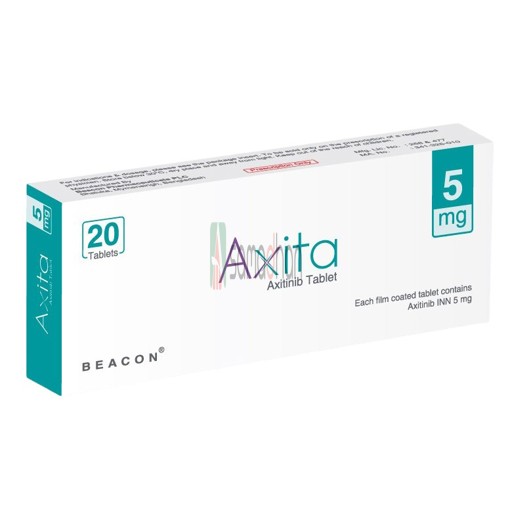
Axita 5 mg is a Product of the Generic Axitinib
Axita 5 mg belongs to the generic category of Axitinib. This medicine should be used according to a doctor's advice. We have provided detailed information about the uses, dosage, effectiveness, side effects, precautions, drug interactions, storage conditions, and other important details of Axita 5 mg. Our goal is to present essential medicine information in one place for patients, caregivers, and healthcare professionals. To better understand Axitinib and ensure the safe use of this medicine, please read the information below carefully and consult a healthcare professional when necessary.
*Up to 10% Discount
(Depends on pharmacy)
Axita 5 mg
Beacon Pharmaceuticals PLC · Tablet
Axitinib
/ Piece
Description of Axita 5 mg
Axita 5 mg may be available as a prescription or over-the-counter medicine, depending on local regulations and medical recommendations. It is used for the treatment and management of specific conditions or symptoms. The way this medicine is used may vary depending on the patient's condition and the advice of a healthcare provider. Detailed information about the approved uses, therapeutic applications, and other relevant details of Axita 5 mg is provided below to help users gain a clear understanding of this medicine.
What Is Axita 5 mg Indications and Uses?
Axitinib tablet is indicated for the treatment of advanced renal cell carcinoma (RCC) after failure of one prior systemic therapy.
Pharmacology (Source, Chemical and Physical Composition) Of Axita 5 mg
Axitinib has been shown to inhibit receptor tyrosine kinases including vascular endothelial growth factor receptors (VEGFR)-1, VEGFR-2, and VEGFR-3 at therapeutic plasma concentrations. These receptors are implicated in pathologic angiogenesis, tumor growth, and cancer progression. VEGF-mediated endothelial cell proliferation and survival were inhibited by axitinib in vitro and in mouse models. Axitinib was shown to inhibit tumor growth and phosphorylation of VEGFR-2 in tumor xenograft mouse models.
Dosage And Administration of Axita 5 mg
Recommended Dosing: The recommended starting oral dose of Axitinib is 5 mg twice daily. Administer Axitinib doses approximately 12 hours apart with or without food. Axitinib should be swallowed whole with a glass of water.If the patient vomits or misses a dose, an additional dose should not be taken. The next prescribed dose should be taken at the usual time.Dose Modification Guidelines: Dose increase or reduction is recommended based on individual safety and tolerability.Over the course of treatment, patients who tolerate Axitinib for at least two consecutive weeks with no adverse reactions > Grade 2 (according to the Common Toxicity Criteria for Adverse Events), are normotensive, and are not receiving anti-hypertension medication, may have their dose increased. When a dose increase from 5 mg twice daily is recommended, the Axitinib dose may be increased to 7 mg twice daily, and further to 10 mg twice daily using the same criteria.Over the course of treatment, management of some adverse drug reactions may require temporary interruption or permanent discontinuation and/or dose reduction of Axitinib therapy. If dose reduction from 5 mg twice daily is required, the recommended dose is 3 mg twice daily. If additional dose reduction is required, the recommended dose is 2 mg twice daily.
Drug Interactions of Axita 5 mg
In vitro data indicate that axitinib is metabolized primarily by CYP3A4/5 and, to a lesser extent, CYP1A2, CYP2C19, and uridine diphosphate-glucuronosyltransferase (UGT) 1A1.CYP3A4/5 Inhibitors: Co-administration of ketoconazole, a strong inhibitor of CYP3A4/5, increased the plasma exposure of axitinib in healthy volunteers. Co-administration of Axitinib with strong CYP3A4/5 inhibitors should be avoided. Grapefruit or grapefruit juice may also increase axitinib plasma concentrations and should be avoided. Selection of concomitant medication with no or minimal CYP3A4/5 inhibition potential is recommended. If a strong CYP3A4/5 inhibitor must be co-administered, the Axitinib dose should be reduced CYP3A4/5 Inducers: Co-administration of rifampin, a strong inducer of CYP3A4/5, reduced the plasma exposure of axitinib in healthy volunteers. Co-administration of Axitinib with strong CYP3A4/5 inducers (e.g., rifampin, dexamethasone, phenytoin, carbamazepine, rifabutin, rifapentin, phenobarbital, and St. John's wort) should be avoided. Selection of concomitant medication with no or minimal CYP3A4/5 induction potential is recommended. Moderate CYP3A4/5 inducers (e.g., bosentan, efavirenz, etravirine, modafinil, and nafcillin) may also reduce the plasma exposure of axitinib and should be avoided if possible.
Side Effects of Axita 5 mg
Selected adverse reactions (all grades) that were reported in < 10% of patients treated with Axitinib included dizziness (9%), upper abdominal pain (8%), myalgia (7%), dehydration (6%), epistaxis (6%), anemia (4%), hemorrhoids (4%), hematuria (3%), tinnitus (3%), lipase increased (3%), glossodynia (3%), pulmonary embolism (2%), rectal hemorrhage (2%), hemoptysis (2%), deep vein thrombosis (1%), retinal-veinocclusion/thrombosis (1%), polycythemia (1%), and transient ischemic attack (1%).
Use During Pregnancy and Lactation
Pregnancy Category D. Axitinib can cause fetal harm when administered to a pregnant woman based on its mechanism of action. There are no adequate and well-controlled studies in pregnant women using Axitinib. In developmental toxicity studies in mice, axitinib was teratogenic, embryotoxic and fetotoxic at maternal exposures that were lower than human exposures at the recommended clinical dose.Women of childbearing potential should be advised to avoid becoming pregnant while receiving Axitinib. If this drug is used during pregnancy, or if a patient becomes pregnant while receiving this drug, the patient should be apprised of the potential hazard to the fetusNursing Mothers: It is not known whether axitinib is excreted in human milk. Because many drugs are excreted in human milk and because of the potential for serious adverse reactions in nursing infants from Axitinib, a decision should be made whether to discontinue nursing or to discontinue the drug, taking into account the importance of the drug to the mother.
Precautions And Warnings for Axita 5 mg
Hypertension including hypertensive crisis has been observed. Blood pressure should be well-controlled prior to initiating Axitinib. Monitor for hypertension and treat as needed. For persistent hypertension despite use of anti-hypertensive medications, reduce the Axitinib dose.Arterial and venous thrombotic events have been observed and can be fatal. Use with caution in patients who are at increased risk for these events.Hemorrhagic events, including fatal events, have been reported. Axitinib has not been studied in patients with evidence of untreated brain metastasis or recent active gastrointestinal bleeding and should not be used in those patients.Cardiac failure has been observed and can be fatal. Monitor for signs or symptoms of cardiac failure throughout treatment with Axitinib.Gastrointestinal perforation and fistula, including death, have occurred. Use with caution in patients at risk for gastrointestinal perforation or fistula.Hypothyroidism requiring thyroid hormone replacement has been reported. Monitor thyroid function before initiation of, and periodically throughout, treatment with Axitinib.Stop Axitinib at least 24 hours prior to scheduled surgery.Reversible Posterior Leukoencephalopathy Syndrome (RPLS) has been observed. Permanently discontinue Axitinib if signs or symptoms of RPLS occur.Monitor for proteinuria before initiation of, and periodically throughout, treatment with Axitinib. For moderate to severe proteinuria, reduce the dose or temporarily interrupt treatment with Axitinib.Liver enzyme elevation has been observed during treatment with Axitinib. Monitor ALT, AST and bilirubin before initiation of, and periodically throughout, treatment with Axitinib.The starting dose of Axitinib should be decreased if used in patients with moderate hepatic impairment. Axitinib has not been studied in patients with severe hepatic impairment.Axitinib can cause fetal harm when administered to a pregnant woman based on its mechanism of action. Women of childbearing potential should be advised of the potential hazard to the fetus and to avoid becoming pregnant while receiving Axitinib.
Use In Special Populations
Strong CYP3A4/5 Inhibitors: The concomitant use of strong CYP3A4/5 inhibitors should be avoided (e.g., Ketoconazole, Itraconazole, Clarithromycin, Atazanavir, Indinavir, Nefazodone, Nelfinavir, Ritonavir, Saquinavir, Telithromycin, and Voriconazole). Selection of an alternate concomitant medication with no or minimal CYP3A4/5 inhibition potential is recommended. Although Axitinib dose adjustment has not been studied in patients receiving strong CYP3A4/5 inhibitors, if a strong CYP3A4/5 inhibitor must be co-administered, a dose decrease of Axitinib by approximately half is recommended, as this dose reduction is predicted to adjust the Axitinib area under the plasma concentration vs time curve (AUC) to the range observed without inhibitors. The subsequent doses can be increased or decreased based on individual safety and tolerability. If co-administration of the strong inhibitor is discontinued, the Axitinib dose should be returned (after 3-5 half-lives of the inhibitor) to that used prior to initiation of the strong CYP3A4/5 inhibitor.Hepatic Impairment: No starting dose adjustment is required when administering Axitinib to patients with mild hepatic impairment (Child-Pugh class A). Based on the pharmacokinetic data, the Axitinib starting dose should be reduced by approximately half in patients with baseline moderate hepatic impairment (Child Pugh class B). The subsequent doses can be increased or decreased based on individual safety and tolerability. Axitinib has not been studied in patients with severe hepatic impairment (Child-Pugh class C).
Therapeutic Class
Targeted Cancer Therapy
Storage Conditions of It
আলো ও আর্দ্রতা থেকে দূরে, ২৫ ডিগ্রী সেঃ তাপমাত্রার নীচে রাখুন। শিশুদের নাগালের বাইরে রাখুন।
Data Source: Data source of Indications and Usages, Pharmacology, Dosage & Administration, Drug Interactions, Side Effects, Use during Pregnancy & Lactation, Precautions & Warnings, Use in Special Populations, Therapeutic Class, and Storage Conditions is the concerned medicine company or respective organization.
Alternative Medicines
⚠ Disclaimer
The information provided on All Samadhan is intended for general informational purposes only and is prepared based on our best practices. It is not a substitute for professional medical advice, diagnosis, or treatment. While we strive to keep the information accurate and up to date, we do not guarantee its completeness or accuracy. The absence of specific information or warnings about any medicine or service should not be considered as an assurance or endorsement by All Samadhan. All Samadhan shall not be held responsible for any consequences arising from the use of this information. We strongly recommend consulting a qualified healthcare professional or physician for any medical concerns, questions, or clarifications.All Samadhan is a digital healthcare software platform operated by MS Genius Experts. We provide technology solutions for pharmacies and healthcare providers; we are not a direct seller or dispenser of prescription medicines

N.B.: All Samadhan is a digital healthcare software platform operated by MS Genius Experts. We provide technology solutions for pharmacies and healthcare providers; we are not a direct seller or dispenser of prescription medicines.
Copyright © All Samadhan - Operated by M/S. Genius Experts | All Rights Reserved
DBID
Registration ID: 176322642
Trade License: TRAD/DNCC/040904/2023