
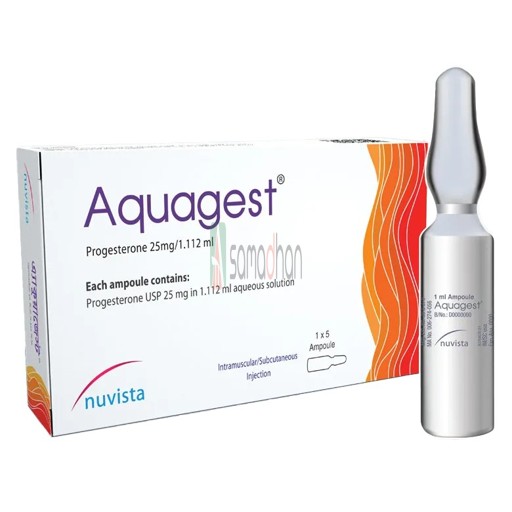
Aquagest 25 mg/1.119 ml is a Product of the Generic Progesterone Micronised (SC injection)
Aquagest 25 mg/1.119 ml belongs to the generic category of Progesterone Micronised (SC injection). This medicine should be used according to a doctor's advice. We have provided detailed information about the uses, dosage, effectiveness, side effects, precautions, drug interactions, storage conditions, and other important details of Aquagest 25 mg/1.119 ml. Our goal is to present essential medicine information in one place for patients, caregivers, and healthcare professionals. To better understand Progesterone Micronised (SC injection) and ensure the safe use of this medicine, please read the information below carefully and consult a healthcare professional when necessary.
*Up to 10% Discount
(Depends on pharmacy)
Aquagest 25 mg/1.119 ml
Nuvista Pharma Ltd. · SC Injection
Progesterone Micronised (SC injection)
/ Piece
Description of Aquagest 25 mg/1.119 ml
Aquagest 25 mg/1.119 ml may be available as a prescription or over-the-counter medicine, depending on local regulations and medical recommendations. It is used for the treatment and management of specific conditions or symptoms. The way this medicine is used may vary depending on the patient's condition and the advice of a healthcare provider. Detailed information about the approved uses, therapeutic applications, and other relevant details of Aquagest 25 mg/1.119 ml is provided below to help users gain a clear understanding of this medicine.
What Is Aquagest 25 mg/1.119 ml Indications and Uses?
Progesterone SC injection is indicated for progesterone supplementation in women up to and including 34 years of age who are unable to use or tolerate vaginal preparations and undergoing In Vitro Fertilization (IVF) with or without Intracytoplasmic Sperm Injection (ICSI).
Pharmacology (Source, Chemical and Physical Composition) Of Aquagest 25 mg/1.119 ml
Progesterone is a hormone that occurs naturally in females, and is essential for endometrial receptivity, embryo implantation, and the successful establishment of pregnancy. A low progesterone concentration or an insufficient response to progesterone can cause infertility and pregnancy loss. Progesterone binds and activates its nuclear receptor, PR, which plays an important part in the signaling of stimuli that maintain the endometrium during its preparation for pregnancy.
Dosage And Administration of Aquagest 25 mg/1.119 ml
Route of Administration: SC injection only.Adult: Once daily injection of 25 mg from day of oocyte retrieval for up to 10 weeks of total duration, usually until 12 weeks of confirmed pregnancy.Pediatrics (0 to 18 years): The safety and efficacy of Progesterone in pediatric patients has not been established.Geriatrics (>65 years of age): No clinical data have been established in patients over the age of 65.
Drug Interactions of Aquagest 25 mg/1.119 ml
With Medicine: Drugs known to induce the hepatic cytochrome-P450-3A4 system (e.g. rifampicin, carbamazepine, griseofulvin, phenobarbital, phenytoin or St. John's Wort (Hypericum perforatum-containing herbal products) may increase the elimination rate and thereby decrease the bioavailability of progesterone. In contrast ketoconazole and other inhibitors of cytochrome P450-3A4 may decrease elimination rate and thereby increase the bioavailability of progesterone. Since progesterone can influence diabetic control an adjustment in antidiabetic dosage could be required. Progestogens may inhibit Cycloporine metabolism leading to increased Plasma-Cycloporine concentrations and a risk of toxicity.With Food and Others: Food can increase the bioavailability of progesterone administered orally. When micronized progesterone capsules were given to postmenopausal women at a dose of 200 mg, concurrent food consumption increased the AUC and Cmax values, but had no influence on Tmax in comparison to a fasting state.
Side Effects of Aquagest 25 mg/1.119 ml
Headache, Abdominal distension, Abdominal pain, Nausea, Vomiting, Constipation, Uterine spasm, Vaginal haemorrhage, Breast tenderness, Breast pain, Vaginal discharge, Vulvo-vaginal pruritus, Vulvo-vaginal discomfort, Vulvo-vaginal inflammation, OHSS, Administration site reactions, such as irritation, pain, pruritus and swelling, Injection site haematoma, Injection site induration, Fatigue.
Use During Pregnancy and Lactation
USFDA pregnancy category B. There is limited and inconclusive data on the risk of congenital anomalies, including genital abnormalities in male or female infants, following intrauterine exposure during pregnancy. Progesterone is excreted in human milk and this should not be used during breast-feeding.
Precautions And Warnings for Aquagest 25 mg/1.119 ml
Progesterone should be discontinued if any of the following conditions are suspected: Myocardial infarction, cerebrovascular disorders, arterial or venous thromboembolism, thrombophlebitis, or retinal thrombosis.Caution is indicated in patients with mild to moderate hepatic dysfunction. Patients with a history of depression need to be closely observed. Consider discontinuation if symptoms worsen. Because progesterone may cause some degree of fluid retention, conditions that might be influenced by this factor (e.g. epilepsy, migraine, asthma, cardiac or renal dysfunction) require careful observation. A decrease in insulin sensitivity and thereby in glucose tolerance has been observed in a small number of patients on oestrogen-progestogen combination drugs. The mechanism of this decrease is not known. For this reason, diabetic patients should be carefully observed while receiving progesterone therapy.Sex steroid use may also increase the risk of retinal vascular lesions. To prevent these latter complications, caution is to be taken in users >35 years, in smokers, and in those with risk factors for atherosclerosis. Use should be terminated in case of transient ischemic events, appearance of sudden severe headaches, or vision impairments related to papillary oedema or retinal haemorrhage.
Therapeutic Class
Drugs for menopausal symptoms: Hormone replacement therapy, Female Sex hormones
Storage Conditions of It
For indications and dosage please see the package insert. To be sold only on the prescription of a registered physician. Store below 25ºC. & dry place. Keep away from light. Keep out of the reach of children.
Data Source: Data source of Indications and Usages, Pharmacology, Dosage & Administration, Drug Interactions, Side Effects, Use during Pregnancy & Lactation, Precautions & Warnings, Use in Special Populations, Therapeutic Class, and Storage Conditions is the concerned medicine company or respective organization.
Alternative Medicines
⚠ Disclaimer
The information provided on All Samadhan is intended for general informational purposes only and is prepared based on our best practices. It is not a substitute for professional medical advice, diagnosis, or treatment. While we strive to keep the information accurate and up to date, we do not guarantee its completeness or accuracy. The absence of specific information or warnings about any medicine or service should not be considered as an assurance or endorsement by All Samadhan. All Samadhan shall not be held responsible for any consequences arising from the use of this information. We strongly recommend consulting a qualified healthcare professional or physician for any medical concerns, questions, or clarifications.All Samadhan is a digital healthcare software platform operated by MS Genius Experts. We provide technology solutions for pharmacies and healthcare providers; we are not a direct seller or dispenser of prescription medicines

N.B.: All Samadhan is a digital healthcare software platform operated by MS Genius Experts. We provide technology solutions for pharmacies and healthcare providers; we are not a direct seller or dispenser of prescription medicines.
Copyright © All Samadhan - Operated by M/S. Genius Experts | All Rights Reserved
DBID
Registration ID: 176322642
Trade License: TRAD/DNCC/040904/2023