
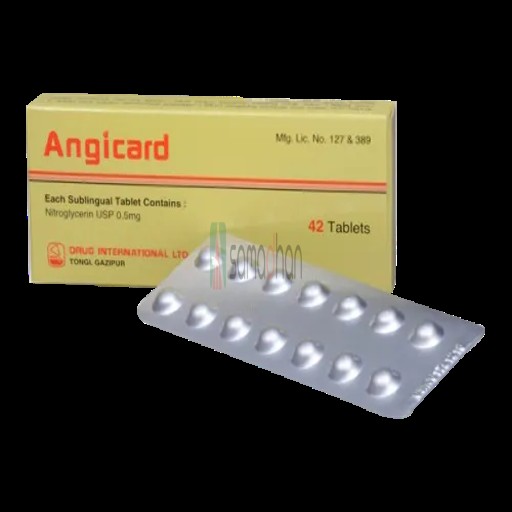
Angicard 0.5 mg is a Product of the Generic Nitroglycerin
Angicard 0.5 mg belongs to the generic category of Nitroglycerin. This medicine should be used according to a doctor's advice. We have provided detailed information about the uses, dosage, effectiveness, side effects, precautions, drug interactions, storage conditions, and other important details of Angicard 0.5 mg. Our goal is to present essential medicine information in one place for patients, caregivers, and healthcare professionals. To better understand Nitroglycerin and ensure the safe use of this medicine, please read the information below carefully and consult a healthcare professional when necessary.
*Up to 10% Discount
(Depends on pharmacy)
Angicard 0.5 mg
Drug International Ltd. · Sublingual Tablet
Nitroglycerin
/ Piece
Description of Angicard 0.5 mg
Angicard 0.5 mg may be available as a prescription or over-the-counter medicine, depending on local regulations and medical recommendations. It is used for the treatment and management of specific conditions or symptoms. The way this medicine is used may vary depending on the patient's condition and the advice of a healthcare provider. Detailed information about the approved uses, therapeutic applications, and other relevant details of Angicard 0.5 mg is provided below to help users gain a clear understanding of this medicine.
What Is Angicard 0.5 mg Indications and Uses?
Nitroglycerin is indicated for acute relief of an attack or prophylaxis of angina pectoris due to coronary artery disease.
Pharmacology (Source, Chemical and Physical Composition) Of Angicard 0.5 mg
The principal pharmacological action of nitroglycerin is relaxation of vascular smooth muscle, producing a vasodilator effect on both peripheral arteries and veins with more prominent effects on the latter. Dilation of the post-capillary vessels, including large veins, promotes peripheral pooling of blood and decreases venous return to the heart, thereby reducing left ventricular enddiastolic pressure (pre-load). Arteriolar relaxation reduces systemic vascular resistance and arterial pressure (after-load).Nitroglycerin forms free radical nitric oxide (NO), which activates guanylate cyclase, resulting in an increase of guanosine 3’5’-monophosphate (cyclic GMP) in smooth muscle and other tissues. This eventually leads to dephosphorylation of myosin light chains, which regulates thecontractile state in smooth muscle and results in vasodilation.Absorption: Nitroglycerin is rapidly absorbed and is often used in emergency situations for this reason. Distribution: The volume of distribution of Nitroglycerin is 3 L/kg. Metabolism: Nitroglycerin is rapidly metabolized in the liver by hepatic enzymes to di-nitrates and mononitrates. Elimination: Nitroglycerin is excreted by the renal route, primarily as the 2 di-nitro-metabolites.
Dosage And Administration of Angicard 0.5 mg
Sublingual tablet: One tablet (0.5 mg) should be dissolved under the tongue at the first sign of an acute anginal attack. The dose may be repeated approximately every five minutes, until relief is obtained. If the pain persists after a total of 3 tablets in a 15-minute period, prompt medical attention is recommended.Sustained release tablet: Dosage should always to be adjusted according to the requirement and response obtained by the individual patient and the severity of the anginal pain.
2.6 mg: 1 tablet 2 times a day before meal (in the morning, at noon). If necessary the doses may be raised gradually 2 or 3 tablets 2 times daily.
6.4 mg: One tablet twice daily. Or as directed by the registered physician
Spray: At the onset of an attack, one metered dose spray or two metered dose sprays should be administered under the tongue. A spray may be repeated approximately every 5 minutes as needed. Maximum of 3 metered sprays are recommended within a 15-minute period. If chest pain persists after a total of 3 sprays, prompt medical attention is recommended. May be used prophylactically 5 minutes to 10 minutes before engaging in activities that might precipitate an acute attack.
Drug Interactions of Angicard 0.5 mg
Patients receiving antihypertensive drugs, beta-adrenergic blockers or phenothiazines and nitrates should be observed for possible additive hypotensive effects. Concomitant use of nitrates and alcohol may cause hypotension. The vasodilatory and hemodynamic effects of Nitroglycerin may be enhanced by concomitant administration of Aspirin.
Side Effects of Angicard 0.5 mg
Most common adverse reactions are headache, flushing and hypotension.
Use During Pregnancy and Lactation
There is no evidence relating to the safety of nitrates in pregnancy and lactation. Nitrates should be administered to pregnant women and nursing mothers unless considered essential by the physician. It is not known whether Nitroglycerin is excreted in human milk.
Precautions And Warnings for Angicard 0.5 mg
Only the smallest dose is required for effective control of the acute anginal attack. Excessive use may lead tothe development of tolerance. This drug should be used with caution in patients who may be volume-depleted or are already hypotensive.
Use In Special Populations
Safety and effectiveness of nitroglycerin in pediatric patients have not been established.
Therapeutic Class
Nitrates: Coronary vasodilators
Storage Conditions of It
Keep out of reach of children. Store in a dry place, below 25°C temperature and protected from light.
Data Source: Data source of Indications and Usages, Pharmacology, Dosage & Administration, Drug Interactions, Side Effects, Use during Pregnancy & Lactation, Precautions & Warnings, Use in Special Populations, Therapeutic Class, and Storage Conditions is the concerned medicine company or respective organization.
Alternative Medicines
⚠ Disclaimer
The information provided on All Samadhan is intended for general informational purposes only and is prepared based on our best practices. It is not a substitute for professional medical advice, diagnosis, or treatment. While we strive to keep the information accurate and up to date, we do not guarantee its completeness or accuracy. The absence of specific information or warnings about any medicine or service should not be considered as an assurance or endorsement by All Samadhan. All Samadhan shall not be held responsible for any consequences arising from the use of this information. We strongly recommend consulting a qualified healthcare professional or physician for any medical concerns, questions, or clarifications.All Samadhan is a digital healthcare software platform operated by MS Genius Experts. We provide technology solutions for pharmacies and healthcare providers; we are not a direct seller or dispenser of prescription medicines

N.B.: All Samadhan is a digital healthcare software platform operated by MS Genius Experts. We provide technology solutions for pharmacies and healthcare providers; we are not a direct seller or dispenser of prescription medicines.
Copyright © All Samadhan - Operated by M/S. Genius Experts | All Rights Reserved
DBID
Registration ID: 176322642
Trade License: TRAD/DNCC/040904/2023