
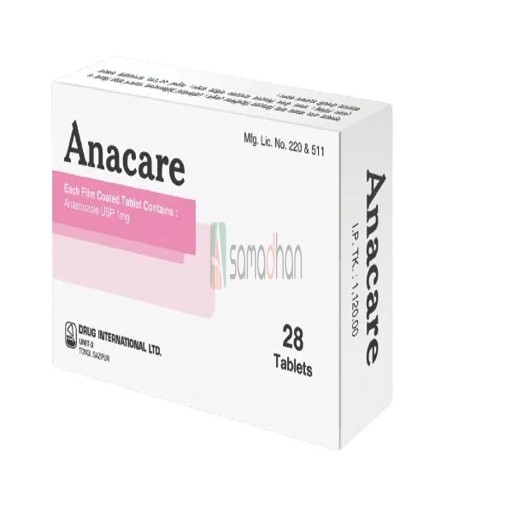
Anacare 1 mg is a Product of the Generic Anastrozole
Anacare 1 mg belongs to the generic category of Anastrozole. This medicine should be used according to a doctor's advice. We have provided detailed information about the uses, dosage, effectiveness, side effects, precautions, drug interactions, storage conditions, and other important details of Anacare 1 mg. Our goal is to present essential medicine information in one place for patients, caregivers, and healthcare professionals. To better understand Anastrozole and ensure the safe use of this medicine, please read the information below carefully and consult a healthcare professional when necessary.
*Up to 10% Discount
(Depends on pharmacy)
Anacare 1 mg
Drug International Ltd. · Tablet
Anastrozole
/ Piece
Description of Anacare 1 mg
Anacare 1 mg may be available as a prescription or over-the-counter medicine, depending on local regulations and medical recommendations. It is used for the treatment and management of specific conditions or symptoms. The way this medicine is used may vary depending on the patient's condition and the advice of a healthcare provider. Detailed information about the approved uses, therapeutic applications, and other relevant details of Anacare 1 mg is provided below to help users gain a clear understanding of this medicine.
What Is Anacare 1 mg Indications and Uses?
Anastrozole is indicated for adjuvant treatment of postmenopausal women with hormone receptor-positive early breast cancer. Anastrozole is indicated for the first-line treatment of postmenopausal women with hormone receptor-positive or hormone receptor unknown locally advanced or metastatic ... Read moreAnastrozole is indicated for adjuvant treatment of postmenopausal women with hormone receptor-positive early breast cancer. Anastrozole is indicated for the first-line treatment of postmenopausal women with hormone receptor-positive or hormone receptor unknown locally advanced or metastatic breast cancer. Anastrozole is indicated for the second-line treatment of advanced breast cancer in postmenopausal women with disease progression following tamoxifen therapy. Patients with ER-negative disease and patients who did not respond to previous tamoxifen therapy rarely responded to Anastrozole.
Pharmacology (Source, Chemical and Physical Composition) Of Anacare 1 mg
Anastrozole is a non-steroidal aromatase inhibitor. The growth of many cancers of the breast is stimulated or maintained by estrogens. In postmenopausal women, estrogens are mainly derived from the action of the aromatase enzyme, which converts adrenal androgens (primarily androstenedione and testosterone) to estrone and estradiol. The suppression of estrogen biosynthesis in peripheral tissues and in the cancer tissue itself can therefore be achieved by specifically inhibiting the aromatase enzyme.
Dosage And Administration of Anacare 1 mg
The dose of Anastrozole is one tablet 1 mg taken once a day. For patients with advanced breast cancer, Anastrozole should be continued until tumor progression. For adjuvant treatment of early breast cancer in postmenonausal women, the optimal duration of therapy is unknown. Patients with Hepatic Impairment: No changes in dose are recommended for patients with mild-to-moderate hepatic impairment. Anastrozole has not been studied in patients with severe hepatic impairment. Patients with Renal Impairment: No changes in dose are necessary for patients with renal impairment.Pediatric Use: The safety and efficacy of Anastrozole in pediatric patients have not been established.Geriatric Use: The pharmacokinetics of Anastrozole are not affected by age.
Drug Interactions of Anacare 1 mg
Co-administration of Anastrozole and tamoxifen in breast cancer patients reduced Anastrozole plasma concentration by 27%. Based on clinical and pharmacokinetic results from the ATAC trial, tamoxifen should not be administered with Anastrozole. Estrogen-containing therapies should not be used with Anastrozole as they may diminish its pharmacological action. In a study conducted in 16 male volunteers, Anastrozole did not alter the exposure (as measured by Cmax and AUC) and anticoagulant activity (as measured by prothrombin time, activated partial thromboplastin time, and thrombin time) of both R- and S-warfarin. Based on in vitro and in vivo results, it is unlikely that co-administration of Anastrozole 1 mg will affect other drugs as a result inhibition of cytochrome P450.
Side Effects of Anacare 1 mg
Serious adverse reactions with Anastrozole occurring in less than 1 in 10,000 patients, are: 1) skin reactions such as lesions, ulcers, or blisters; 2) allergic reactions with swelling of the face, lips, tongue, and/or throat. This may cause difficulty in swallowing and/or breathing; and 3) changes in blood tests of the liver function, including inflammation of the liver with symptoms that may include a general feeling of not being well, with or without jaundice, liver pain or liver swelling. Common adverse reactions (occurring with an incidence of >10%) in women taking Anastrozole included: hot flashes, asthenia, arthritis, pain, arthralgia, hypertension, depression, nausea and vomiting, rash, osteoporosis, fractures, back pain, insomnia, pain, headache, bone pain, peripheral edema, increased cough, dyspnea, pharyngitis and lymphedema.
Use During Pregnancy and Lactation
Pregnancy Category X. It is not known it Anastrozole is excreted in human milk. Because many drugs are excreted in human milk or the potential for serious adverse reactions in nursing infants, a decision should be made whether to discontinue nursing or to discontinue the drug, taking into account the importance of the drug to the mother.
Precautions And Warnings for Anacare 1 mg
Ischemic Cardiovascular Events: In women with pre-existing ischemic heart disease, an increased incidence of ischemic cardiovascular events was observed with Anastrozole in the ATAC trial (17% of patients on Anastrozole and 10% of patients on tamoxifen). Risk and benefits of Anastrozole therapy should be considered in patients with pre-existing ischemic heart disease.Bone Effects: Results from the ATAC trial bone substudy at 12 and 24 months demonstrated that patients receiving Anastrozole had a mean decrease in both lumbar spine and total hip bone mineral density (BMD) compared to baseline. Patients receiving tamoxifen had a mean increase in both lumbar spine and total hip BMD compared to baseline.Cholesterol: During the ATAC trial, more patients receiving Anastrozole were reported to have elevated serum cholesterol compared to patients receiving tamoxifen (9% versus 3.5%, respectively).
Therapeutic Class
Hormonal Chemotherapy
Storage Conditions of It
Keep below 30°C temperature, away from light & moisture. Keep out of the reach of children.
Data Source: Data source of Indications and Usages, Pharmacology, Dosage & Administration, Drug Interactions, Side Effects, Use during Pregnancy & Lactation, Precautions & Warnings, Use in Special Populations, Therapeutic Class, and Storage Conditions is the concerned medicine company or respective organization.
Alternative Medicines
⚠ Disclaimer
The information provided on All Samadhan is intended for general informational purposes only and is prepared based on our best practices. It is not a substitute for professional medical advice, diagnosis, or treatment. While we strive to keep the information accurate and up to date, we do not guarantee its completeness or accuracy. The absence of specific information or warnings about any medicine or service should not be considered as an assurance or endorsement by All Samadhan. All Samadhan shall not be held responsible for any consequences arising from the use of this information. We strongly recommend consulting a qualified healthcare professional or physician for any medical concerns, questions, or clarifications.All Samadhan is a digital healthcare software platform operated by MS Genius Experts. We provide technology solutions for pharmacies and healthcare providers; we are not a direct seller or dispenser of prescription medicines

N.B.: All Samadhan is a digital healthcare software platform operated by MS Genius Experts. We provide technology solutions for pharmacies and healthcare providers; we are not a direct seller or dispenser of prescription medicines.
Copyright © All Samadhan - Operated by M/S. Genius Experts | All Rights Reserved
DBID
Registration ID: 176322642
Trade License: TRAD/DNCC/040904/2023