
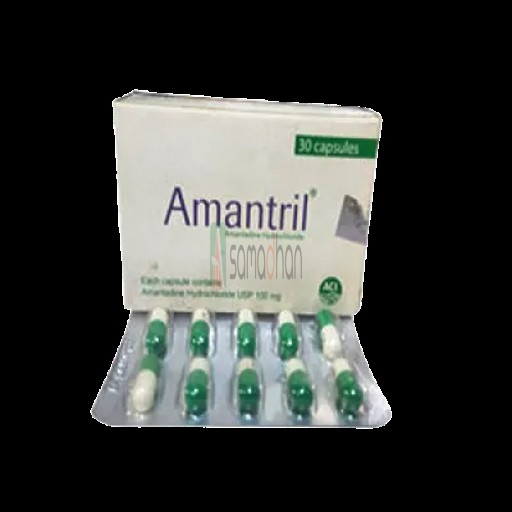
Amantril 100 mg is a Product of the Generic Amantadine Hydrochloride
Amantril 100 mg belongs to the generic category of Amantadine Hydrochloride. This medicine should be used according to a doctor's advice. We have provided detailed information about the uses, dosage, effectiveness, side effects, precautions, drug interactions, storage conditions, and other important details of Amantril 100 mg. Our goal is to present essential medicine information in one place for patients, caregivers, and healthcare professionals. To better understand Amantadine Hydrochloride and ensure the safe use of this medicine, please read the information below carefully and consult a healthcare professional when necessary.
*Up to 10% Discount
(Depends on pharmacy)
Amantril 100 mg
ACI Limited · Capsule
Amantadine Hydrochloride
/ Piece
Description of Amantril 100 mg
Amantril 100 mg may be available as a prescription or over-the-counter medicine, depending on local regulations and medical recommendations. It is used for the treatment and management of specific conditions or symptoms. The way this medicine is used may vary depending on the patient's condition and the advice of a healthcare provider. Detailed information about the approved uses, therapeutic applications, and other relevant details of Amantril 100 mg is provided below to help users gain a clear understanding of this medicine.
What Is Amantril 100 mg Indications and Uses?
Amantadine Hydrochloride is indicated for-
Treatment of parkinsonism
Treatment of drug-induced extrapyramidal reactions
Prophylaxis and treatment of signs and symptoms of infection caused by various strains of influenza A virus
Pharmacology (Source, Chemical and Physical Composition) Of Amantril 100 mg
Amantadine Hydrochloride has direct and indirect effects on dopamine neurons. It acts on the pre-synaptic membrane, enhancing the release of dopamine and inhibiting its reuptake. Post-synaptically, Amantadine acts directly on the dopamine receptor, and up regulates D2 receptors. This may be due to Amantadine-induced hypersensitivity of dopamine receptors. It has antimuscarinic properties. Amantadine also has antiglutamatergic properties, via non-competitive antagonism of NMDA receptors. Furthermore, potent, competitive, non-subunit selective NMDA receptor antagonists reduce the severity of levodopa-induced dyskinesias. NMDA receptor sensitization may be a key event in the genesis of levodopa-induced dyskinesias. It also has immunomodulatory properties. It restores the production of interleukin-2 (IL-2), which is defective in Parkinson’s disease patients. The mechanism by which Amantadine exerts its antiviral activity is not clearly understood. It appears to mainly prevent the release of infectious viral nucleic acid into the host cell by interfering with the function of the transmembrane domain of the viral M2 protein. Amantadine is also known to prevent virus assembly during virus replication. It does not appear to interfere with the immunogenicity of inactivated influenza A virus vaccine.
Dosage And Administration of Amantril 100 mg
Parkinson's disease-
Adults: The usual dose is 100 mg twice a day when used alone.
The initial dose of Amantadine is 100 mg daily for patients with serious associated medical illnesses or who are receiving high doses of other antiparkinson drugs. After one to several weeks at 100 mg once daily, the dose may be increased to 100 mg twice daily, if necessary.
Occasionally, patients whose responses are not optimal with Amantadine at 200 mg daily may benefit from an increase up to 400 mg daily in divided doses.
Dosage for Concomitant Therapy: Some patients who do not respond to anticholinergic antiparkinson drugs may respond to Amantadine.
When Amantadine or anticholinergic antiparkinson drugs are each used with marginal benefit, concomitant use may produce additional benefit. When Amantadine and levodopa therapy are initiated concurrently, the patient can exhibit rapid therapeutic benefits. Amantadine dose, should be held constant at 100 mg daily or twice daily while the daily dose of levodopa is gradually increased to optimal benefit.
When Amantadine is added to optimal well-tolerated doses of levodopa, additional benefit may result, including smoothing out the fluctuations in improvement which sometimes occur in patients on levodopa alone. Patients who require a reduction in their usual dose of levodopa because of development of side effects may possibly regain lost benefit with the addition of Amantadine.
Drug-induced extrapyramidal reactions-
Adults: The usual dose is 100 mg twice a day.
Occasionally, patients whose responses are not optimal with Amantadine at 200 mg daily may benefit from an increase up to 300 mg daily in divided doses.
Prophylaxis and treatment of Influenza A virus illness-
Adults: 200 mg/day as single dose or 100 mg twice daily. If CNS effects develop on a once- daily dosage, split dosage schedule may reduce complaints.
Elderly over 65 years of age: 100 mg every day.
Children: 1 to 9 years of age: 4.4 to 8.8 mg/kg/day; not to exceed 150 mg/day. 9 to 12 years of age: 100 mg twice daily
Method of administration: Each capsule is to be taken orally either with or without food.Patients with renal impairment: The dose should be reduced. This can be achieved by either reducing the total daily dose, or by increasing the dosage interval in accordance with the creatinine clearance.Patients with hepatic impairment: Use with caution.
Drug Interactions of Amantril 100 mg
Concurrent administration of Amantadine and anticholinergic agents or levodopa may increase confusion, hallucinations, nightmares, gastro-intestinal disturbances, or other atropine-like side effects. Psychotic reactions have been observed in patients receiving Amantadine and Levodopa. Concurrent administration of Amantadine and drugs or substances (e.g. alcohol) acting on the CNS may result in additive CNS toxicity. Close observation is recommended.
Side Effects of Amantril 100 mg
The adverse effects of Amantadine are generally mild and, when they occur, may diminish or cease after a week or more on the medication. The most commonly reported side effects include nausea, dizziness/lightheadedness, and insomnia. Other side effects may include edema of ankles, livedo reticularis; anxiety, elevation of mood, headache, lethargy, hallucinations, ataxia, slurred speech, blurred vision, loss of concentration, nervousness, depression, myalgia, palpitations, orthostatic hypotension, dry mouth, anorexia, constipation and diaphoresis.
Use During Pregnancy and Lactation
Pregnancy category C. No well-controlled studies have been done in pregnant women to evaluate Amantadine’s safety. Amantadine may be used during pregnancy when the potential benefits outweigh the potential but unknown risks to the fetus. Amantadine is excreted into breast milk in low concentrations. As no information is available on the effects in infants, therefore amantadine should be used cautiously in women who are breastfeeding.
Precautions And Warnings for Amantril 100 mg
Amantadine should not be discontinued abruptly in patients with Parkinson's disease since a few patients have experienced a parkinsonian crisis, i.e., a sudden marked clinical deterioration, when this medication was suddenly stopped. The dose of anticholinergic drugs or of Amantadine Hydrochloride should be reduced if atropine-like effects appear when these drugs are used concurrently. Abrupt discontinuation may also precipitate delirium, agitation, delusions, hallucinations, paranoid reaction, stupor, anxiety, depression and slurred speech.
Therapeutic Class
Respiratory viral infections (Influenza)
Storage Conditions of It
Keep away from the reach of children. Store in a cool & dry place. Protect from light.
Data Source: Data source of Indications and Usages, Pharmacology, Dosage & Administration, Drug Interactions, Side Effects, Use during Pregnancy & Lactation, Precautions & Warnings, Use in Special Populations, Therapeutic Class, and Storage Conditions is the concerned medicine company or respective organization.
Alternative Medicines
⚠ Disclaimer
The information provided on All Samadhan is intended for general informational purposes only and is prepared based on our best practices. It is not a substitute for professional medical advice, diagnosis, or treatment. While we strive to keep the information accurate and up to date, we do not guarantee its completeness or accuracy. The absence of specific information or warnings about any medicine or service should not be considered as an assurance or endorsement by All Samadhan. All Samadhan shall not be held responsible for any consequences arising from the use of this information. We strongly recommend consulting a qualified healthcare professional or physician for any medical concerns, questions, or clarifications.All Samadhan is a digital healthcare software platform operated by MS Genius Experts. We provide technology solutions for pharmacies and healthcare providers; we are not a direct seller or dispenser of prescription medicines

N.B.: All Samadhan is a digital healthcare software platform operated by MS Genius Experts. We provide technology solutions for pharmacies and healthcare providers; we are not a direct seller or dispenser of prescription medicines.
Copyright © All Samadhan - Operated by M/S. Genius Experts | All Rights Reserved
DBID
Registration ID: 176322642
Trade License: TRAD/DNCC/040904/2023