
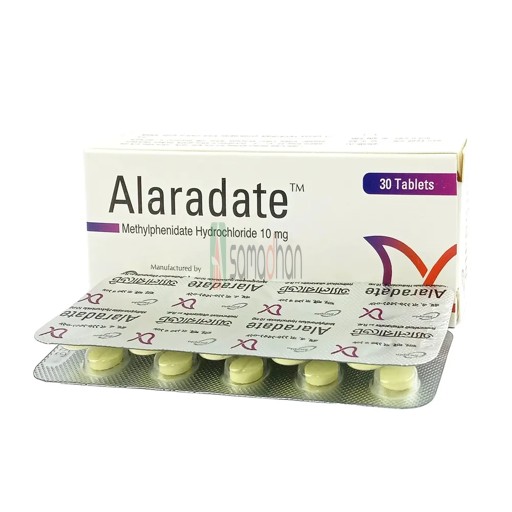
Alaradate 10 mg is a Product of the Generic Methylphenidate Hydrochloride
Alaradate 10 mg belongs to the generic category of Methylphenidate Hydrochloride. This medicine should be used according to a doctor's advice. We have provided detailed information about the uses, dosage, effectiveness, side effects, precautions, drug interactions, storage conditions, and other important details of Alaradate 10 mg. Our goal is to present essential medicine information in one place for patients, caregivers, and healthcare professionals. To better understand Methylphenidate Hydrochloride and ensure the safe use of this medicine, please read the information below carefully and consult a healthcare professional when necessary.
*Up to 10% Discount
(Depends on pharmacy)
Alaradate 10 mg
Incepta Pharmaceuticals Ltd. · Tablet
Methylphenidate Hydrochloride
/ Piece
Description of Alaradate 10 mg
Alaradate 10 mg may be available as a prescription or over-the-counter medicine, depending on local regulations and medical recommendations. It is used for the treatment and management of specific conditions or symptoms. The way this medicine is used may vary depending on the patient's condition and the advice of a healthcare provider. Detailed information about the approved uses, therapeutic applications, and other relevant details of Alaradate 10 mg is provided below to help users gain a clear understanding of this medicine.
What Is Alaradate 10 mg Indications and Uses?
Methylphenidate tablet is used in the treatment of attention deficit hyper activity disorder (ADHD) and narcolepsy.
Pharmacology (Source, Chemical and Physical Composition) Of Alaradate 10 mg
methylphenidate (MPH) has been shown to act as a norepinephrine and dopamine reuptake inhibitor (NDRI), thereby increasing the presence of these neurotransmitters in the extraneuronal space and prolonging their action. There is a dose-related effect of psychostimulants on receptor stimulation, where higher doses are shown to increase norepinephrine (NE) and dopamine (DA) efflux throughout the brain which can result in impaired cognition and locomotor-activating effects. In contrast, low doses are found to selectively activate NE and DE neurotransmission within the prefrontal cortex which is an area of the brain thought to play a prominent role in ADHD pathophysiology, thereby improving clinical efficacy and preventing side effects. The lower doses used to treat ADHD are not associated with the locomotor-activating effects associated with higher doses and instead reduce movement, impulsivity, and increase cognitive function including sustained attention and working memory. Methylphenidate's beneficial effects in sustaining attention have also been shown to be mediated by alpha-1 adrenergic receptor activity.Clinical findings have shown that children with ADHD have an abnormality in the dopamine transporter gene (DAT1), the D4 receptor gene (DRD-4), and/or the D2 receptor gene that may be at least partly overcome by the dopaminergic effects of methylphenidate, suggesting a possible mode of action.
Dosage And Administration of Alaradate 10 mg
Child: Over 6 years, initially 5 mg 1-2 times daily, increased if necessary at weekly intervals by 5-10 mg daily to max. 60 mg daily in divided doses; discontinue if no response after one month also suspend periodically to assess child’s condition (usually finally discontinued during or after puberty); Child under 6 years not recommended.Adult: 10-15 mg daily in divided doses (2-3 times daily). Average dosage is 20-30 mg daily. Some patients may require 40-60 mg daily. Patients who are unable to sleep if medication is taken late in the day should take the last dose before 6 pm.
Drug Interactions of Alaradate 10 mg
The elimination of phenytoin is slowed by methylphenidate. It may also increase the anticoagulant effect of Coumarin. It also increases the serum concentration of imipramine and desipramine.
Side Effects of Alaradate 10 mg
Sleep disturbances, restlessness, dizziness, headache, tremor, convulsion, rash, pruritis; urticaria, fever, arthralgia, alopecia, exfoliative, dermatitis, erythema multiforme, thrombocytopenic purpuria, thrombocytopenia, Leucopenia, urinary disorder and very rarely liver damage.
Use During Pregnancy and Lactation
The use of methylphenidate in pregnancy and lactation has not been established.
Precautions And Warnings for Alaradate 10 mg
In mild hypertension (contraindicated if moderate or severe)-monitor blood pressure; history of epilepsy; tics and Tourette syndrome. Occasional cystic ovarian swellings in premenopausal women, occasional hypercalcemia if bony metastases; increased risk of thromboembolic events when used with cytotoxics; breast feeding; endometrial changes; porphyria
Therapeutic Class
CNS stimulant drugs
Storage Conditions of It
Store in a cool (below 25°C) and dry place, away from light. Keep out of reach of the children.
Data Source: Data source of Indications and Usages, Pharmacology, Dosage & Administration, Drug Interactions, Side Effects, Use during Pregnancy & Lactation, Precautions & Warnings, Use in Special Populations, Therapeutic Class, and Storage Conditions is the concerned medicine company or respective organization.
Alternative Medicines
⚠ Disclaimer
The information provided on All Samadhan is intended for general informational purposes only and is prepared based on our best practices. It is not a substitute for professional medical advice, diagnosis, or treatment. While we strive to keep the information accurate and up to date, we do not guarantee its completeness or accuracy. The absence of specific information or warnings about any medicine or service should not be considered as an assurance or endorsement by All Samadhan. All Samadhan shall not be held responsible for any consequences arising from the use of this information. We strongly recommend consulting a qualified healthcare professional or physician for any medical concerns, questions, or clarifications.All Samadhan is a digital healthcare software platform operated by MS Genius Experts. We provide technology solutions for pharmacies and healthcare providers; we are not a direct seller or dispenser of prescription medicines

N.B.: All Samadhan is a digital healthcare software platform operated by MS Genius Experts. We provide technology solutions for pharmacies and healthcare providers; we are not a direct seller or dispenser of prescription medicines.
Copyright © All Samadhan - Operated by M/S. Genius Experts | All Rights Reserved
DBID
Registration ID: 176322642
Trade License: TRAD/DNCC/040904/2023