
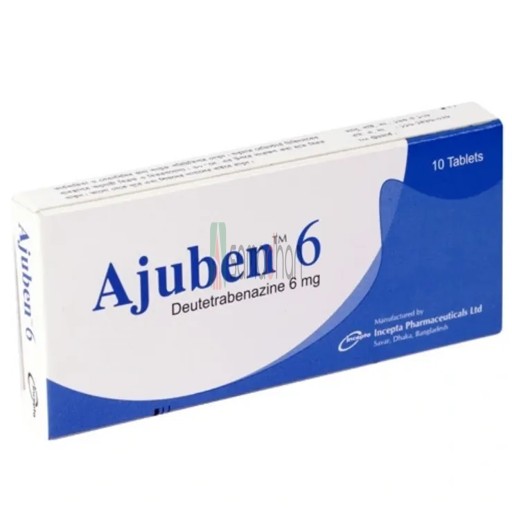
Ajuben 6 mg is a Product of the Generic Deutetrabenazine
Ajuben 6 mg belongs to the generic category of Deutetrabenazine. This medicine should be used according to a doctor's advice. We have provided detailed information about the uses, dosage, effectiveness, side effects, precautions, drug interactions, storage conditions, and other important details of Ajuben 6 mg. Our goal is to present essential medicine information in one place for patients, caregivers, and healthcare professionals. To better understand Deutetrabenazine and ensure the safe use of this medicine, please read the information below carefully and consult a healthcare professional when necessary.
*Up to 10% Discount
(Depends on pharmacy)
Ajuben 6 mg
Incepta Pharmaceuticals Ltd. · Tablet
Deutetrabenazine
/ Piece
Description of Ajuben 6 mg
Ajuben 6 mg may be available as a prescription or over-the-counter medicine, depending on local regulations and medical recommendations. It is used for the treatment and management of specific conditions or symptoms. The way this medicine is used may vary depending on the patient's condition and the advice of a healthcare provider. Detailed information about the approved uses, therapeutic applications, and other relevant details of Ajuben 6 mg is provided below to help users gain a clear understanding of this medicine.
What Is Ajuben 6 mg Indications and Uses?
Deutetrabenazine is a vesicular monoamine transporter 2 (VMAT2) inhibitor indicated for the treatment of-
Chorea associated with Huntington's disease
Tardive dyskinesia in adults.
Pharmacology (Source, Chemical and Physical Composition) Of Ajuben 6 mg
The precise mechanism by which deutetrabenazine exerts its anti-chorea effects is unknown but is believed to be related to its effect as a reversible depletor of monoamines (such as dopamine, serotonin, norepinephrine, and histamine) from nerve terminals. The major circulating metabolites (α-dihydrotetrabenazine and β-dihydrotetrabenazine) of deutetrabenazine, are reversible inhibitors of vesicular monoamine transporter 2 (VMAT2), resulting in decreased uptake of monoamines into synaptic vesicles and depletion of monoamine stores.
Dosage And Administration of Ajuben 6 mg
Patients not presently receiving Tetrabenazine:Chorea associated with Huntington’s disease-
Initial dose: 6 mg/day
Maintenance dose: 6 mg-48 mg/day
Maximum dose: 48 mg/day
Tardive dyskinesia-
Initial dose: 12 mg/day
Maintenance dose: 12 mg-48 mg/day
Maximum dose: 48 mg/day
Titrate up at weekly intervals by 6 mg per day to a tolerated dose that reduces chorea, up to a maximum recommended daily dosage of 48 mg (24 mg twice daily). Administer total daily dosages of 12 mg or above in two divided doses and administer with foods.Patients receiving Tetrabenazine: If switching patients from tetrabenazine, discontinue tetrabenazine and initiate deutetrabenazine the following day. The recommended initial dosing regimen of deutetrabenazine in patients switching from tetrabenazine to deutetrabenazine is shown in below chert:
Current Tetrabenazine daily dosage
Initial regimen of Deutetrabenazine
12.5 mg
6 mg once daily
25 mg
6 mg once daily
37.5 mg
9 mg once daily
50 mg
12 mg once daily
62.5 mg
15 mg once daily
75 mg
18 mg once daily
87.5 mg
21 mg once daily
100 mg
24 mg once daily
After patients are switched to deutetrabenazine, the dose may be adjusted at weekly intervals.
Drug Interactions of Ajuben 6 mg
Concomitant use of strong CYP2D6 inhibitors: Maximum recommended dose of deutetrabenazine is 36 mg per day (18 mg twice daily) and alcohol or other sedating drugs- may have additive sedation and somnolence.
Side Effects of Ajuben 6 mg
Most common adverse reactions (>8%) of deutetrabenzine’s are somnolence, diarrhea, dry mouth, and fatigue.
Use During Pregnancy and Lactation
There are no adequate data on the developmental risk associated with the use of deutetrabenazine in pregnant women. There are no data on the presence of deutetrabenazine or its metabolites in human milk, the effects on the breastfed infant, or the effects of the drug on milk production.
Precautions And Warnings for Ajuben 6 mg
Patients may experience Neuroleptic Malignant Syndrome (discontinue deutetrabenazine if this occurs), Akathisia, agitation, restlessness, and Parkinsonism (reduce the daily dose of deutetrabenazine or discontinue if this occurs) and Sedation/somnolence.
Use In Special Populations
Use in Children: Safety & effectiveness of deutetrabenzine in infants & children have not been established.Patients with Hepatic & Renal Impairment: No clinical studies have been conducted to assess the effect of renal & hepatic impairment on the pharmacokinetics of deutetrabenazine.Patients with poor CYP2D6 metabolizers: Maximum recommended dosage of deutetrabenazine in poor CYP2D6 metabolizers is 36 mg per day (i.e., 18 mg twice daily)
Storage Conditions of It
Keep below 30°C temperature, away from light & moisture. Keep out of the reach of children.
Data Source: Data source of Indications and Usages, Pharmacology, Dosage & Administration, Drug Interactions, Side Effects, Use during Pregnancy & Lactation, Precautions & Warnings, Use in Special Populations, Therapeutic Class, and Storage Conditions is the concerned medicine company or respective organization.
Alternative Medicines
⚠ Disclaimer
The information provided on All Samadhan is intended for general informational purposes only and is prepared based on our best practices. It is not a substitute for professional medical advice, diagnosis, or treatment. While we strive to keep the information accurate and up to date, we do not guarantee its completeness or accuracy. The absence of specific information or warnings about any medicine or service should not be considered as an assurance or endorsement by All Samadhan. All Samadhan shall not be held responsible for any consequences arising from the use of this information. We strongly recommend consulting a qualified healthcare professional or physician for any medical concerns, questions, or clarifications.All Samadhan is a digital healthcare software platform operated by MS Genius Experts. We provide technology solutions for pharmacies and healthcare providers; we are not a direct seller or dispenser of prescription medicines

N.B.: All Samadhan is a digital healthcare software platform operated by MS Genius Experts. We provide technology solutions for pharmacies and healthcare providers; we are not a direct seller or dispenser of prescription medicines.
Copyright © All Samadhan - Operated by M/S. Genius Experts | All Rights Reserved
DBID
Registration ID: 176322642
Trade License: TRAD/DNCC/040904/2023