
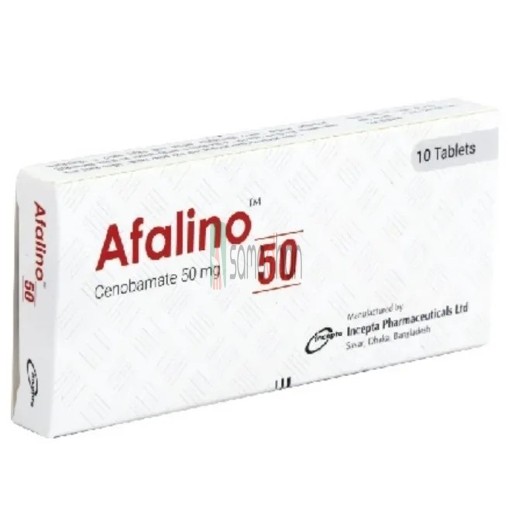
Afalino 50 mg is a Product of the Generic Cenobamate
Afalino 50 mg belongs to the generic category of Cenobamate. This medicine should be used according to a doctor's advice. We have provided detailed information about the uses, dosage, effectiveness, side effects, precautions, drug interactions, storage conditions, and other important details of Afalino 50 mg. Our goal is to present essential medicine information in one place for patients, caregivers, and healthcare professionals. To better understand Cenobamate and ensure the safe use of this medicine, please read the information below carefully and consult a healthcare professional when necessary.
*Up to 10% Discount
(Depends on pharmacy)
Afalino 50 mg
Incepta Pharmaceuticals Ltd. · Tablet
Cenobamate
/ Piece
Description of Afalino 50 mg
Afalino 50 mg may be available as a prescription or over-the-counter medicine, depending on local regulations and medical recommendations. It is used for the treatment and management of specific conditions or symptoms. The way this medicine is used may vary depending on the patient's condition and the advice of a healthcare provider. Detailed information about the approved uses, therapeutic applications, and other relevant details of Afalino 50 mg is provided below to help users gain a clear understanding of this medicine.
What Is Afalino 50 mg Indications and Uses?
Cenobamate is indicated for the treatment of partial-onset seizures in adult patients.
Pharmacology (Source, Chemical and Physical Composition) Of Afalino 50 mg
Cenobamate is a positive GABA-A modulator which inhibits voltage-gated sodium channels. Inhibition of voltage-gated sodium channels increases the threshold for generating action potentials and decreases the number of action potentials. Its dual, complementary mechanisms of action may contribute to superior anti-seizure activity.
Dosage And Administration of Afalino 50 mg
Cenobamate can be taken with or without food, or as recommended by a physician. Recommended dosage for partial-onset seizures in adult-Initial Dosage: For Week 1 and 2 dose is 12.5 mg once dailyTitration Regimen:
For Week 3 and 4 dose is 25 mg once daily
For Week 5 and 6 dose is 50 mg once daily
For Week 7 and 8 dose is 100 mg once daily
For Week 9 and 10 dose is 150 mg once daily
Maintenance Dosage: For Week 11 and thereafter dose is 200 mg once dailyMaximum Dosage: If needed based on clinical response and tolerability, the dose may be increased above 200 mg by increments of 50 mg once daily every two weeks to 400 mg once daily.
Drug Interactions of Afalino 50 mg
Phenytoin: Gradually decrease phenytoin dosage by up to 50%Phenobarbital and Clobazam: Reduce dosage as needed when used concomitantly with Cenobamate.Lamotrigine, Carbamazepine: Increase dosage as needed when used concomitantly with Cenobamate.CYP2B6 and CYP3A Substrates: Increase dosage as needed when used concomitantly with Cenobamate.CYP2C19 Substrates: Reduce dosage as needed when used concomitantly with Cenobamate.Oral Contraceptives: Effectiveness of hormonal oral contraceptives may be reduced when administered concomitantly with Cenobamate. Women should use additional or alternative non-hormonal birth control
Side Effects of Afalino 50 mg
Common: Somnolence, fatigue, dizziness or feeling sleepy, nausea, constipation, double vision, decreased appetite, diarrhea, or weakness may occur.Rare: A very serious allergic reaction to this drug is rare.
Use During Pregnancy and Lactation
There are no adequate and well-controlled studies in pregnant women with the use of Cenobamate. But it may cause fetal harm when administered to a pregnant woman. It should be used during pregnancy only if the potential benefits justify the potential risk to the fetus. There are no data on the presence of Cenobamate in human milk, the effects of Cenobamate on the breastfed infant, or the effects of Cenobamate on milk production.
Precautions And Warnings for Afalino 50 mg
Potential adverse effects such as Multiorgan hypersensitivity reaction, QT shortening, and Suicidal thoughts. Somnolence and fatigue should be periodically re-evaluated. During cenobamate therapeutic regimen, patients are advised not to drive or operate machinery. Cenobamate should be gradually withdrawn to minimize the potential or increased seizure frequency.Drug Reaction with Eosinophilia and Systemic Symptoms (DRESS) / Multi-Organ Hypersensitivity: Discontinue if no alternate etiology.QT Shortening: Use caution when administering Cenobamate with other drugs that shorten the QT intervalSuicidal Behavior and Ideation: Monitor patients for suicidal behavior and ideation.Neurological Adverse Reactions: Monitor for somnolence and fatigue and advise patients not to drive or operate machinery until they have gained sufficient experience on Cenobamate. Concomitant use with other CNS depressants or alcohol may have additive effects.Withdrawal of Antiepileptic Drugs: Cenobamate should be gradually withdrawn to minimize the potential of increased seizure frequency
Use In Special Populations
Pediatric use: The safety and efficacy of cenobamate in children under 18 years have not yet been established.Geriatric use: Start at the low end of the dosing range.Renal impairment: Cenobamate should be used with caution and reduction of the target dose may be considered in patients with mild to moderate (creatinine clearance 30 to <90 ml/min) or severe (creatinine clearance <30 ml/min) renal impairment. The maximum recommended dose for patients with mild, moderate, or severe renal impairment is 300 mg/day. Cenobamate should not be used in patients with end-stage renal disease or patients undergoing hemodialysis.Hepatic impairment: Use with caution in patients with mild to moderate hepatic impairment: lower maximum dose and additional dose reduction may be considered. The use of cenobamate in patients with severe hepatic impairment is not recommended.
Therapeutic Class
Adjunct anti-epileptic drugs
Storage Conditions of It
Do not store above 30 degree C. Keep away from light and out of the reach of children.
Data Source: Data source of Indications and Usages, Pharmacology, Dosage & Administration, Drug Interactions, Side Effects, Use during Pregnancy & Lactation, Precautions & Warnings, Use in Special Populations, Therapeutic Class, and Storage Conditions is the concerned medicine company or respective organization.
Alternative Medicines
⚠ Disclaimer
The information provided on All Samadhan is intended for general informational purposes only and is prepared based on our best practices. It is not a substitute for professional medical advice, diagnosis, or treatment. While we strive to keep the information accurate and up to date, we do not guarantee its completeness or accuracy. The absence of specific information or warnings about any medicine or service should not be considered as an assurance or endorsement by All Samadhan. All Samadhan shall not be held responsible for any consequences arising from the use of this information. We strongly recommend consulting a qualified healthcare professional or physician for any medical concerns, questions, or clarifications.All Samadhan is a digital healthcare software platform operated by MS Genius Experts. We provide technology solutions for pharmacies and healthcare providers; we are not a direct seller or dispenser of prescription medicines

N.B.: All Samadhan is a digital healthcare software platform operated by MS Genius Experts. We provide technology solutions for pharmacies and healthcare providers; we are not a direct seller or dispenser of prescription medicines.
Copyright © All Samadhan - Operated by M/S. Genius Experts | All Rights Reserved
DBID
Registration ID: 176322642
Trade License: TRAD/DNCC/040904/2023