
Actemra 162 mg/0.9 ml is a Product of the Generic Tocilizumab
Actemra 162 mg/0.9 ml belongs to the generic category of Tocilizumab. This medicine should be used according to a doctor's advice. We have provided detailed information about the uses, dosage, effectiveness, side effects, precautions, drug interactions, storage conditions, and other important details of Actemra 162 mg/0.9 ml. Our goal is to present essential medicine information in one place for patients, caregivers, and healthcare professionals. To better understand Tocilizumab and ensure the safe use of this medicine, please read the information below carefully and consult a healthcare professional when necessary.
*Up to 10% Discount
(Depends on pharmacy)
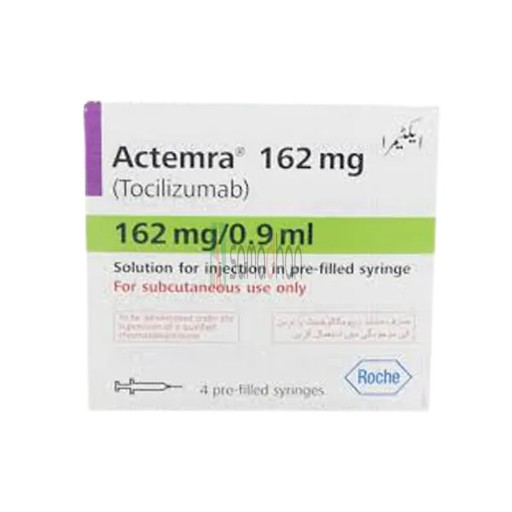
Actemra 162 mg/0.9 ml
Roche Bangladesh Ltd. · SC Injection
Tocilizumab
/ 0.9 ml pre-filled syringe
Description of Actemra 162 mg/0.9 ml
Actemra 162 mg/0.9 ml may be available as a prescription or over-the-counter medicine, depending on local regulations and medical recommendations. It is used for the treatment and management of specific conditions or symptoms. The way this medicine is used may vary depending on the patient's condition and the advice of a healthcare provider. Detailed information about the approved uses, therapeutic applications, and other relevant details of Actemra 162 mg/0.9 ml is provided below to help users gain a clear understanding of this medicine.
What Is Actemra 162 mg/0.9 ml Indications and Uses?
Tocilizumab is an interleukin-6 (IL-6) receptor antagonist indicated for treatment of:
Rheumatoid Arthritis (RA): Adult patients with moderately to severely active rheumatoid arthritis who have had an inadequate response to one or more Disease-Modifying Anti-Rheumatic Drugs (DMARDs) ... Read moreTocilizumab is an interleukin-6 (IL-6) receptor antagonist indicated for treatment of:
Rheumatoid Arthritis (RA): Adult patients with moderately to severely active rheumatoid arthritis who have had an inadequate response to one or more Disease-Modifying Anti-Rheumatic Drugs (DMARDs)
Polyarticular Juvenile Idiopathic Arthritis (PJIA): Patients 2 years of age and older with active polyarticular juvenile idiopathic arthritis
Systemic Juvenile Idiopathic Arthritis (SJIA): Patients 2 years of age and older with active systemic juvenile idiopathic arthritis
Cytokine Release Syndrome (CRS): Adults and pediatric patients 2 years of age and older with chimeric antigen receptor (CAR) T cell-induced severe or life-threatening cytokine release syndrome
Giant Cell Arteritis (GCA): Adult patients with giant cell arteritis
Systemic Sclerosis-Associated Interstitial Lung Disease (SSc-ILD): Slowing the rate of decline in pulmonary function in adult patients with systemic sclerosis-associated interstitial lung disease (SSc-ILD)
COVID-19: Emergency use of Tocilizumab for the treatment of coronavirus disease 2019 in hospitalized adults and pediatric patients (2 years of age and older) who are receiving systemic corticosteroids and require supplemental oxygen, non-invasive or invasive mechanical ventilation, or extracorporeal membrane oxygenation (ECMO)
Pharmacology (Source, Chemical and Physical Composition) Of Actemra 162 mg/0.9 ml
Tocilizumab is a recombinant humanized anti-human interleukin 6 (IL-6) receptor monoclonal antibody of theimmunoglobulin IgG1K (gamma 1, kappa) subclass. Tocilizumab binds to both soluble and membrane-bound IL-6 receptors, and has been shown to inhibit IL-6-mediated signaling through these receptors. IL-6 is a pleiotropic pro-inflammatory cytokine produced by a variety of cell types including T-cells and B-cells, lymphocytes, monocytes, and fibroblasts. IL-6 has been shown to be involved in diverse physiological processes such as T-cell activation, induction of immunoglobulin secretion, initiation of hepatic acute phaseprotein synthesis, and stimulation of hematopoietic precursor cell proliferation and differentiation. IL-6 is also produced by synovial and endothelial cells leading to local production of IL-6 in joints affected by inflammatory processes such as rheumatoid arthritis.
Dosage And Administration of Actemra 162 mg/0.9 ml
Interruption of dosing may be needed for management of dose-related laboratory abnormalities including elevated liver enzymes, neutropenia, and thrombocytopenia.Rheumatoid Arthritis: Tocilizumab may be used as monotherapy or concomitantly with methotrexate or other non-biologic DMARDs as an intravenous infusion.Recommended Intravenous Dosage Regimen:
The recommended dosage of Tocilizumab for adult patients given as a 60-minute single intravenous drip infusion is 4 mg per kg of body weight every 4 weeks followed by an increase to 8 mg per kg of body weight every 4 weeks based on clinical response.
Reduction of dose from 8 mg per kg of body weight to 4 mg per kg of body weight is recommended for management of certain dose-related laboratory changes including elevated liver enzymes, neutropenia, and thrombocytopenia
Doses exceeding 800 mg per infusion are not recommended in RA patients
Polyarticular Juvenile Idiopathic Arthritis: Tocilizumab may be used as an intravenous infusion or as asubcutaneous injection alone or in combination with methotrexate. Do not change dose based solely on a single body weight measurement, as weight may fluctuate.Recommended Intravenous Dosage Regimen: The recommended dosage of Tocilizumab for PJIA patients given once every 4 weeks as a 60-minute single intravenous drip infusion is:
Patients less than 30 kg weight: 10 mg per kg of body weight
Patients at or above 30 kg weight: 8 mg per kg of body weight
Systemic Juvenile Idiopathic Arthritis: Tocilizumab may be used as an intravenous infusion or as a subcutaneous injection alone or in combination with methotrexate. Do not change a dose based solely on a single body weight measurement, as weight may fluctuate.Recommended Intravenous Dosage Regimen: The recommended dose of Tocilizumab for SJIA patients givenonce every 2 weeks as a 60-minute single intravenous drip infusion is:
Patients less than 30 kg weight: 12 mg per kg of body weight
Patients at or above 30 kg weight: 8 mg per kg of body weight
Coronavirus Disease 2019: The recommended dosage of Tocilizumab is a single 60-minuteintravenous infusion as follows:
Patients less than 30 kg weight: 12 mg per kg of body weight
Patients at or above 30 kg weight: 8 mg per kg of body weight
If clinical signs or symptoms worsen or do not improve after the first dose, one additional infusion of Tocilizumab may be administered at least 8 hours after the initial infusion. Maximum dosage in COVID-19 patients is 800 mg per infusion. Cytokine Release Syndrome: Use only the intravenous route for treatment of CRS. The recommended dose of Tocilizumab for treatment of CRS given as a 60-minute intravenous infusion is:Recommended Intravenous CRS Dosage
Patients less than 30 kg weight: 12 mg per kg of body weight Alone or in combination with corticosteroids.
Patients at or above 30 kg weight: 8 mg per kg of body weight Alone or in combination with corticosteroids.
If no clinical improvement in the signs and symptoms of CRS occurs after the first dose, up to 3 additional doses of Tocilizumab may be administered. The interval between consecutive doses should be at least 8 hours. Doses exceeding 800 mg per infusion are not recommended in CRS patients.Giant Cell Arteritis:
The recommended dosage of Tocilizumab for adult patients given as a 60-minute single intravenous drip infusion is 6 mg per kg of body weight every 4 weeks in combination with a tapering course of glucocorticoids.
Tocilizumab can be used alone following discontinuation of glucocorticoids
Doses exceeding 600 mg per infusion are not recommended in GCA patients
Systemic Sclerosis-Associated Interstitial Lung Disease:
The recommended dose of Tocilizumab for adult patients with SSc-ILD is 162 mg given once every week as a subcutaneous injection.
Intravenous administration is not approved for SSc-ILD
Administration of Intravenous Formulation:
For adults with RA, GCA, CRS, PJIA and SJIA patients at or above 30 kg, dilute to 100 mL in 0.9% or 0.45% Sodium Chloride Injection, USP for intravenous infusion using aseptic technique
For PJIA, SJIA and CRS patients less than 30 kg, dilute to 50 mL in 0.9% or 0.45% Sodium Chloride Injection, USP for intravenous infusion using aseptic technique
Administer as a single intravenous drip infusion over 1 hour; do not administer as bolus or push.
Drug Interactions of Actemra 162 mg/0.9 ml
Exercise caution when coadministering Tocilizumab with CYP3A4 substrate drugs where decrease in effectiveness is undesirable, e.g., oral contraceptives, lovastatin, atorvastatin, etc. The effect of Tocilizumab on CYP450 enzyme activity may persist for several weeks after stopping therapy.
Side Effects of Actemra 162 mg/0.9 ml
Most common adverse reactions [incidence of at least 5%): upper respiratory tract infections, nasopharyngitis, headache, hypertension, increased ALT, injection site reactions. Most common adverse reactions in COVID-19 (incidence >3%) are constipation, anxiety, diarrhea, insomnia, hypertension and nausea.
Use During Pregnancy and Lactation
Based on animal data, may cause fetal harm. In case of COVID-19, Tocilizumab should be used during pregnancy only if the potential benefit justifies the potential risk for the mother and the fetus. Discontinue drug or nursing taking into consideration importance of drug to mother. Breastfeeding individuals with COVID-19 should follow practices according to clinical guidelines to avoid exposing the infant to COVID-19.
Precautions And Warnings for Actemra 162 mg/0.9 ml
Serious Infections: Do not administer Tocilizumab during an active infection, including localized infections. If a serious infection develops, interrupt Tocilizumab until the infection is controlledTuberculosis: Evaluate patients for tuberculosis risk factors and test for latent infection prior to initiating TocilizumabGastrointestinal Perforation: Use with caution in patients who may be at increased riskHepatotoxicity: Monitor patients for signs and symptoms of hepatic injury. Modify or discontinue Tocilizumab if abnormal liver tests persist or worsen or if clinical signs and symptoms of liver disease developLaboratory Monitoring: Recommended due to potential consequences of treatment-related changes in neutrophils, platelets, lipids, and liver function testsHypersensitivity reactions, including anaphylaxis and death have occurredLive Vaccines: Avoid use with TocilizumabAvoid using Tocilizumab with biological DMARDs.It is recommended that Tocilizumab not be initiated in patients with an absolute neutrophil count (ANC) below 2000 per mm3 , platelet count below 100,000 per mm3 , or who have ALT or AST above 1.5 times the upper limit of normal (ULN)
Use In Special Populations
Pediatric Use: The safety and effectiveness of Tocilizumab in pediatric patients with conditions other than PJIA, SJIA or CRS have not been established. The safety and effectiveness in pediatric patients below the age of 2 have not been established in PJIA, SJIA, or CRS. Tocilizumab is not authorized or approved for emergency use for the treatment of COVID-19 in pediatric patients less than 2 years of ageGeriatric Use: As there is a higher incidence of infections in the elderly population in general, caution should be used when treating the elderlyHepatic Impairment: The safety and efficacy of Tocilizumab have not been studied in patients with hepatic impairment, including patients with positive HBV and HCV serologyRenal Impairment: No dose adjustment is required in patients with mild or moderate renal impairment. Tocilizumab has not been studied in patients with severe renal impairment
Therapeutic Class
Drugs used for Rheumatoid Arthritis
Storage Conditions of It
Store at a temperature of 2°C to 8°C in a dry place. Do not freeze.
Data Source: Data source of Indications and Usages, Pharmacology, Dosage & Administration, Drug Interactions, Side Effects, Use during Pregnancy & Lactation, Precautions & Warnings, Use in Special Populations, Therapeutic Class, and Storage Conditions is the concerned medicine company or respective organization.
Alternative Medicines
⚠ Disclaimer
The information provided on All Samadhan is intended for general informational purposes only and is prepared based on our best practices. It is not a substitute for professional medical advice, diagnosis, or treatment. While we strive to keep the information accurate and up to date, we do not guarantee its completeness or accuracy. The absence of specific information or warnings about any medicine or service should not be considered as an assurance or endorsement by All Samadhan. All Samadhan shall not be held responsible for any consequences arising from the use of this information. We strongly recommend consulting a qualified healthcare professional or physician for any medical concerns, questions, or clarifications.All Samadhan is a digital healthcare software platform operated by MS Genius Experts. We provide technology solutions for pharmacies and healthcare providers; we are not a direct seller or dispenser of prescription medicines

N.B.: All Samadhan is a digital healthcare software platform operated by MS Genius Experts. We provide technology solutions for pharmacies and healthcare providers; we are not a direct seller or dispenser of prescription medicines.
Copyright © All Samadhan - Operated by M/S. Genius Experts | All Rights Reserved
DBID
Registration ID: 176322642
Trade License: TRAD/DNCC/040904/2023