
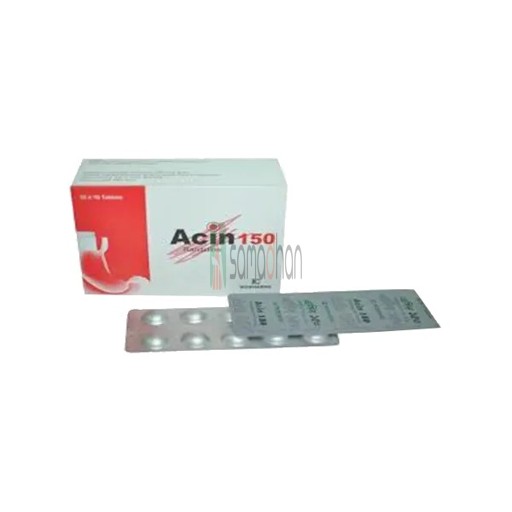
Acin 150 mg is a Product of the Generic Ranitidine
Acin 150 mg belongs to the generic category of Ranitidine. This medicine should be used according to a doctor's advice. We have provided detailed information about the uses, dosage, effectiveness, side effects, precautions, drug interactions, storage conditions, and other important details of Acin 150 mg. Our goal is to present essential medicine information in one place for patients, caregivers, and healthcare professionals. To better understand Ranitidine and ensure the safe use of this medicine, please read the information below carefully and consult a healthcare professional when necessary.
*Up to 10% Discount
(Depends on pharmacy)
Acin 150 mg
Biopharma Laboratories Ltd. · Tablet
Ranitidine
/ Piece
Description of Acin 150 mg
Acin 150 mg may be available as a prescription or over-the-counter medicine, depending on local regulations and medical recommendations. It is used for the treatment and management of specific conditions or symptoms. The way this medicine is used may vary depending on the patient's condition and the advice of a healthcare provider. Detailed information about the approved uses, therapeutic applications, and other relevant details of Acin 150 mg is provided below to help users gain a clear understanding of this medicine.
Indications
Treatment of an active duodenal ulcer with ranitidine
Gastric ulcer that isn't harmful
The use of a non-steroidal anti-inflammatory drug in the treatment and prevention of ulcers
Stress ulcer after surgery.
The Zollinger-Ellison Syndrome is a condition that affects people.
Gastroesophageal reflux disease (GERD) is a type of gastroesophageal reflux (GERD).
Stress ulcer causes a gastrointestinal bleeding in a critically unwell patient.
Patients with a bleeding peptic ulcer may experience recurrent haemorrhage.
Before undergoing general anesthesia in individuals who are at risk of acid
aspiration, such as obstetric patients.
Pharmacology
Ranitidine decreases stomach acid output by competitively blocking histamine at H2-receptors in the gastric parietal cells. Pepsin secretion, pentagastrin-stimulated intrinsic factor secretion, and serum gastrin are unaffected.
Dosage & Administration
Ranitidine Tablet & Syrup:
Duodenal and gastric ulcer: The usual dosage is 150 mg twice daily taken in the morning and evening or 300 mg as a single daily dose at night for 4 to 8 weeks.
Reflux oesophagitis: 150 mg twice daily or 300 mg at bed time for up to 8 weeks
Zollinger Ellison syndrome: 150 mg 3 times daily and increased if necessary up to 6 g daily in divided doses. Dosage should be continued as long as clinically indicated.
Episodic dyspepsia: 150 mg twice daily or 300 mg at bed time for up to 6 weeks.
Maintenance: 150 mg at night for preventing recurrences.
Child (peptic ulcer): 2-4 mg/kg twice daily, maximum 300 mg daily.
Ranitidine IV injection & IV Infusion:
Ranitidine injection may be given either as a slow (over a period of at least two minutes) intravenous injection of 50 mg, after dilution to a volume of 20 ml per 50 mg dose, which may be repeated every six to eight hours; or as an intermittent intravenous infusion at a rate of 25 mg per hour for two hours; the infusion may be repeated at six to eight hour intervals; or as an intramuscular injection of 50 mg (2 ml) every six to eight hours. In the prophylaxis of haemorrhage from stress ulceration in seriously ill patients or the prophylaxis of recurrent haemorrhage in patients bleeding from peptic ulceration, parenteral administration may be continued until oral feeding commences.
In the prophylaxis of upper gastrointestinal haemorrhage from stress ulceration in seriously ill patient sapriming dose of 50 mg as low as intravenous injection followed by a continuous intravenous infusion of 0.125-0.250 mg/kg/hour may be preferred. In patients considered to be at risk of developing aspiration syndrome Ranitidine injection 50 mg may be given intramuscularly or by slow intravenous injection 45 to 60 minutes before induction of general anaesthesia.
Children: The recommended oral dose for the treatment of peptic ulcer in children is 2 mg/kg to 4 mg/kg twice daily to a maximum of 300 mg ranitidine per day. Safety and effectiveness of Ranitidine injection have not been established in case of children.
Interaction
Propantheline bromide delayed absorption and raised peak serum levels. Ranitidine has a minor inhibitory effect on the hepatic metabolism of coumarin anticoagulants, theophylline, diazepam, and propanolol. pH-dependent medication absorption may be affected (e.g. ketoconazole, midazolam, glipizide). Antacids may decrease bioavailability.
Contraindications
Patients who are allergic to ranitidine
Side Effects
Ranitidine is generally well tolerated, with little adverse effects. Changes in bowel habits, dizziness, rash, fatigue, reversible confusional episodes, headache, reduced blood counts, and muscular or joint pain have been observed seldom.
Pregnancy & Lactation
Ranitidine crosses the placenta during pregnancy. However, there is no proof that Ranitidine causes infertility or damage to the fetus. Ranitidine, like other medications, should only be taken during pregnancy if absolutely necessary.
Ranitidine is secreted in human breast milk during lactation. When administering the medication to a nursing mother, extreme caution should be used.
Precautions & Warnings
Patients with poor renal and hepatic function should be administered ranitidine at a lower dose.
Therapeutic Class
H2 receptor antagonist
Storage Conditions
Keep in a cool, dry place. shield against the sun.
Pharmaceutical Name
Biopharma Laboratories Ltd.
Data Source: Data source of Indications and Usages, Pharmacology, Dosage & Administration, Drug Interactions, Side Effects, Use during Pregnancy & Lactation, Precautions & Warnings, Use in Special Populations, Therapeutic Class, and Storage Conditions is the concerned medicine company or respective organization.
Alternative Medicines
⚠ Disclaimer
The information provided on All Samadhan is intended for general informational purposes only and is prepared based on our best practices. It is not a substitute for professional medical advice, diagnosis, or treatment. While we strive to keep the information accurate and up to date, we do not guarantee its completeness or accuracy. The absence of specific information or warnings about any medicine or service should not be considered as an assurance or endorsement by All Samadhan. All Samadhan shall not be held responsible for any consequences arising from the use of this information. We strongly recommend consulting a qualified healthcare professional or physician for any medical concerns, questions, or clarifications.All Samadhan is a digital healthcare software platform operated by MS Genius Experts. We provide technology solutions for pharmacies and healthcare providers; we are not a direct seller or dispenser of prescription medicines

N.B.: All Samadhan is a digital healthcare software platform operated by MS Genius Experts. We provide technology solutions for pharmacies and healthcare providers; we are not a direct seller or dispenser of prescription medicines.
Copyright © All Samadhan - Operated by M/S. Genius Experts | All Rights Reserved
DBID
Registration ID: 176322642
Trade License: TRAD/DNCC/040904/2023