
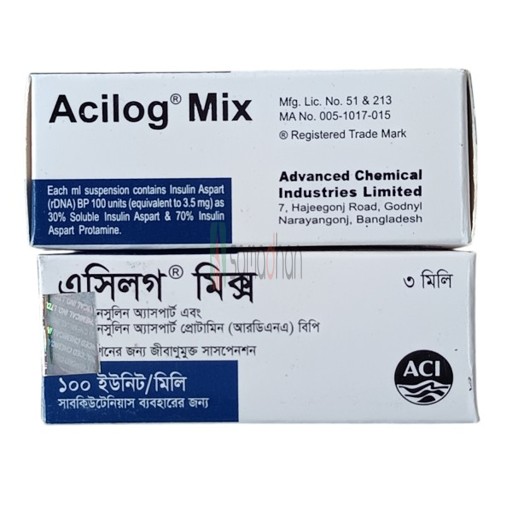
Acilog Mix 30%+70% is a Product of the Generic Biphasic Insulin Aspart
Acilog Mix 30%+70% belongs to the generic category of Biphasic Insulin Aspart. This medicine should be used according to a doctor's advice. We have provided detailed information about the uses, dosage, effectiveness, side effects, precautions, drug interactions, storage conditions, and other important details of Acilog Mix 30%+70%. Our goal is to present essential medicine information in one place for patients, caregivers, and healthcare professionals. To better understand Biphasic Insulin Aspart and ensure the safe use of this medicine, please read the information below carefully and consult a healthcare professional when necessary.
*Up to 10% Discount
(Depends on pharmacy)
Acilog Mix 30%+70%
ACI Limited · SC Injection
Biphasic Insulin Aspart
/ 3 ml cartridge
Description of Acilog Mix 30%+70%
Acilog Mix 30%+70% may be available as a prescription or over-the-counter medicine, depending on local regulations and medical recommendations. It is used for the treatment and management of specific conditions or symptoms. The way this medicine is used may vary depending on the patient's condition and the advice of a healthcare provider. Detailed information about the approved uses, therapeutic applications, and other relevant details of Acilog Mix 30%+70% is provided below to help users gain a clear understanding of this medicine.
What Is Acilog Mix 30%+70% Indications and Uses?
Biphasic Insulin Aspart (rDNA) injection is indicated to improve glycemic control in adults and children with type 1 diabetes mellitus and in adults with type 2 diabetes mellitus.
Pharmacology (Source, Chemical and Physical Composition) Of Acilog Mix 30%+70%
30% Insulin Aspart and 70% Insulin Aspart Protamine (rDNA) is a human insulin analog suspension containing 30 % soluble Insulin Aspart and 70% Insulin Aspart Protamine crystals. This is a blood glucose lowering agent with an earlier onset and an intermediate duration of action. Insulin Aspart is homologous with regular human insulin with the exception of a single substitution of the proline by aspartic acid in position B28, and is produced by recombinant DNA technology utilizing Saccharomyces cerevisiae (baker’s yeast).Primary function of insulin, including Insulin Aspart, is regulation of glucose metabolism. Insulin and its analogs lower blood glucose by stimulating peripheral glucose uptake, primarily by skeletal muscle and fat, and by inhibiting hepatic glucose production. Insulin inhibits lipolysis and proteolysis, and enhances protein synthesis.
Dosage And Administration of Acilog Mix 30%+70%
The dosage of insulin aspart must be individualized.Subcutaneous injection: insulin aspart should generally be given immediately (within 5-10 minutes) prior to the start of a meal.Use in pumps: Change the insulin aspart in the reservoir at least every 6 days, change the infusion set, and the infusion set insertion site at least every 3 days. insulin aspart should not be mixed with other insulins or with a diluent when it is used in the pump.Intravenous use: insulin aspart should be used at concentrations from 0.05 U/mL to 1.0 U/mL insulin aspart in infusion systems using polypropylene infusion bags. insulin aspart has been shown to be stable in infusion fluids such as 0.9% sodiumchloride.
Drug Interactions of Acilog Mix 30%+70%
A number of substances affect glucose metabolism and may require dose adjustment and particularly close monitoring.The following are examples that may increase the blood glucose lowering effect and susceptibility to hypoglycemia: oral anti-diabetic products, pramlintide and angiotensin converting enzyme (ACE) inhibitors, disopyramide, fibrates, fluoxetine, monoamine oxidase inhibitors, propoxyphene, salicylates and sulfonamide antibiotics.The following substances are examples that may reduce the blood glucose lowering effect: corticosteroids, niacin, danazol, diuretics, sympathomimetic agents, isoniazid, phenothiazine derivatives, somatropin, estrogens, progestogens, atypical antipsychotics and danazol. Beta-blockers, clonidine, lithium salts, and alcohol may either potentiate or weaken the blood-glucose-lowering effect of insulin. Pentamidine may cause hypoglycemia, which may sometimes be followed by hyperglycemia.
Side Effects of Acilog Mix 30%+70%
Side effects of Insulin Aspart are hypoglycemia, lipodystrophy, weight gain, peripheral edema.
Use During Pregnancy and Lactation
Pregnancy category B. Careful monitoring of glucose control is essential in such patients because insulin requirements change during different stages of pregnancy. Therefore female patients should be advised to tell their physician if they intend to become or if they become pregnant while taking insulin aspartLactation: It is unknown whether Insulin Aspart is excreted in human milk as occurs with human insulin. There are no adequate and well-controlled studies of the use of insulin aspart in lactating women. Lactating Women may require adjustments of their insulin doses.
Precautions And Warnings for Acilog Mix 30%+70%
Dose adjustment and monitoring: Blood glucose should be monitored in all patients treated with insulin. Insulin regimens should be modified cautiously and only under medical supervision. Renal or hepatic impairment: Reduction in the Insulin Aspart dose may require in these cases.
Use In Special Populations
Pediatric: Has not been studied in children with type 2 diabetes. Has not been studied in children with type 1 diabetes <2 years of age
Therapeutic Class
Combination Insulin
Storage Conditions of It
Store at 2°C to 8°C in a refrigerator. Do not freeze. In case of insulin for recent use need not be refrigerated, try to keep it in a cool place and keep away from heat and light. The insulin in use can be kept under the room temperature for a month.
Data Source: Data source of Indications and Usages, Pharmacology, Dosage & Administration, Drug Interactions, Side Effects, Use during Pregnancy & Lactation, Precautions & Warnings, Use in Special Populations, Therapeutic Class, and Storage Conditions is the concerned medicine company or respective organization.
Alternative Medicines
⚠ Disclaimer
The information provided on All Samadhan is intended for general informational purposes only and is prepared based on our best practices. It is not a substitute for professional medical advice, diagnosis, or treatment. While we strive to keep the information accurate and up to date, we do not guarantee its completeness or accuracy. The absence of specific information or warnings about any medicine or service should not be considered as an assurance or endorsement by All Samadhan. All Samadhan shall not be held responsible for any consequences arising from the use of this information. We strongly recommend consulting a qualified healthcare professional or physician for any medical concerns, questions, or clarifications.All Samadhan is a digital healthcare software platform operated by MS Genius Experts. We provide technology solutions for pharmacies and healthcare providers; we are not a direct seller or dispenser of prescription medicines

N.B.: All Samadhan is a digital healthcare software platform operated by MS Genius Experts. We provide technology solutions for pharmacies and healthcare providers; we are not a direct seller or dispenser of prescription medicines.
Copyright © All Samadhan - Operated by M/S. Genius Experts | All Rights Reserved
DBID
Registration ID: 176322642
Trade License: TRAD/DNCC/040904/2023